
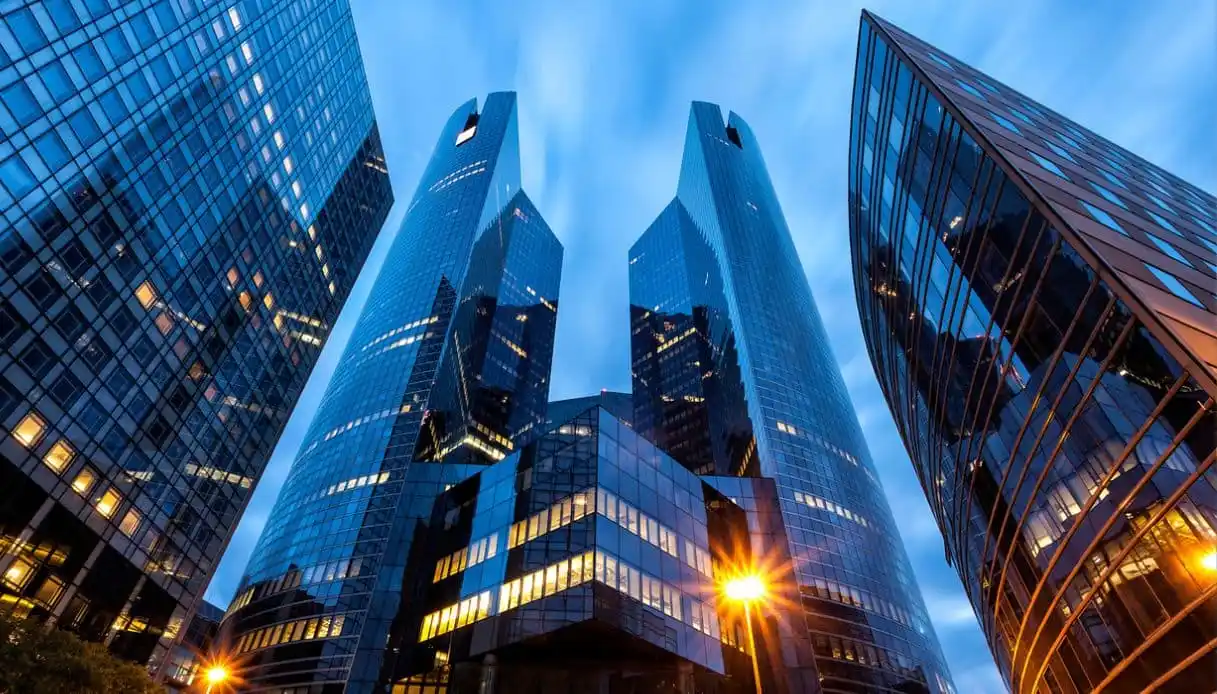
Illuminated skyscrapers, glass façades reflecting the winter sky, and when the snow falls, streets and rooftops turn white: you don’t need to cross the Atlantic to reach New York and encounter a skyline of a great American metropolis.
Europe also hides cities that have chosen to grow vertically, with financial districts, panoramic towers and waterfronts redesigned by contemporary architecture, and a snowfall can transform them into spectacular cinematic backdrops.
Warsaw, the skyline that overlooks Europe from above
If you are looking for the European city that most astonishes with how quickly its profile keeps changing, Warsaw is the perfect candidate and the absolute star is Varso Tower, which at 310 meters tall is the tallest building in the European Union. On the 53rd floor, at about 230 meters above ground, Highline Warsaw offers a 360-degree view of the Polish capital, while on the 49th floor the HighGarden Rooftop Lounge even adds a suspended garden between the skyscrapers.
From above you will see the modern towers of the center and of Wola rise, with the Palace of Culture and Science creating an extraordinary contrast between the socialist past and the new vertical architecture. In winter, when the snow covers the roofs and the lights come on early, Warsaw truly takes on the look of a North American metropolis in central Europe.
London and Canary Wharf, Manhattan on the Thames
To find one of Europe’s most recognizable skylines you must move to the east of London, on the Isle of Dogs: Canary Wharf is a “city within the city” with glass and steel towers, pedestrian bridges, contemporary squares and old harbour basins transformed into a futuristic financial district. At the center stands One Canada Square with its distinctive pyramidal apex.
If you want to step back to observe the entire skyline, head to Greenwich Park: from the area of the Royal Observatory you’ll see the skyscrapers rise above the greenery and the Thames. In the district, enter the Crossrail Place Roof Garden, a large rooftop garden enclosed by a spectacular contemporary structure.
London snow is far from certain, but when it arrives the contrast between towers, water and white transforms Canary Wharf into an unusual setting.
Paris La Défense, skyscrapers along the Arc de Triomphe axis
Put aside for a moment mansard roofs and nineteenth-century boulevards: west of the historic center, La Défense shows Paris in its most vertical form. The perspective is one of Europe’s most extraordinary: the district continues the axis that passes through the Louvre, Place de la Concorde, the Champs-Élysées and the Arc de Triomphe, up to the monumental Grande Arche.
Around them towers rise such as Tour First, 231 meters high, and Tour Hekla, Jean Nouvel’s skyscraper reaching 220 meters with a prism-like silhouette of glass and metal. In winter, especially on the cold and clear days, the monumental center of Paris stays in the background while in front of you geometries, reflections and towers dominate as if belonging to a great American city.
Frankfurt, the “Mainhattan” of Germany
Here the comparison with Manhattan has even entered the city’s nickname: Frankfurt on the Main is indeed called “Mainhattan,” a fusion of Main, the river, and Manhattan, precisely thanks to the concentration of skyscrapers in its financial district.
Among the towers stands the Commerzbank Tower, 259 meters tall, while the Main Tower allows you to ascend to the panoramic platform and admire the city from above, but perhaps the most beautiful postcard is at river level. Walk along the banks of the Main or cross one of the bridges and turn toward the center: the towers seem to rise beyond the water.
If a snowfall coats the banks and the lower roofs, while the skyscrapers stay illuminated in the background, you’ll immediately understand why Frankfurt is the German city with the most New York-like soul.
Vienna, the vertical city along the Danube
We associate Vienna with imperial palaces, historic cafés and nineteenth-century façades, yet a visit to Donau City reveals a different face: the modern district runs along the Danube and is led by the DC Tower 1, designed by Dominique Perrault and rising 250 meters. Not far away, the Donauturm reaches 252 meters and offers a panoramic terrace at about 155 meters above ground.
Around them the United Nations complex and other contemporary towers create an unusual skyline for those who know only the historic center, and in winter the contrast becomes even sharper: on one side imperial Vienna, on the other a glass city facing the Danube, which beneath the snow takes on futuristic atmospheres.
Oslo and Barcode, skyscrapers on the fjord
In Oslo the Manhattan effect takes on a Scandinavian silhouette: in the Bjørvika district, right beside the fjord, rises the Barcode, twelve narrow buildings of different heights, interspersed with gaps that, viewed together, resemble the bars of a gigantic barcode. The project emerged from a collaboration between DARK, a-lab and MVRDV.
The towers rise near the Central Station, the Opera House and the Munch Museum, within a broad transformation of the old port area. Winter paints one of the most evocative images: glass, fjord, ice and snow, with the lit windows reflecting on the water during the long Nordic evenings.
Rotterdam, the Dutch city toward the sky
Few European cities have made contemporary architecture such a defining part of their identity as Rotterdam: after the destruction of World War II, the city chose to rebuild by looking ahead, and over the decades began to grow upward. Today its skyline is characterized by the Kop van Zuid towers, De Rotterdam and the unmistakable Erasmusbrug, the white bridge nicknamed “The Swan.”
To admire it all from above you can climb the Euromast, which reaches 185 meters and offers panoramic views up to the port and far beyond the center, or stay along the Nieuwe Maas: when the lights of the skyscrapers reflect on the water and a snowfall whiten the banks, Rotterdam shows one of its most photogenic faces.
Stockholm, a spectacular skyline on the snow
Stockholm is the least “Manhattan-like” because its profile isn’t dominated by a forest of skyscrapers, but it’s still worth including for the way modern architecture, towers, water and historic districts build a unique winter skyline.
From the viewpoints of Fjällgatan, Monteliusvägen and Skinnarviksberget you’ll see the spires and roofs of Gamla Stan rise above the waters, while newer buildings outline the rest of the city. Also SkyView, on the Avicii Arena, lets you observe the southern part of Stockholm from above.
Then, with the snow, the Swedish capital changes its look: dark water, white roofs, warm lights and a wintry sky compose a postcard less American than Frankfurt or Warsaw, but perhaps even more evocative.