
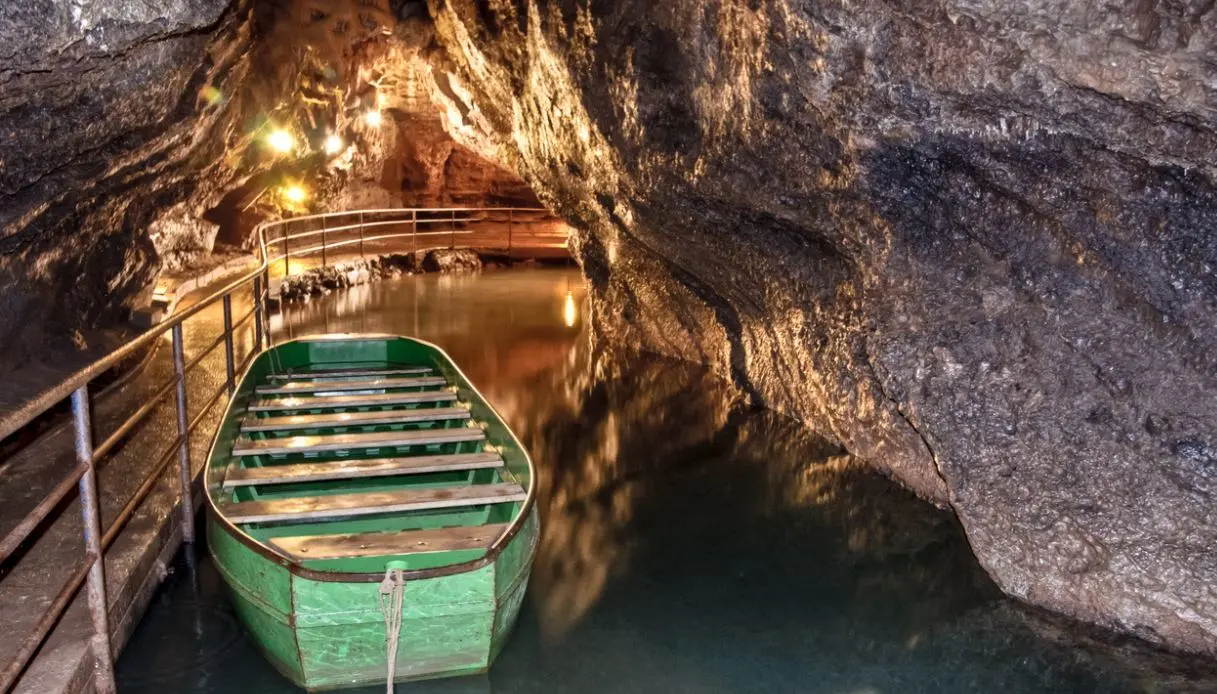
On the surface, life flows quietly among houses, streets, and small towns, but underground the water continues to sculpt a landscape that seems to belong to another planet. There are carved walls, limestone columns, enormous cavities and a secret river, all incredible elements that form one of the most astonishing natural environments in Wallonia: the Remouchamps Caves, an underground complex in the Province of Liège.
Narrow passages lead to spaces of monumental proportions, while the illuminated concretions take on shapes so unusual that they resemble sculptures carved by patient hands. And yet, the most extraordinary feature reveals itself only after you pass the galleries on foot, when the route continues aboard a small boat along the waters of the Rubicon.
This is the longest underground navigation in Europe accessible to tourists, a record that makes Remouchamps a destination particularly fascinating even for those who have already visited other natural caverns. Think that some have nicknamed this world beneath our feet the “Wonder of Wonders.”
Origin, formation and legends of the Remouchamps Caves
In the past, the appearance of Belgium was profoundly different from today. The limestone rocks that characterize this part of the Ardennes date back to the Devonian, a geological period when vast areas of western Europe were occupied by ancient marine environments.
Over millions of years, the movements of the Earth’s crust have warped these rock layers, creating folds and fractures. Subsequently, rainwater (slightly acidic due to dissolved carbon dioxide) began to permeate the fractures in the limestone, slowly dissolving it and expanding the subterranean passages.
But here, then, came the work of the Rubicon, which gave life to a landscape arranged on multiple levels, shaped as much by erosion as by collapses of rock masses. Making this environment even more intriguing is its long relationship with humans: the area near the entrance was frequented by prehistoric hunters about 8000 years ago.
Centuries later, the initial environments were used to preserve wine, and during World War II they served as shelters for the locals. And then there is the mystery that has accompanied these caverns for a long time: according to an ancient Ardennes tradition, in the Remouchamps Caves lived the Sottais, also known as Massottais, small supernatural beings belonging to Walloon folklore.
The popular tales described them as gnomes, ready to aid farmers in daily tasks in exchange for a few provisions left near their shelter. Yet (as always), they had a decidedly vindictive temperament toward those who deceived or mocked them.
A particularly eerie legend recounts the fate of the last Sottai of Remouchamps, who vanished after sacrificing his life to the Devil to save the son of a beloved woman. Even at the start of the nineteenth century, according to historical testimonies, some locals regarded the cave’s depths as a sort of antechamber to Hell.
Visit to the Remouchamps Caves
The guided visit lasts about 75 minutes and is divided into two parts: on the way out you traverse more than 1 km on foot through halls and galleries; the return takes place by boat along 700 meters of the Rubicon. The first space preserves the memory of the cave’s ancient visitors, from which one gradually penetrates into the depths of the mountain.
A sequence of rock passages leads toward the Chamber of the Precipice, a stretch particularly evocative due to the river running about 8 meters below. At a certain point the Great Drapery, a limestone formation about 7 meters high, developed over hundreds of thousands of years, appears, in which tiny infiltrations continue to flow along the formation, feeding a geological process still active today.
These droplets explain the presence of stalactites hanging from the vaults and stalagmites rising from the floor. Then there is the Hall of Ruins, with large boulders that fell from above, and the Virgin Hall, named for a formation that evokes the figure of the Madonna with Child.
The moment of greatest wonder during the walking stretch comes in the Cathedral, a gigantic cavity discovered in 1912. Here the ceiling reaches 40 meters in height, while the space extends for almost 60 meters in length and 20 in width.
Unlike human-made architectures, however, this hall displays unpredictable surfaces, overhangs and fractures that tell the geological history of the mountain. From this area you reach the lower level via the Pont des Titans, the Bridge of the Titans, a large natural arch that introduces the most original part of the experience (the one in which you navigate).
Once in the boat, the walls close in, the lights reflect on the river’s surface, and the slow motion lets you observe the rock formations from a completely different perspective. During the voyage appears the Palmier, a limestone column formed by the joining of a stalactite and a stalagmite, which resembles a palm tree and its position right in the middle of the watercourse constitutes one of Remouchamps’s most celebrated features.
A little further on, the ceiling lowers markedly and the boat crosses an ancient siphon, a passage that originally had features designed to hinder passage and which has been widened by humans to allow tourist navigation. It becomes impossible not to notice the boatmen’s skill, who in the lower stretches can employ a technique nicknamed the bat, using their feet against the ceiling to push the craft along.
Finally, be aware that several species of bats inhabit the caves, using the initial zones mainly for winter roosting.
Where they are and how to get there
The Remouchamps Caves are located in Sougné-Remouchamps, in the municipality of Aywaille, about 25 km south of Liège. The entrance sits at Rue de Louveigné 3, directly in the village. To reach them by car, take the E25 highway, which links Liège with Luxembourg, using exit 46 Aywaille-Remouchamps.
Those who prefer public transport can arrive by train at Aywaille station, about 3 km away, and continue with a local bus or along the Voie des Aulnes, a cycling-walk route that runs along the Amblève. Line 64 also connects the Remouchamps area with Liège and Aywaille, but it is advisable to check schedules and individual departures before setting off.
