
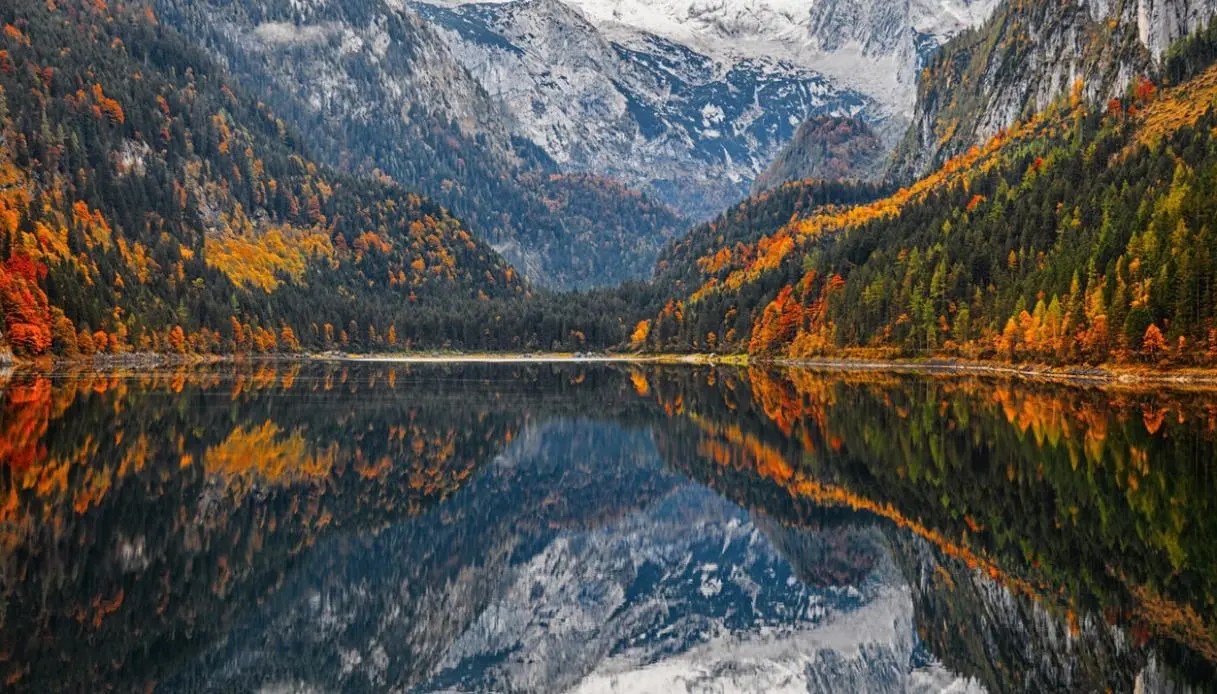
Among the folds of the Salzkammergut, an Alpine region set in the central-northern part of Austria, lies a stretch of crystal-clear water framed by the Gosaukamm and the great mountains of the Dachstein. That is the Gosau Lake, one of the most recognizable images in this vast region made up of lakes, forests, and high Alpine peaks.
However, the scene carries a far more intricate history than its postcard fame suggests: the lake was raised artificially by about 12 meters through a dam, intended to improve water availability and power production, which is still used today with a capacity sufficient to supply around 2,200 homes per year.
It was precisely in front of this panorama that the naturalist and traveler Alexander von Humboldt was struck by the landscape’s particular beauty. He is credited with the nickname “Eye of God,” tied to the lake’s shape and its position at the foot of the Dachstein mountains.
Origin, formation and legends of Gosau Lake
The Gosausee (this is the local name) belongs to a system formed by three Alpine lakes: the Vorderer Gosausee is the one accessible by car and represents the first large body of water in the valley; further on, accessible only on foot, appear the Gosaulacke and the Hinterer Gosausee, respectively the middle and rear lakes.
The Hinterer Gosausee normally feeds the Gosaubach through underground springs. Only during snowmelt or after heavy rainfall does the water rise above the level of the upper lake, reach the Gosaulacke, and from there continue toward the Vorderer Gosausee.
The Gosaulacke is therefore a seasonal phenomenon. In some periods it may appear almost empty, while after heavy rains or during snowmelt it fills up and becomes the visible link between the two main lakes. The landscape thus changes throughout the year, following the rhythm of precipitation and the snow on the mountains.
The environment also possesses particularly favorable characteristics for aquatic fauna. The waters of the Vorderer Gosausee are crystal-clear and potable. Among the fish present are local trout, rainbow trout, perch, pike, char, and eels. An native species, the so-called black rider, became extinct about 50 years ago following the introduction of trout.
Around the lake, Alpine geology becomes an integral part of the panorama. The Dachstein dominates the scenery with its cliffs and glaciers, while the Gosaukamm forms a sequence of faces and peaks on the opposite side. The sense is that of standing inside a large natural bowl, with water at the center and the surrounding mountains gradually closing in the horizon.
What to see and what to do at Gosau Lake
The first stop is naturally the Vorderer Gosausee. A circular trail of about 4.5 km lets you follow the shores and observe the landscape from different perspectives. The route is fairly easy and suitable for families, even if the terrain includes some uphill sections.
In the morning the light is particularly favorable for admiring the reflection of the Dachstein: at dawn the first hues slowly reach the walls of the Gosaukamm and transform the water’s surface; in autumn the contrast between the colored forest, the rocks, and the snowy peaks makes the panorama even more striking.
For those who wish to continue, the path toward the Hinterer Gosausee follows a forest road. From the first lake you pass beside the Gosaulacke and then tackle another ascent of about 20 minutes before reaching the maple forest and finally the rear lake. The trek to Holzmeister Alm, located near the southern part of the Hinterer Gosausee, takes about 1 hour and 30 minutes. The out-and-back route measures nearly 12.6 km, with a total elevation gain of approximately 261 meters.
The second lake appears more compact and secluded. The presence of the Dachstein in the background changes the perspective once again, while the forest dampens the sounds coming from the valley. In autumn, the Gosaulacke represents one of the most interesting passages precisely because of its intermittent nature.
The Gosaukamm, on the other hand, raises the alpine experience considerably. From the lake area, the Gosaukammbahn cable car departs, located next to the Vorderer Gosausee, arriving in the Zwieselalm area. In summer the facility makes it easy to reach trails and Alpine pastures, while the Dachstein West resort is tied to winter sports.
Fans of via ferrata have at their disposal the Laserer Alpin Klettersteig, a roughly one-hour course rated C, built above the lake. Another option is the Intersport Klettersteig Donnerkogel, rated C/D.
The water itself becomes part of the experience during the warmer season: Gosausee allows swimming, diving, stand-up paddleboarding, and excursions by pedal boat or electric boats. The water’s transparency also allows divers to observe the lake’s submerged scenery.
Those who prefer an ascent toward the alpine meadows can instead reach the Zwieselalm, with huts and trails through meadows and woods. The cable car eases the initial climb, while more trained hikers can tackle the route on foot.
Where it is located and how to get there
Gosau Lake is located in the town of Gosau itself, in Upper Austria, in the Salzkammergut region, about a 25-minute drive from Hallstatt. The exact address is Vorderer Gosausee, 4824 Gosau, Austria. Driving is the simplest way to reach it. Paid parking is available along Gosauseestrasse and in the Vorderer Gosausee parking area. The nearest bus stop is Hintertal b.Gosau Vorderer Gosausee, also indicated with the reference Gosaukammbahn.
Those arriving by public transport can use the direct link between Bad Ischl and Gosausee via line 541. From Salzburg the route requires bus 150 to Bad Ischl Bahnhof and then a transfer to line 541. From the village of Gosau you can also reach the lake via hiking routes connected to the Dachstein Rundwanderweg network.
The setting invites a longer stay than a classic photographic excursion. Gosausee can indeed be just the start of a visit, with the Gosaulacke, the Hinterer Gosausee, the Zwieselalm, and the Gosaukamm itineraries shaping a day that’s much broader.
However, one should consider the seasonality of the trails: the path around Vorderer Gosausee is closed in winter due to the risk of falling rocks and avalanches. The visiting period is roughly from May–June to October, while the actual condition of the trails depends on weather conditions.