
Discovering the French castles in winter can yield pleasant surprises, and while during the cold season many shorten opening hours or suspend visits, some continue to welcome visitors even in January and February. Around Paris, among residences linked to the history of the monarchy, ancient medieval fortresses, and estates set in green surroundings, there are plenty of opportunities to plan a day trip outside the city.
Here, then, is a selection of five castles to consider during a trip to Paris.
Breteuil Castle, timeless fairy tales
Between Versailles and Rambouillet, in the heart of the Chevreuse Valley Regional Natural Park, the Breteuil Castle, built in the 17th century and expanded over the following two centuries, has welcomed over time high-ranking figures, including ministers, ambassadors, scientists, prefects, and bishops.
Characterized by a blend of brick and stone, it has been restored and enriched with prestigious decorations and furnishings. Among its most precious works stands the Teschen Table, also known as the “Table of Europe”: a refined masterpiece of goldsmithing created in 1779 by Neuber, a jeweler of the Saxon court, and adorned with precious stones.
The visit route also allows visitors to retrace the history of the de Breteuil family, owners of the residence since 1712, thanks to about fifty wax figures created by the Musée Grévin, including Louis XVI, Marie Antoinette, and Marcel Proust.
Outside, a 75-hectare park extends, classified as Jardin Remarquable, that is, a Remarkable Garden. The formal gardens, the boxwood maze, the Garden of the Princes, the ponds, and the ancient trees invite a stroll through romantic corners and atmospheres of days gone by.
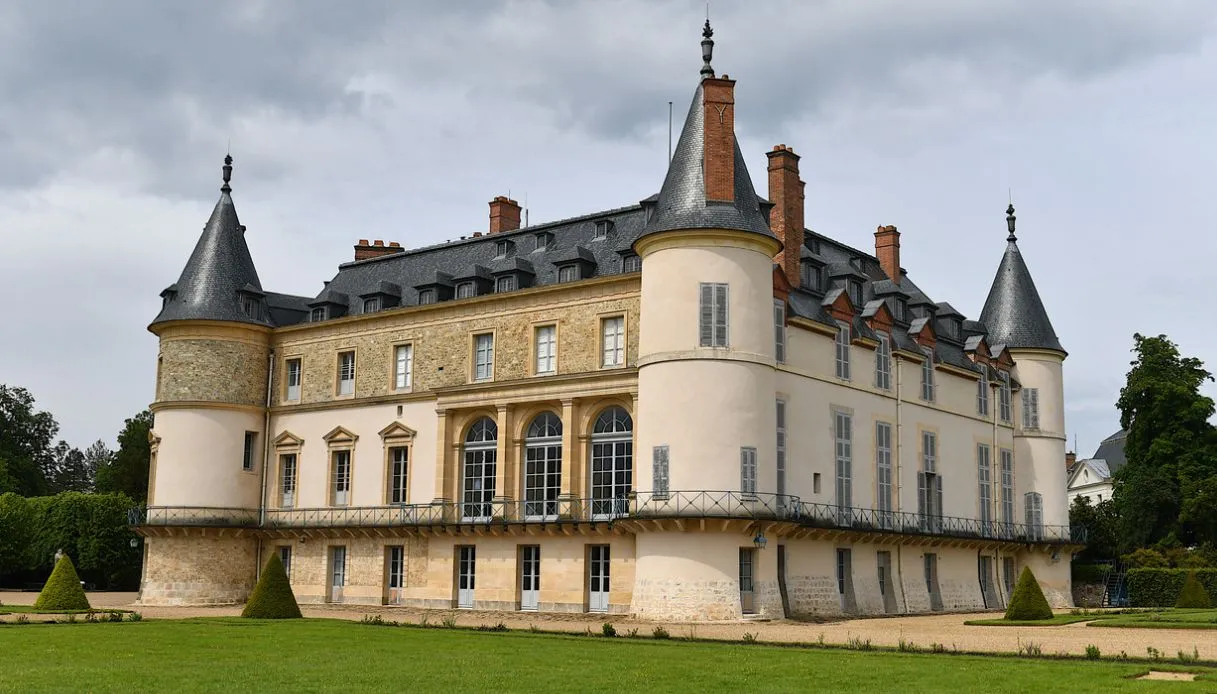
Rambouillet Castle, between kings and French presidents
Between Versailles and Chartres, in the Yvelines, the Rambouillet estate is tied to the history of France, and its fame is also linked to the vast surrounding forest, spanning about 22,000 hectares and once frequented during royal hunts.
The castle’s origins go back to the 14th century, when a medieval fortress was built that, partially destroyed around 1425 during the Hundred Years’ War, was later rebuilt and transformed into a noble residence. Over the centuries it saw illustrious owners, including Louis XVI and Napoleon I, eventually becoming, for more than a century, a summer residence of the Presidents of the French Republic. One can admire the 16th-century Marble Hall, the Empire-style furnishings of the dining room, and the Rococo decorations of Marie Antoinette’s apartments.
The 150-hectare park has been recognized as a Remarkable Garden since 2004. Alongside the formal garden, crossed by canals that form geometric islands, there is a 25-hectare English garden, characterized by winding paths, streams, and small bridges. The stroll leads to the Chaumière aux Coquillages, created by the Duke of Penthièvre for the Princess of Lamballe, and the Laiterie de la Reine, donated by Louis XVI to Marie Antoinette.
Malmaison Castle, the dwelling of Napoleon and Josephine
In Rueil-Malmaison, not far from Paris, Malmaison Castle offers the opportunity to glimpse the private and political life of Napoleon Bonaparte and his first wife, Joséphine de Beauharnais.
It was Joséphine who bought the 17th-century residence in 1799, and, upon his return from the Egyptian campaign, Napoleon, then First Consul, became its owner. Between 1800 and 1802, the castle served as one of the seats of the French government, on par with the Tuileries, and hosted meetings of the ministers of the Consulate.
The couple made changes to the interiors and gardens, reshaping the property to suit their tastes. After their divorce in 1809, Joséphine retired to Malmaison and the following year purchased the nearby Château de Bois-Préau. In 1905, the two residences entered the National Museum of the Castles of Malmaison and Bois-Préau.
During the visit, marble, gilding, and mosaics accompany the stroll through the rooms, enriched by paintings, furniture, tableware, and arms that recount the early years of Napoleon I’s reign. Among the most significant spaces are the mahogany library and the Oval Room, where Joséphine died on May 29, 1814. A section dedicated to Napoleon’s life on the island of Saint Helena completes the exhibition since 2017.
Outside, the rose garden created by Joséphine, with nearly 150 varieties, stands as one of the most distinctive features of the property.
Dourdan Castle, medieval fortress of Île-de-France
If you prefer the atmosphere of ancient fortifications, head to Dourdan, where one of the best-preserved medieval castles in Île-de-France rises. Completed in 1222 by order of Philip Augustus, it replaced an earlier wooden structure dating back to the era of Hugh Capet.
The regular plan reflects the architectural system developed under Philip Augustus: to this day, the complex preserves much of the original 13th-century structures, including the keep, the towers, and the dry moats.
The castle’s history changed from 1672, when Philippe d’Orléans transformed it into a royal prison. During the French Revolution it became a departmental prison and continued to house detainees until 1852.
In 1864 the property was bequeathed to the Guyot family and Joseph Guyot devoted years to restoring and organizing the complex, which has been classified as a Historic Monument since 1964.
Dampierre Castle, gardens and walks
At Dampierre-en-Yvelines, the Dampierre Castle estate spans almost 400 hectares: it was built in the 17th century by architect Jules Hardouin-Mansart and remained in the de Luynes family for nearly four centuries. In 2018 it was sold to Franky Mulliez, founder of Kiloutou and a connoisseur of art and architecture.
Surrounded by a moat and classified as a Historic Monument since 2022, it is set in a landscape of great interest: the formal gardens designed by André Le Nôtre stand next to an English-style park, where ponds and canals create evocative vistas. On the island also stands an elegant 18th-century pavilion.
Since 2022, the Chemin des libellules also allows visitors to deepen the history of the estate and its biodiversity. In the carriage gallery, some historic carriages belonging to the de Luynes family are on display.
