
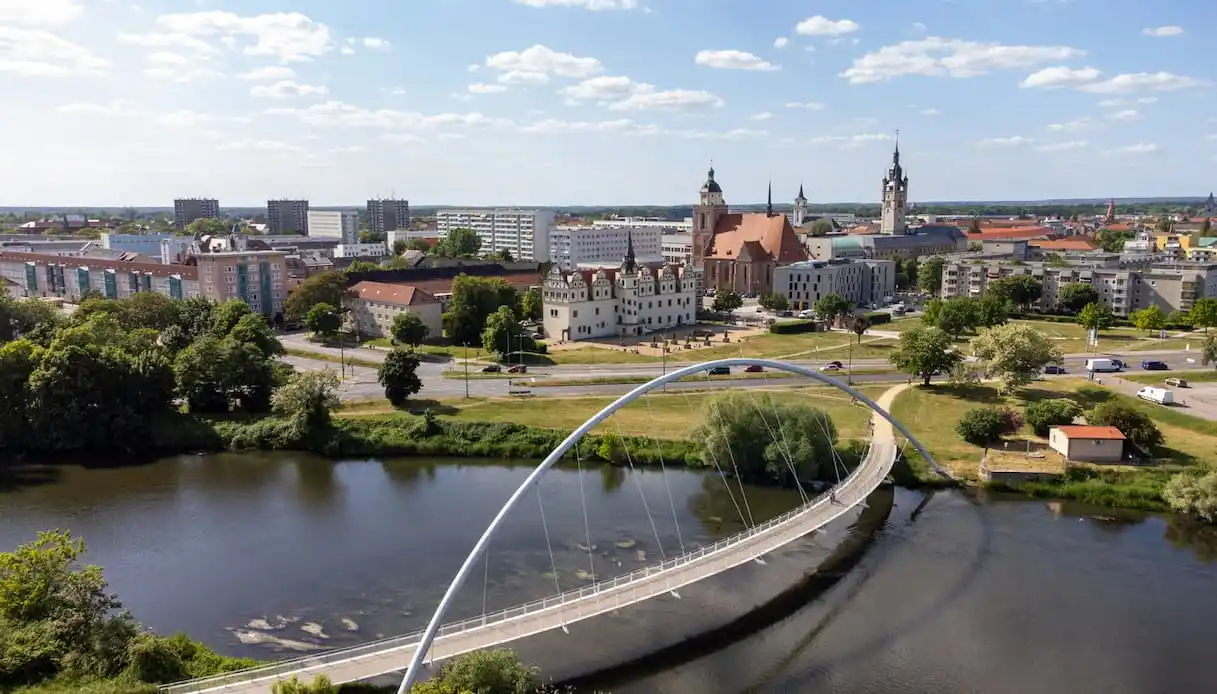
Dessau is one of Germany’s most interesting cities for those who love architecture, design, and urban planning. Part of the municipality of Dessau-Roßlau, it is inseparably tied to the history of the Bauhaus, the movement that revolutionized the way buildings, objects, and spaces were conceived in the twentieth century.
The school founded by Walter Gropius moved here in 1925 and Dessau experienced one of its most important phases. Even today the city preserves numerous buildings, museums, and residential complexes connected to the movement, some of which are recognized as UNESCO World Heritage. Visiting Dessau today still means coming into contact with one of the most influential chapters in the history of modern architecture, but also discovering a German destination less well known than the country’s major cities.
What to see in Dessau
Dessau is increasingly on the radar, so much so that Lonely Planet has included it among the Best in Travel 2027 destinations, with particular attention to its Bauhaus heritage. The starting point for exploring it is the Bauhaus Building, designed by Walter Gropius and inaugurated in 1926. With its large glass façades, clean geometries, and spaces conceived according to their use, the building has become one of the international symbols of modern architecture. Today it houses the Stiftung Bauhaus Dessau and is used for exhibitions, research, events, and cultural activities.
Not far away stand the Masters’ Houses, the residences designed for the school’s masters and linked to key names such as Wassily Kandinsky and Paul Klee. Together with the Bauhaus Building and the houses with balconies, they are part of Dessau’s Bauhaus sites listed as UNESCO World Heritage.
Also worth a visit is the Bauhaus Museum Dessau, which houses one of the world’s most important collections of objects related to the school. To observe how Bauhaus ideas were applied to daily life, one can reach the residential district Dessau-Törten, designed to create functional and economically accessible housing.
What to do in Dessau beyond the Bauhaus
Dessau is not only a destination for architecture enthusiasts. The city is located in a territory rich in parks, gardens, and cultural landscapes, with several possibilities to alternate museum visits with walks and outdoor itineraries. One of the most interesting places in the surrounding area is the Dessau-Wörlitz Garden Realm, a vast complex of parks, palaces, and gardens listed as a UNESCO World Heritage site. The landscape blends architecture, nature, and landscape design and represents one of the most important systems of historic gardens in Germany.
Dessau also lends itself well to inclusion in a broader itinerary through eastern Germany. The city does not have a large international airport and is reached mainly by land, with rail connections from cities such as Berlin and Leipzig. The compact size itself makes Dessau suitable for a short stay: the center and the main Bauhaus sites can easily be combined with excursions in the surroundings, creating an itinerary that fuses modern architecture, scenery, and historic heritage.
Where it is located and how to reach it
Dessau is situated in the state of Saxony-Anhalt, in east-central Germany, between Berlin and Leipzig. There are currently no direct connections from Italy, but reaching it is nonetheless fairly straightforward with a layover in one of the nearby cities.
The most convenient option is to fly to Berlin Brandenburg or to Leipzig/Halle and then continue by train to Dessau. Leipzig is the geographically closest option, while Berlin generally offers a broader range of flights from Italy.
Travelers by car can instead reach the city via the A9 motorway, which connects Berlin and Bavaria and passes in the immediate vicinity of Dessau. From Milan, for example, it is a road trip of roughly 9 to 10 hours.