
Along the eastern coast of the Adriatic Sea, one of Europe’s most fascinating landscapes takes shape: the Dalmatian Archipelago, home to dozens of inhabited islands and hundreds of islets. In this area, geography (together with Mother Nature’s artistry) has shaped a mosaic of limestone promontories, pine forests, wind-carved cliffs, and small ports that arose centuries ago around Venetian trade routes.
Since antiquity these lands have represented a strategic point in the eastern Mediterranean. Greeks, Romans, Byzantines, Venetians, and Austro-Hungarians left traces that remain perfectly recognizable among sturdy walls, cathedrals, monasteries, and palaces built with the famous local white stone. Just observe how light reflects on the façades to understand the value of this material, used even for landmark buildings thousands of kilometers away from Croatia.
Navigating among the islands means witnessing continual changes of scenery: a bay gives way to a cliff, a pine forest precedes lavender fields, a small fishing village introduces elegant squares animated by outdoor tables. And here are the Dalmatian Islands to not miss.
Hvar, the island of sun and lavender
Hvar is often described as the glamour island of Croatia, but the truth is that its charm goes far beyond the yachts moored at the main harbor. Thanks to one of the Adriatic’s highest numbers of sunshine hours, the landscape alternates rows of vines, centuries-old olive groves, rosemary shrubs, and expansive lavender fields that, between June and July, color the inland with violet hues.
The town of Hvar preserves architectural heritage dating from the era of the Serenissima. St. Stephen’s Square, among the largest in Dalmatia, introduces visitors to the cathedral dedicated to the patron saint, rebuilt between the XVI and XVII centuries after Ottoman attacks. A little higher up dominates the Spanish Fortress, erected in the XVI century on the foundations of a medieval structure. From the bastion the view reaches the port and the Pakleni Islands, a small archipelago scattered with coves.
On the northern side rises Stari Grad, founded in 384 BCE by Greek colonists from the island of Paros. It is one of the oldest urban centers in Croatia. The surrounding agricultural plain still preserves today the original land division traced in the Hellenistic era, a feature that allowed its inclusion among UNESCO World Heritage sites.
Brač, the homeland of white stone
There is also Brač, which instantly captivates with Zlatni Rat: Croatia’s iconic beach. The reason lies in the fact that its slender, tapering shape changes direction with winds and currents, offering a profile that varies over the year. White pebbles and crystal-clear water transform this peninsula into one of the Adriatic’s most famous images.
Yet the island guards a tradition far older than seaside tourism. From the quarries of Brač comes a limestone prized since Roman times for its resilience and brightness. Numerous historic Dalmatian buildings were built with this material, chosen even for important international constructions, including the White House in Washington (at least according to a tradition widely handed down).
Bol represents the island’s liveliest center with its cobbled lanes, stone houses, and small quays that preserve a long seafaring history. In the hinterland flourish olive trees of the rare Buhavica variety, cultivated since the Venetian era and used for an oil with an intense flavor.
Korčula, the small Dubrovnik
Among Korčula’s inhabitants there is a belief passed down through generations that Marco Polo was born here. The historical certainty continues to fuel the debate, while tradition remains a core part of local identity. The old town often earns the nickname “Little Dubrovnik” due to the presence of massive walls, cylindrical towers, and bastions that enclose a labyrinth of streets laid out in a fishbone pattern.
A fascinating urban planning solution, one that favored air circulation and offered protection from the strongest winds. In the center of the town rises the Cathedral of St. Mark, a splendid example of Gothic–Renaissance architecture completed in the 15th century. Carved portals, stone decorations, and a bell tower dominate the city’s silhouette. Around the historic core vineyards produce the famous white Pošip wine, derived from a native grape now known far beyond Croatian borders.
Vis, the island kept secret for decades
Vis, for its part, represents the farthest of the major inhabited Dalmatian islands. This position contributed to its fate: it was turned into a military base and remained closed to foreign visitors until 1989. This isolation preserved landscapes and villages from the scale of development seen elsewhere.
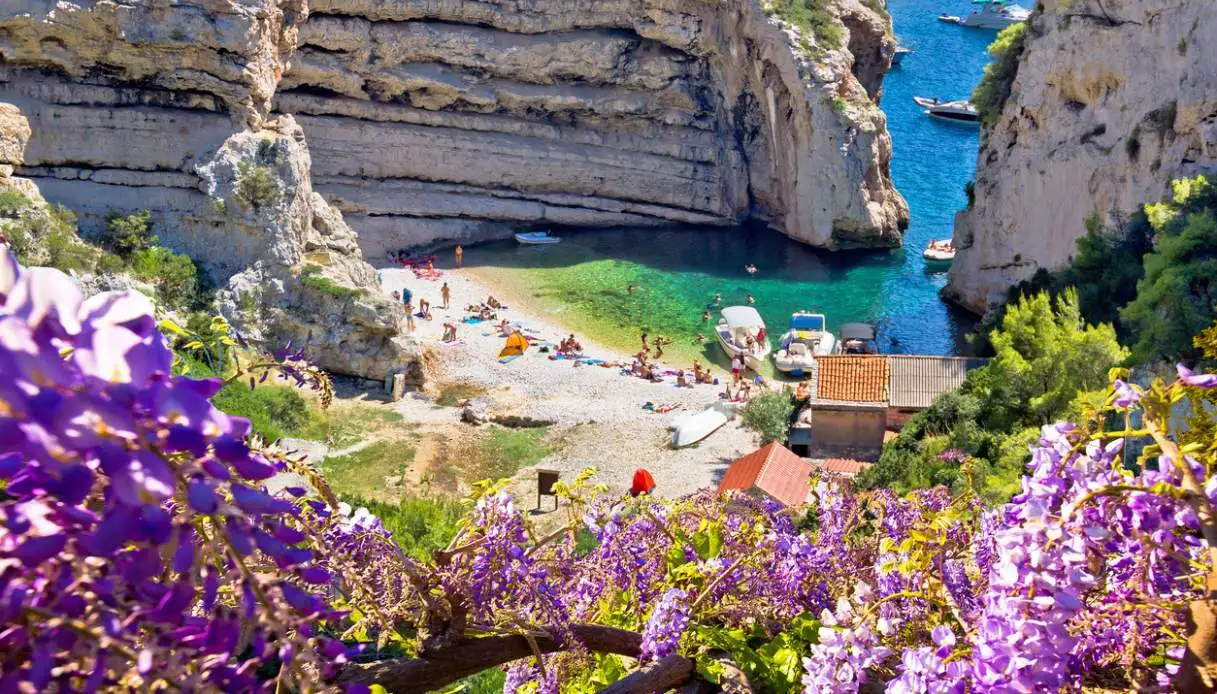
The port of Komiža keeps the ambiance of an ancient fishing town, filled with colorful boats rocking beside stone houses, while the seafront invites you to slow the pace of the day. Among the most spectacular images is certainly Stiniva, a cove surrounded by high rock faces that allows the sea to pass through a narrow opening.
Not far away, on the islet of Biševo, the Blue Cave offers a surprising natural phenomenon: some morning hours allow sunlight to pass through an underwater cavity, coloring the water in a luminous blue. Fortifications, tunnels carved into rock, and archaeological finds bear witness to a past rich in military and commercial episodes.
Mljet, the green heart of the Adriatic
Also beautiful is Mljet, often cited among Croatia’s greenest islands. A vast forest cover blankets much of the area, while the western part belongs to the National Park established in 1960. The most famous stretch includes saltwater lakes connected to the sea by a natural narrow channel. They are Veliko Jezero and Malo Jezero, presenting continuously changing hues from turquoise to emerald depending on light and water depth.
At the center of the larger lake rises the islet of Santa Maria, where a 12th-century Benedictine monastery dominates the whole. Those who reach the complex by boat discover stone courtyards, austere cloisters, and an atmosphere that evokes centuries of spirituality.
Lastovo, the kingdom of the starry sky
Far from the most frequented tourist routes, Lastovo captivates with a reserved character. It is part of a natural park that protects the sea, vegetation, and biodiversity. The extremely low level of light pollution has earned the island the reputation as a paradise for stargazing. The main village climbs up the slope of a hill, with limestone houses displaying the original cylindrical chimneys.
Vineyards, olive groves, and small allotments accompany the landscape down to the rugged coastline. Not lacking are underwater caverns that attract divers from all over Europe.
