
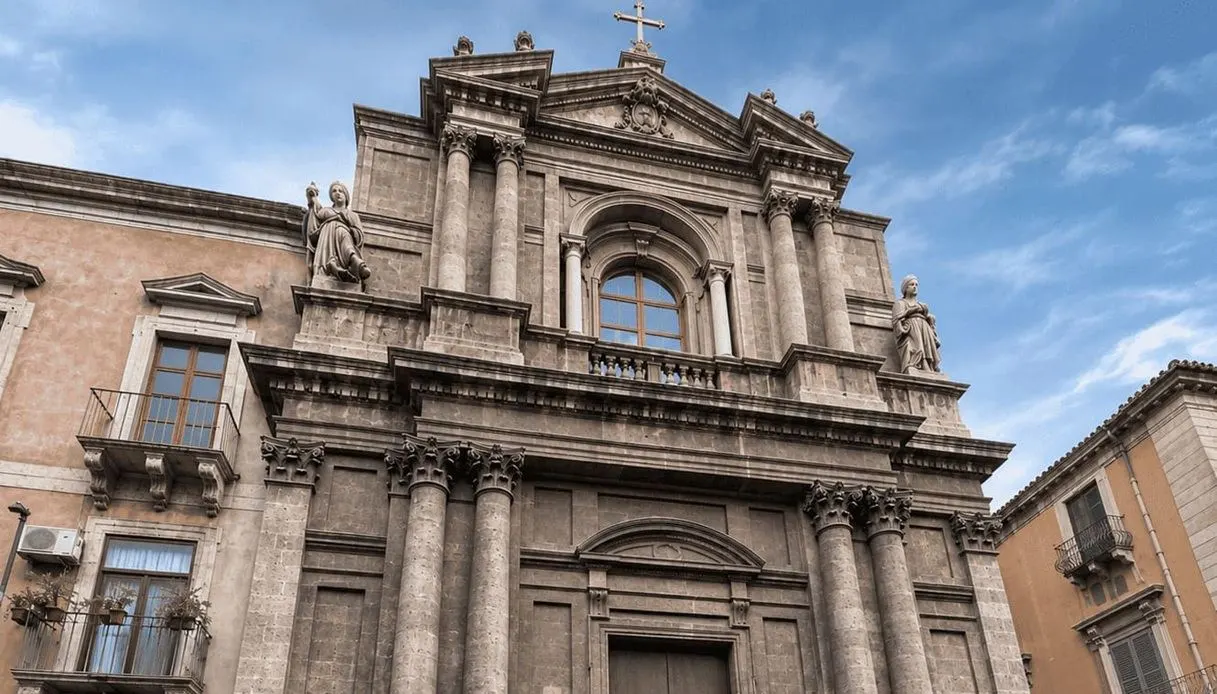
Under the floor of one of the historic churches of Catania, about three and a half meters deep, lies a world that remained for a long time hidden. An intertwining of ancient burial chambers, corridors, stairways and lava-stone architectures that recounts funeral customs and rites of a distant past.
A heritage of historical and architectural value that is preparing to become accessible again after a major restoration. It is the Ancient Hypogeum of the Church of Saint Augustine, today the Diocesan Sanctuary of Santa Rita, which on Monday, November 9 2026, at 6:00 PM, will be officially inaugurated in the presence of the archbishop of Catania, Monsignor Luigi Renna.
An underground labyrinth among burial chambers and ancient funeral rites
Descending into the Ancient Hypogeum means embarking on a journey into the Catania of centuries past, uncovering spaces that still preserve testimonies of the funeral practices spread between the eighteenth and nineteenth centuries. The complex extends beneath the nave of the church and comprises five burial chambers, connected to each other by corridors and ancient staircases that follow the architectural orientation of the building above.
The spaces house architectural elements of particular interest: barrel and cross vaults, terracotta pavements, niches, ossaries, and masonry benches used for the ancient customs related to the burial of the deceased. Among the most evocative details are the so-called mortuary chutes, structures intended for the treatment of the corpses before their final interment. They are testimonies precious not only from a historical and architectural standpoint but also anthropological, because they allow us to understand practices and traditions that have now disappeared.
The history of the hypogeum is closely tied to that of the Church of Saint Augustine. The Augustinian complex was founded in 1384 along the old Royal Road, today Vittorio Emanuele II Street. Severely damaged by the 1693 earthquake, it was subsequently rebuilt in the first half of the eighteenth century on the design of architect Girolamo Palazzotto, one of the leading figures in the city’s Baroque reconstruction. In 2013 the church was elevated to the Diocesan Sanctuary of Santa Rita in Sant’Agostino.
The restoration of the hypogeum and the reopening to the public
The restoration of the Ancient Hypogeum arises from the will to safeguard a heritage of particular interest, long hampered by humidity problems and by the progressive closure of the original connections with the church above. The works were carried out with the aim of preserving the authentic characteristics of the environments, while at the same time improving their usability and enhancing their architectural details, through interventions respectful of the historical structure.
The inaugural ceremony will take place in the Church of Santa Rita in Sant’Agostino and will open with the greetings of the rector, Don Massimiliano Parisi. The speeches will follow from the project designers, the architects Francesco Anfuso and Marco Bertolone, and the engineer Mauro Scaccianoce, who will illustrate the works carried out. Also planned is a musical interlude by the polyphonic choir directed by Maestro Paolo Cipolla and the presentation of a video dedicated to the history of the hypogeum, produced by the Academy of Fine Arts of Catania.
After the institutional greetings and the conclusions of the Archbishop Luigi Renna, there will be the ribbon-cutting and a first tour reserved for the authorities. Subsequently, the Ancient Hypogeum will finally be opened to the public, with entry organized in staggered groups.
