
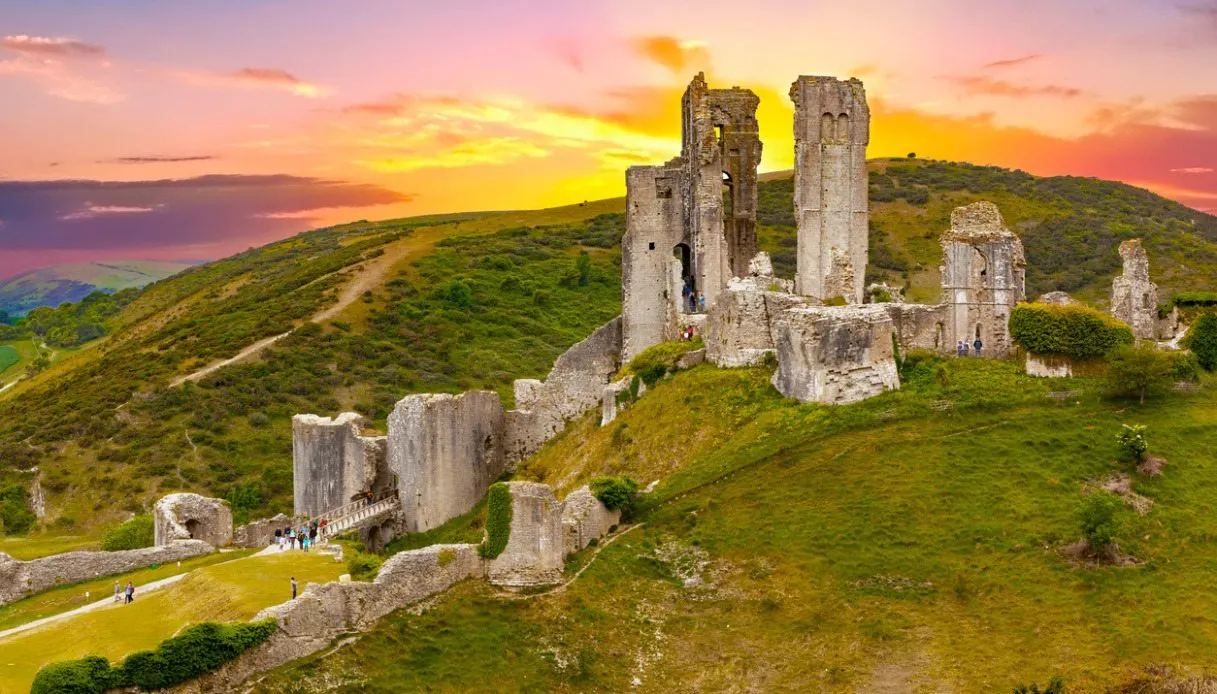
What the eye sees is incredible: silhouettes of shattered towers, walls tilted in an almost impossible way, and large blocks of stone abandoned on the slopes. Corfe Castle appears thus, like a fortress struck by a catastrophe and left exactly where its history stopped.
We are in Dorset, a county of southern England, more precisely on a 55-meter-high hill in the heart of the Purbeck Hills. And it is there that the remains of one of Britain’s most important medieval fortresses endure against the passage of time, while at its feet the stone houses of the village of the same name seem tiny. Today, through its ruins, one virtually traverses almost 1,000 years of English history.
Brief history and legends of Corfe Castle
The history of Corfe Castle begins before the Norman conquest of England. Archaeological excavations have in fact identified traces of an important Anglo-Saxon building, probably linked to an aristocratic residence.
It was William the Conqueror, after the victory of 1066, to transform this strategic position into a powerful stronghold. The curious fact is that he chose to use stone at a time when much of the local fortifications were still made of wood and earth.
Around 1105, under Henry I, the great keep, the central keep, was completed. Standing about 21 meters high, it was built with Purbeck limestone and dominated the surrounding territory. During the reign of King John, Corfe reached an extraordinary political importance.
For this reason, the sovereign had refined residential spaces built, among them the Gloriette, intended for the private life of the court. Beside luxury, however, there was a much darker reality: after the mysterious disappearance of Prince Arthur of Brittany, rival in the succession, John had his niece Eleanor and 25 knights allied to the young claimant imprisoned within these walls.
The most dramatic fate arrived in the 17th century. The castle was indeed purchased by Sir John Bankes and was transformed into a Royalist fortress during the English Civil War. In 1643 Lady Mary Bankes, wife of the owner, successfully led the defense against an initial siege, earning the nickname Brave Dame Mary, the courageous Lady Mary.
A second attack, begun in 1645, had a tragic outcome: in February 1646, a treacherous officer allowed entry to Parliament troops disguised as Royalist reinforcements. Once the fortress was conquered, Parliament ordered its demolition and the engineers used explosives to destroy towers and curtain walls, leaving huge inclined sections and fragments scattered along the hill. This, whether by choice or not, marked the end of Corfe Castle (even if today its long history survives among the fascinating ruins).
Among the legends that have survived the destruction, there is one about the imperial ravens nesting among the ruins: it was said (and is partly still said) that a terrible misfortune would strike Corfe Castle if these birds abandoned it and, as fate would have it, they disappeared just before its fall during the Civil War. To this day, their cries contribute to the enigmatic atmosphere of the place.
Visiting Corfe Castle and what to see
There are no restored and furnished rooms, but something perhaps even more exceptional happens: you enter directly into the skeleton of an ancient royal residence, through defensive passages, courtyards and staircases. The entrance is via a four-arched stone bridge, built over a now dry moat.
Beyond the outer guardhouse, one reaches the spaces once protected by a succession of walls and towers. Of particular interest are the ancient vertical slits used by archers and the so-called murder holes, defensive openings carved above certain passages through which attackers could be struck in the past.
In the western courtyard survive the remains of the Old Hall, one of the oldest buildings in the entire complex, where in some cases the brickwork remains show the herringbone pattern and traces of the original arched openings. Climbing toward the inner enclosure, the great keep rises, today deeply mutilated.
Its walls, however, retain elements of the transformations that occurred during the Middle Ages and in Tudor times, between windows, old fireplaces and fragments of the monarchs’ living spaces. The most striking are the enormous blocks of masonry that tumbled down during the 1646 demolition, left close to the spot where they fell.
Another key point is the Gloriette, a residential complex built by King John at the beginning of the 13th century. Today there remain windows framed by elaborate stone mouldings, but they attest to the refinement of a building designed to amaze guests.
It must be said, however, that the destruction has paradoxically made visible construction details that would once have remained hidden. From the higher part, the panorama embraces the undulations of the Purbeck Hills, the village below and the Dorset countryside. With a bit of luck, among the distant meadows you can even glimpse the historic Swanage Railway train, recognizable by its plume of steam.
The ruins also host imperial ravens and peregrine falcons that exploit the crevices in the walls to nest. The site is currently managed by the National Trust, a UK organization dedicated to the conservation of historical and natural heritage. To explore it, 1-2 hours are usually sufficient, though history enthusiasts may linger longer.
Where it is and how to get there
Corfe Castle is located in the county of Dorset, in southwestern England, halfway between Wareham and Swanage, within the so-called Isle of Purbeck. To reach it by car, take the A351 road, which links Wareham to the coast. The National Trust has a car park along this route, identifiable by the postal code BH20 5DR, located about a 10-minute walk from the entrance. There are also other paid parking areas nearby.
Those who prefer public transport can use rail connections to Wareham, continuing with the Purbeck Breezer 40 bus toward Swanage. The 30 line links Swanage and Weymouth via Corfe Castle. A particularly evocative alternative is the Swanage Railway, a charming historic railway with steam and diesel locomotives that runs seasonal tourist services.
The Corfe Castle station allows you to reach the site on foot, adding a bygone-era atmosphere to the journey. Before departure, however, it is advisable to check the National Trust’s official website to verify updated hours, fares and any access limitations (especially during the winter months).
