
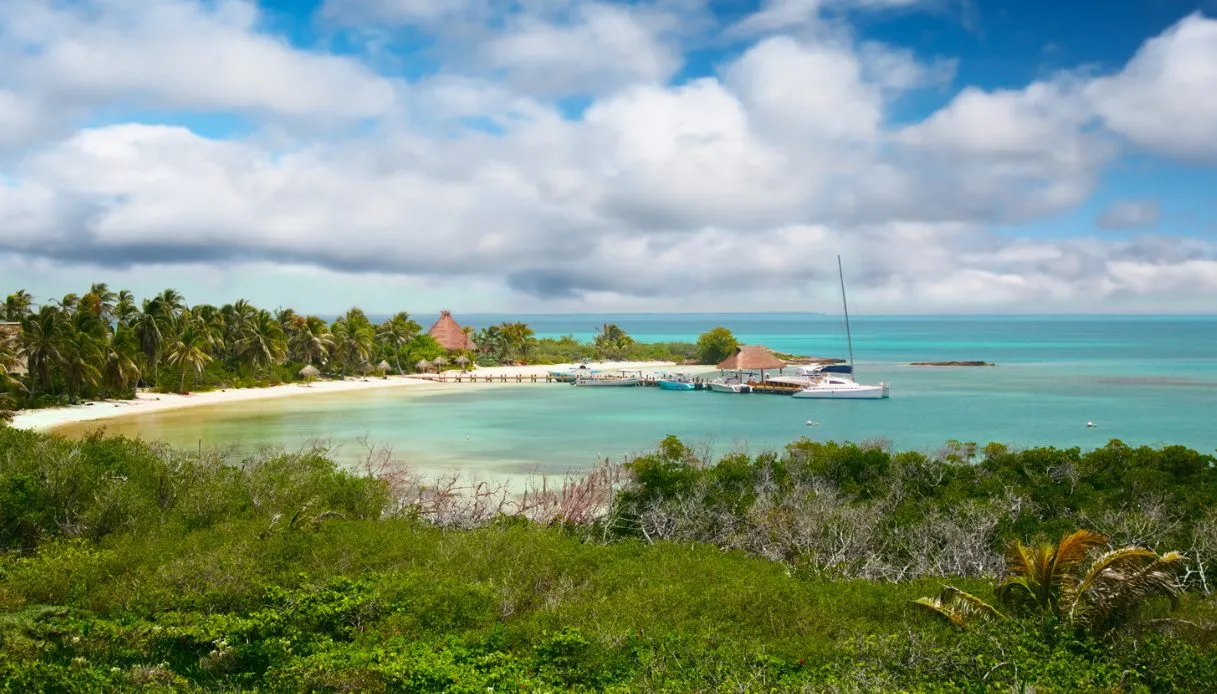
Seen from the sea, Isla Contoy looks like a green brushstroke laid between two vast shades of blue. You don’t notice tall hotels interrupting the landscape, nor rows of beach umbrellas crowding the shoreline. Instead, you can feel the wind, the lull of the waves, and the calls of frigates.
We are in the Caribbean part of Mexico, off the Yucatán Peninsula, and Isla Contoy is a uninhabited marvel just 8.75 km long and at most 700 meters wide, situated at a peculiar geographic point: at the border between the Caribbean Sea and the Gulf of Mexico. Nutrient-rich waters, brackish lagoons, and mangroves have fostered the development of an exceptional ecosystem, to the extent that it is one of the region’s most important refuges for seabirds.
Also known by the nickname Isla de los Pájaros, or Island of the Birds, it offers an extremely wild landscape, yet one that also reveals an ancient history: shards of ceramics and worked shells testify to Maya presence on the island, while in later centuries fishermen used some landing points as shelter.
What to see in Isla Contoy
Although it spans only a few square kilometers, this corner of Mexico houses environments that are very different from one another. Beneath the sea surface, coral gardens flourish, while inland the roots of mangroves trap sediments and create refuges for fish and crustaceans. A small (but essential) service note: visits follow exclusively authorized routes.
The Visitor Center and the Small Natural History Museum
Near the landing dock lies the Visitor Center, the main reference point for discovering the heritage of the protected area. It is a minimalist facility, but with exhibition spaces dedicated to fauna, vegetation, and conservation activities.
Pla nnels and naturalistic materials mainly recount the life of the sea turtles, which here use the sands to lay their eggs.
The Observation Tower and the Realm of Frigatebirds
Climbing the observation tower, the gaze finally rises above the low vegetation and reaches the water surfaces hidden inside. From this vantage point emerges the island’s distinctive layout, a tongue of land crossed by lagoons, channels, and stretches of mangroves.
Above the canopy of trees wheel the magnificent frigatebirds, recognizable by their slender silhouette and long, sharp wings. Brown pelicans, cormorants, boobies, and herons are not missing.
The Trails Through Mangroves and Coastal Dunes
Two interpretive trails allow you to explore a small part of the terrestrial environment: one leads to the Central Lagoon, the other winds through the dune vegetation.
Among the gnarled branches of red mangroves, curved roots emerge that descend into the brackish water. A little further on, salt-tolerant shrubs and creeping plants colonize the sandy ground, helping to protect it from erosion.
To the wetlands follow drier stretches, populated by hermit crabs and iguanas. The paths are short, but require the accompaniment of authorized guides.
The Puerto Viejo Lagoon, refuge of the pelicans
Among Isla Contoy’s most precious environments lies Laguna de Puerto Viejo, the largest inland basin. Its shallow waters host islets, mangroves, and numerous aquatic species.
Its presence tells a fundamental part of the island’s identity, linked to bird nesting and the growth of numerous marine species.
The Ixlaché Coral Reef, a Natural Aquarium
At the southern tip of the park lies the Ixlaché reef, part of the Mesoamerican Barrier Reef System, the vast coral complex that stretches along the coasts of Mexico, Belize, Guatemala, and Honduras.
On favorable days, snorkeling allows you to observe corals, gorgonians, and tropical fish in vivid colors. Even here, the activity takes place only in permitted areas, with guides and flotation equipment, and in respect of sea conditions and the directions of authorized staff.
The most beautiful beaches of Isla Contoy
This island, in some respects, seems almost surreal thanks to its ultrafine sand, calcareous fragments, and waters with almost fluorescent tones. The western side generally offers more sheltered conditions, while the eastern side faces the open sea. It is also worth noting that some beaches are part of a sanctuary dedicated to protecting sea turtles and are therefore excluded from regular excursions.
- Playa de Ixmapoit: on the southwestern part of the island, it is the main reference for visitors. It is a stretch of white sand facing the bay of the same name, with palms, small shaded structures, and usually calm waters. Swimming is allowed only in areas indicated by the guides.
- Playa Camping: belongs to the public-use sector, although the name may be misleading. Indeed, we are talking about a protected coastal area, without tourist campsites. Salt-tolerant vegetation, small sandy patches, and a sparse, essential environment characterize this corner of the island, visitable according to the park’s rules.
- Playa de las Garzas and Playa Tortugas: two beaches along the western coast, important mainly for their ecological value. The names evoke respectively herons and sea turtles, and both fall within protected zones (thus considered sites of naturalistic interest without free recreational access).
On the approved beaches, the most striking sensation comes from the absence of the usual tourist infrastructures: a stretch of sand, the irregular shade of the palm trees, and the sea alone compose the landscape. Even the footprints on the shore seem to last only a short time, erased by the water that slowly returns toward the vegetation.
Where it is located and how to reach it
Isla Contoy belongs to the Mexican state of Quintana Roo, at the northeastern tip of the Yucatán Peninsula. It lies about 30 km north of Isla Mujeres and 50 km north of Cancún, at the passage between the Gulf of Mexico and the Caribbean Sea. It can be reached exclusively by sea, with authorized excursions that typically depart from Cancún, Puerto Juárez, Punta Sam, and Isla Mujeres, with crossings roughly between 45 minutes and 2 hours.
The visit takes a full day, with a morning departure and an afternoon return. Many programs include a view of the Ixlaché reef, a guided walk, time to enjoy the permitted beach area, and lunch (some operators also offer a stop in Isla Mujeres on the way back).
You must book in advance through an organization authorized to operate, ensuring that the park entrance fee is included in the overall price. Regarding the climate, it remains hot for most of the year, but wind and rough seas can cause the trips to be suspended.
