
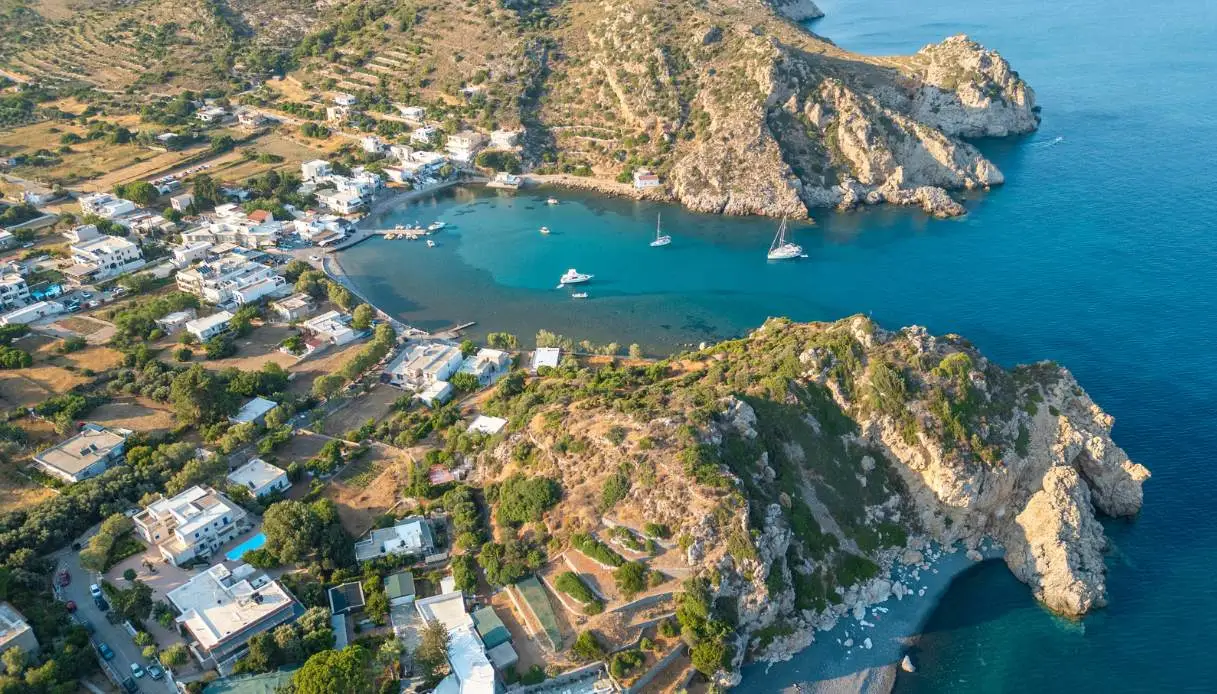
The coast of Anatolia looms incredibly close, a near-constant presence beyond the horizon, immediately revealing the island’s unique position in the northeast Aegean. Here Greece looks toward the East, yet still bears the marks of a deeply European past. Chios has long stood as a crossroads of commerce: Byzantine, then Genoese, and finally Ottoman, so much so that it gathered diverse influences without losing its own character.
Its emblematic symbol is the mastic, the precious resin extracted from the lentisk, a plant cultivated mainly in the southern part. The small translucent droplets that seep from the bark are called “Lacrimae Chios” or “Tears of Chios,” and are collected by ancient methods, with delicate incisions on the trunk that the farmers describe as a kind of embroidery. From this resin are produced sweets, liqueurs, cosmetic products, and flavors known around the world.
The island covers about 842 km² and its landscape shifts from north to south. The Pelinaio Mountains dominate wild terrains, dotted with remote villages and forests of pines and chestnuts. The southern part appears softer, with citrus groves, olive groves, and the Mastichochoria, the ancient fortified centers born around the cultivation of mastic.
Things to See on Chios Island
The soul of this Greek island reveals itself far from the most immediate images. The sea accompanies the journey, but it is stones, stories, and agricultural traditions that define its character. In the area, a village can narrate centuries of trade, a chapel can guard forgotten tragedies, and a simple plant can represent the entire identity of a community.
Pyrgi, the Village with Embroidered Façades
Pyrgi is the most recognizable symbol of the Mastichochoria. Arriving in the historic center, one encounters houses decorated with the xysti, geometric motifs carved into the outer plaster layer, creating white-and-black designs.
The village originated as a defensive structure, with houses linked together to form a barrier against pirate attacks, while the narrow streets facilitated protection of the inhabitants. Today Pyrgi preserves that medieval layout, but daily life has reclaimed the spaces with cafés, shops, and balconies decorated with sun-dried tomatoes.
Mesta, the Genoese Labyrinth
To represent (perhaps) the most complete example of Chiotian medieval architecture, Mesta appears as a compact fortress built from local stone, crisscrossed by narrow alleys that lead to tiny squares. Here too the outer houses formed a protective ring, while the heart of the village housed social and religious life.
Olympi, the Rural Memory of the Mastic
The village of Olympi holds a more restrained charm than its neighbors Pyrgi and Mesta, presenting the appearance of an ancient agricultural settlement tied to resin production. Nearby lies the Sykias Cave, a time-carved natural cavity with stalactites and rock formations dating back millions of years.
Nea Moni, the Byzantine Treasure of the Aegean
In the heart of Chios stands the Monastery of Nea Moni, founded in the 11th century by the Byzantine emperor Constantine IX Monomachos. Included in the UNESCO World Heritage List, it houses some of Greece’s most important Byzantine mosaics.
The gold of the mosaic tesserae illuminates religious scenes crafted with extraordinary refinement, yet here artistic beauty lives alongside painful memory: in 1822 it became a refuge for thousands of inhabitants during the Ottoman attack, to the point that today a chapel preserves the bones and skulls of the victims.
Anavatos, the Abandoned Fortress on the Rock
Anavatos is a medieval village abandoned and perched on a rugged cliff, as if suspended between sky and land. Today the stone houses, the tower, and the remains of the dwellings stand as witnesses to a dramatic history of resistance and isolation.
Chios Town and the Port Castle
The capital reveals the island’s most dynamic facet. The port is the meeting point for fishermen, students, merchants, and travelers. Behind the seafront stretches the historic district with the Genoese castle, a structure that has housed centuries of different dominations. Within the walls coexist Byzantine ruins, Ottoman buildings, and traces of Venetian and Genoese presence.
Vrontados, and the Spectacular Rocket War
To the north of the capital lies Vrontados, linked to a tradition that the poet Homer could have ties with this area. The town is renowned especially for the Rouketopolemos, the Easter rocket battle between the churches of Saint Mark and the Virgin Mary.
During the celebration thousands of handmade rockets are launched between the two religious buildings, creating a luminous display unique to the panorama of Greek festivities.
The Most Beautiful Beaches of Chios
The sea of Chios follows the same logic as the island itself: it surprises visitors who expect the classic Cycladic scenery. Here wild coves predominate, pebbles smoothed by time, and seafloors of vivid colors with water that is often clearer than on other Aegean islands.
- Mavra Volia: the island’s most iconic beach, with large dark pebbles born from ancient volcanic activity that give rise to a landscape almost lunar.
- Karfas: one of the few areas with fine sand and shallow waters. The presence of hotels, restaurants, and bars makes it suitable for those seeking practicality without giving up the Greek character.
- Agia Fotini: a pebble beach that wins you over with its transparent water and relaxed atmosphere.
- Komi: long and lively, alternating sand and small pebbles. In summer it becomes a point of reference for island residents thanks to its restaurants, bars, and opportunities for water sports.
- Lithi: simple atmosphere and a western-facing sunset that casts a particularly evocative light.
- Nagos: surrounded by vegetation and mountains, representing a more remote part of Chios. The water is cool and clear, while the landscape conveys a sense of isolation.
- Vroulidia: reached via a more challenging route, but the payoff is worth the effort.
Where It Is and How to Arrive
Chios lies off the western coast of Turkey, separated from the Anatolian peninsula by a narrow stretch of sea. The closest major islands are Lesbos, Samos, Psara, and Oinousses. The capital, also called Chios, is the main access point. Here most ferries arrive and commercial life concentrates.
Chios International Airport “Omiros” connects the island with Athens via domestic flights of about one hour. From Italy, a stopover in the Greek capital is therefore necessary. Those who prefer the sea can find the main connection from the Port of Piraeus, near Athens, but it is a journey that takes several hours. Chios is also connected to other islands in the Northern Aegean, including Lesbos and Samos.
