
For many years, China appeared as a distant and intricate destination to reach, an intimidating and challenging place to navigate largely because of the language barrier. Yet something has started to change recently. The country is making a strong comeback onto the maps of international tourism, helped by a gradual opening to foreign travelers and by a strategy increasingly aimed at promoting cultural heritage, major cities, and lesser-known overseas destinations.
The numbers tell this new phase well: in 2025 China recorded 154.5 million international tourist arrivals, up 17.1% from the previous year, while foreign visitors’ spending rose by 39.2%. Also fueling the rebound was the extension of visa-free entry policies: during 2025 visa-free entries by foreign nationals reached 30.08 million, a 49.5% increase compared to 2024.
For Italian travelers, moreover, visa-free entry was extended through December 31, 2026, for stays up to 30 days with a ordinary passport. The result is that today China seems increasingly appealing for those seeking a trip that combines millennial history, futuristic metropolises, traditional villages, spectacular mountains, and pop culture.
But to truly grasp its variety, an itinerary must start from the great capitals and reach to the more rural (and surreal) landscapes of the inland. Here are the stops to include in a grand tour of China, with an itinerary that alternates cities, historic heritage, and some of the country’s most renowned natural wonders.
Beijing, the Imperial Heart of China
The journey to discover China cannot really begin anywhere but Beijing, the capital and one of the best cities to connect with Chinese history. Three days allow you to see the main monuments without turning the itinerary into a race against time. The centerpiece of the trip is naturally the Forbidden City, the ancient imperial complex that for centuries was the political and ceremonial heart of China. With its courtyards, pavilions, and buildings featuring distinct wooden architectures, it stands as one of the most important sites of the Chinese imperial heritage.
The historic area of Beijing is today part of a broader UNESCO-recognized heritage site through the Beijing Central Axis. Not to be missed are Tiananmen Square, the Temple of Heaven, the Summer Palace, and a stroll through the hutongs, the capital’s ancient alleyways.
The Great Wall, the Symbol of China
From Beijing you can dedicate a day to the Great Wall, one of the most recognizable images of the country and one of the world’s most impressive monuments. It is not a single continuous structure, but a vast system of fortifications built over centuries and across different dynasties.
The Great Wall has been on the UNESCO World Heritage List since 1987. For a first trip to China, it is one of those stops that’s hard to replace: although very touristy, it immediately conveys the monumental scale of the country’s history.
Shanghai, China Looking to the Future
From imperial history we move to one of the country’s most futuristic scenarios: Shanghai. The metropolis can be explored in about three days, alternating the famous Pudong skyline with a stroll along the Bund, where colonial-era buildings overlook the Huangpu River. Yet Shanghai is more than its skyscrapers: it also deserves a visit to the French Concession, its historic districts, markets and temples.
And for families traveling, but also for Disney enthusiasts, it’s worth adding a full day dedicated to Shanghai Disneyland. The park allows you to insert a completely different interlude into the itinerary, with attractions, shows, and themed areas, some of which are designed specifically for a Chinese audience.
Chongqing, the Cyberpunk Metropolis
If Beijing embodies imperial China and Shanghai captures its financial side, Chongqing perhaps reveals the most spectacular face of contemporary China. In recent years the city has become a real social-media star thanks to its vertical urban landscape, the surrounding mountains, and infrastructures that seem almost impossible. The best-known symbol is the metro train that literally passes through a building in Liziba.
Chongqing is also one of China’s gastronomic capitals, famed especially for the spicy hot pot. Its tourism growth is particularly notable: international tourism is beginning to shift beyond the traditional entry points like Beijing and Shanghai, and Chongqing is among the cities that have recorded the most pronounced increases.
Furong and Zhangjiajie, Film-Set Landscapes
From Chongqing you enter a completely different China, that of grand natural landscapes. The Zhangjiajie area in Hunan province is famous for its spectacular vertical rock formations, made famous worldwide also for their resemblance to landscapes from the film Avatar.
A short distance away lies Furong, another stop to note: an ancient village built along a waterfall, where traditional houses extend along the slopes of the valley.
Pingyao, the China of Ancient Dynasties
To travel back in time, reach Pingyao in Shanxi. The historic city preserves walls, streets, courtyards, and traditional houses that allow you to imagine how some important Chinese centers looked before the urban transformation of the twentieth century.
Here you won’t find skyscrapers, futuristic subways, or illuminated skylines, but laneways, lanterns, and traditional architecture.
Xi’an and the Terracotta Army
Another almost mandatory stop leads to Xi’an, an ancient imperial capital and the eastern starting point of the Silk Road. The main reason to include it is naturally the Terracotta Army, discovered in 1974 and composed of thousands of soldiers, horses, and chariots crafted to accompany the first Chinese emperor in the afterlife.
The site has been part of the UNESCO World Heritage since 1987 along with the mausoleum of the First Qin Emperor. But Xi’an also deserves a visit for its city walls, the Muslim Quarter, and its cuisine, which offers a completely different perspective from that of the large eastern cities.
Mount Tai, the Sacred Mountain
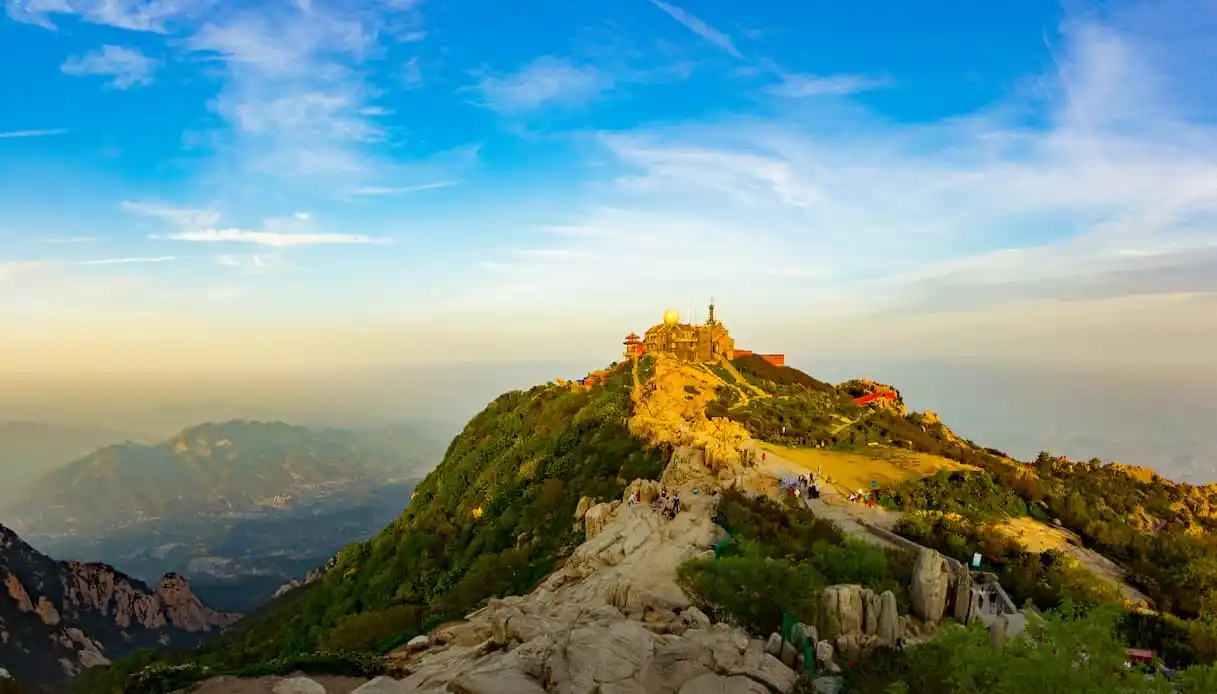
To discover another dimension of Chinese culture you must ascend Mount Tai, one of the most important mountains in the country’s religious and cultural tradition. The mountain, located in Shandong, has for millennia been linked to imperial rituals, pilgrimages, and religious beliefs. The ascent winds through stairways, monumental gates, temples, and ancient inscriptions, up to the summit areas. Mount Tai is recognized by UNESCO as a cultural and natural heritage site and stands as one of the places that best tell the relationship between landscape, spirituality and imperial power in Chinese history.
The Mogao Caves, on the Silk Road
The final stop takes us far to the west, to Dunhuang in Gansu, where the extraordinary Mogao Caves are located. Here the journey takes on an archaeological expedition feel: the caves are adorned with frescoes, sculptures, and artistic testimonies tied to the history of the Silk Road and the cultural exchanges between China, Central Asia, and other regions.
The complex comprises hundreds of caves and preserves an artistic heritage developed over many centuries. UNESCO included it on the World Heritage List in 1987.