
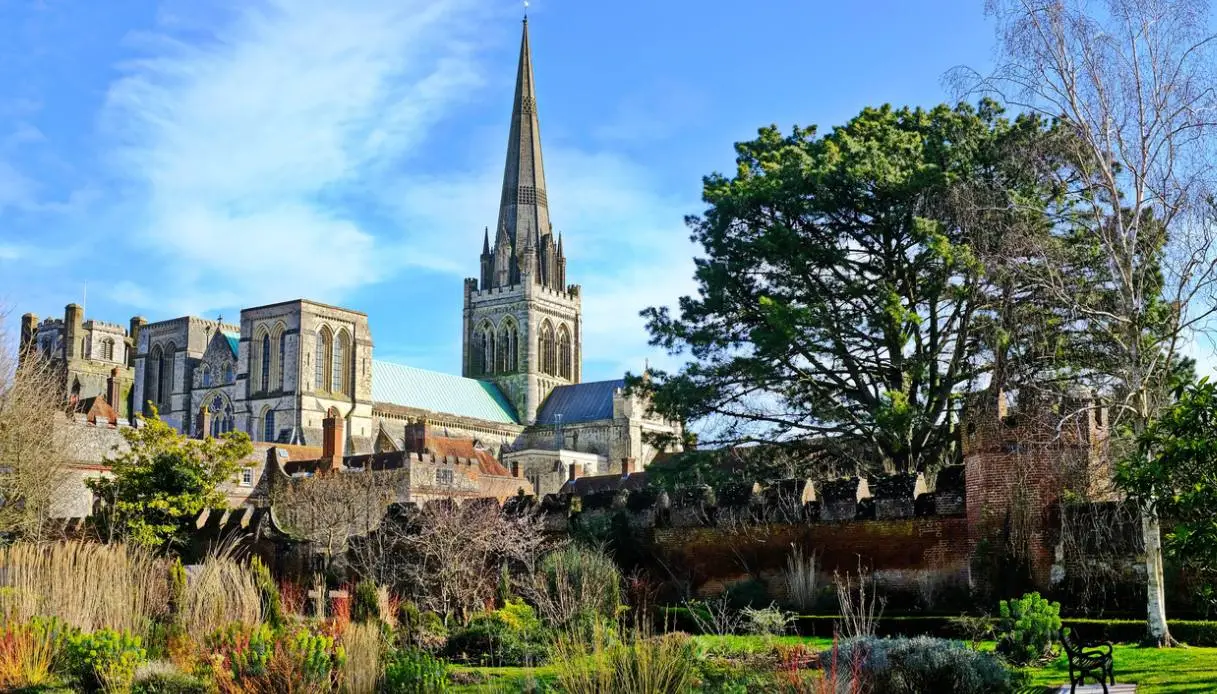
Cities have their own talents too. Don’t believe it? Then take a trip to Chichester in the United Kingdom, and you’ll see how adept it is at making the encounter between very distant eras look utterly natural. And no, it isn’t easy at all. Here you can observe an ancient Roman fortification, and just a few minutes later find yourself in front of a Marc Chagall stained-glass window, nestled among the elegant facades of English houses and the small shops that enliven the town center.
We’re in West Sussex, in southern England, in the heart of a place that preserves a remarkable relationship with its past but, despite this notable ability, remains off the beaten track of the most frequented British tourist routes. Its origins trace back about 2000 years, when the Romans founded the settlement of Noviomagus Reginorum, destined to become an important administrative and commercial center.
Even today, the urban plan tells that era: there are four main streets that meet right in the center, in a layout reminiscent of Roman planning, while the remains of the ancient walls outline the perimeter of the historic core. But this, to be honest, is only the beginning.
What to See in Chichester
This fascinating town in the United Kingdom presents a historic center of compact size, where however there are preserved testimonies of a past far more important than its current extent might suggest.
Chichester Cathedral, the Cathedral that houses a work by Chagall
Yes, you read that correctly: inside the Cathedral of the Holy Trinity there is even an incredible work by Chagall. The building, among other things, stands as his most recognizable monument, not least because it boasts a particularly interesting history—the one related to its spire.
Collapsed in 1861, it was rebuilt under the direction of architect George Gilbert Scott. Not far from the western façade you’ll also find a rarity of architecture, the medieval bell tower separated from the main body of the church, the only surviving example of this type among English cathedrals.
Within its walls, the 20th-century art draws the eye. It is here, indeed, that one has the opportunity to confront a spectacular red stained-glass window created by Marc Chagall in 1978. It interprets Psalm 150 through dancing figures and musical instruments.
Market Cross, the monument that marks the town center
At the crossroads of North Street, South Street, East Street, and West Street rises a structure that seems to belong to a medieval miniature. It is the Market Cross, an elaborate octagonal stone monument with open Gothic arches, decorative pinnacles, buttresses, and later-added clocks.
In the past, beneath the arches, merchants could sell their goods sheltered from the weather, right at the most frequented point in the town. Today it serves as an essential visual reference, surrounded by historic buildings, shopfronts, and cafés.
The Roman Walls, an 1800-year-old defensive circuit
Among Chichester’s most surprising testimonies are the City Walls, built by the Romans about 1800 years ago to protect the settlement. Much of the defensive circuit has survived urban changes and medieval transformations, making these fortifications among the best preserved in southern England.
The northern area, near Priory Park, is particularly evocative, a green space carved inside the historical perimeter.
The Novium Museum, the Roman city beneath your feet
Chichester preserves part of its history even beneath the level of the modern streets. And to demonstrate this impeccably is the Novium Museum, which was built directly over the remains of a Roman bath complex. In essence, visitors can observe the archaeological structures of the ancient baths, while the collections illustrate the evolution of the area from prehistoric times to more recent centuries.
Among the artifacts, notable is the Chilgrove Roman mosaic and items linked to the so‑called Mystery Warrior, an enigmatic Iron Age warrior unearthed in North Bersted.
Pallant House Gallery, a Georgian residence turned museum
A house built around 1712 for wine merchant Henry Peckham is today home to one of the most important collections of British modern art. We’re talking about Pallant House Gallery, which showcases a collection spanning the major movements of the 20th century, all set against an intriguing contrast between historic rooms and contemporary spaces.
Chichester Festival Theatre, the theatre linked to Laurence Olivier
To the north of the center, among the trees of Oaklands Park, rises a decidedly unusual structure: the Chichester Festival Theatre. It is the first British modern theatre equipped with a thrust stage, with the audience seated on three sides.
The modernist architecture, designed by Philip Powell and Hidalgo Moya, features a reinforced concrete structure and a striking roof inspired by the shape of a tent.
What to Do in Chichester
Exploring Chichester offers a genuine opportunity to encounter a surprising facet of England, made up of navigable canals, aristocratic residences, sporting activities, and coastal landscapes shaped by the ebb and flow of the tides.
- Visit Fishbourne Roman Palace: a few kilometers from the center lie the remains of Britain’s largest known Roman residence, full of splendid mosaic floors.
- Navigate the Chichester Canal: it passes through a tranquil landscape frequented by herons and other water birds.
- Reach the West Wittering beaches: pale sands, grassy dunes, and shallow waters characterize one of Sussex’s most cherished seaside destinations.
- Explore Chichester Harbour: a vast system of natural channels, mudflats, and brackish marshes renowned for sailing and birdlife.
- Join events at Goodwood: the aristocratic estate hosts the Festival of Speed, the Goodwood Revival, and major horse-racing competitions.
- Visit Petworth House and the South Downs National Park: the opulent aristocratic residence houses a notable art collection, while the rolling chalk hills of the South Downs offer cycling itineraries, scenic trails, and rural villages.
Location and How to Reach
Chichester is situated in West Sussex, southeastern England, about 110 km southwest of London and a short distance from the coast along the English Channel. For travelers coming from Italy, the London airports provide the main entry points, with London Gatwick being the most convenient thanks to rail connections to the southern coast.
The town is also served by the and regional connections to Portsmouth, Brighton, and other parts of Sussex. From London Victoria, the journey typically takes about 1 hour and 30 minutes or more, depending on the service and any changes. By car, the main arterial road is the A27, linking Chichester to Portsmouth and Brighton.
