
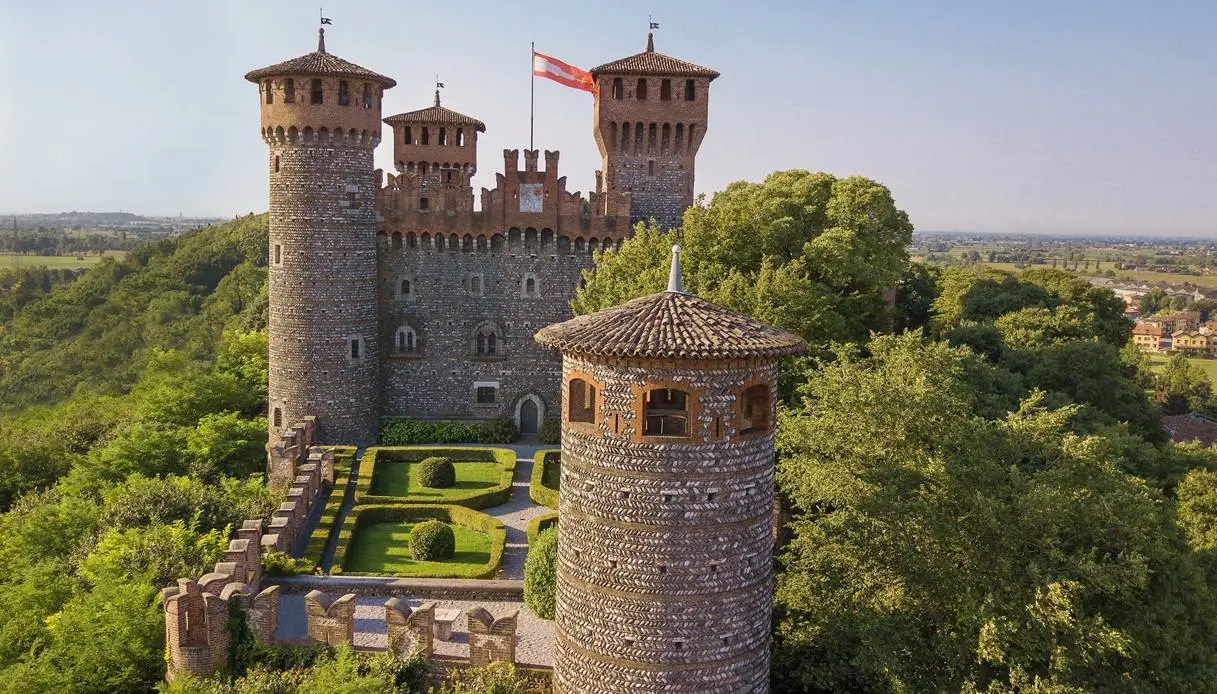
Battlemented towers, stone walls, a moat, and even a drawbridge: looking at the Castello Bonoris from the outside, it’s easy to imagine knights, sieges, and ladies in lavish gowns peering from the windows. But there’s one detail that completely changes the perspective: the manor, perched on a hillside in the province of Brescia, is not a genuine medieval castle.
Its history actually begins at the end of the 19th century, when Gaetano Bonoris decided to transform the remains of the ancient fortress into what would become his extraordinary neogothic residence, with a fairy-tale and imposing architecture.
The Castle Born from a Dream
Before becoming the manor we know today, there really was a fortification atop the hill of San Pancrazio, in Montichiari. The first documentary testimonies of the fortress date back to 1107, but over the centuries the structure was destroyed several times, rebuilt, and eventually abandoned.
When Gaetano Bonoris bought the remains of the fortress, in 1890, little of the original fortification remained. The young banker, however, decided to make it his residence and to recreate around himself a medieval world of his own, made of towers, walls, battlements and romantic atmospheres.
To turn the project into reality he called the architect Antonio Tagliaferri, who was later succeeded by Carlo Melchiotti. The result was a neogothic castle, built taking inspiration also from the Borgo Medievale in Turin, created for the Universal Exhibition of 1884. For the interiors, artisans and artists who had already worked on that project were involved, giving life to a setting where every detail contributes to the illusion of being in another era.
Bonoris, however, did not stop at the walls: the landscape around the manor also had to resemble that of a true romantic castle. In 1901 the landscape architect Giuseppe Roda designed an English-style park of about three hectares and a panoramic “secret” garden, completing the spectacular scenography around the building.
Today the castle belongs to the Municipality of Montichiari, which purchased it in 1996 and began its restoration after a period of abandonment. The manor is part of the Montichiari Musei circuit.
From Decorated Rooms to the Hidden Safe
Bonoris Castle doesn’t just have a spectacular façade: the idea of constructing an idealized Middle Ages continues inside the manor’s rooms, where the play between reality and imagination becomes even more fascinating. Behind the walls unfold spaces richly decorated, frescoes, furnishings and details designed specifically for Bonoris’s residence.
Among the most interesting are the ground-floor chapel and the council chamber on the first floor, the latter modeled on the fifteenth‑century Hall of the Castello della Manta near Saluzzo and decorated by Giuseppe Rollini. The furnishings were also tailor-made: the furniture, for instance, was crafted by the Arboletti brothers of Turin, following models inspired by ancient art.
But there is a detail that adds a touch of mystery to the visit: a secret safe was discovered in the castle, remaining hidden until Bonoris’s death, one of the curiosities that make the manor’s story even more distinctive.
How to Visit Castello Bonoris
Castello Bonoris is open from early April to late October, on Saturdays and Sundays according to the following hours: 10:00–13:00 and 15:00–19:00. The ticket (with guided tour) can be conveniently purchased online on the official Montichiari Musei website or at the site, and grants access also to the Lechi Museum for a free visit. On Friday, August 28, there is a special afternoon opening from 15:00 to 18:00.
The guided tour of Castello Bonoris allows visitors to discover not only the rooms and architectural elements, but above all the story of its creator: a man who, instead of simply living among the ruins of an ancient fortress, decided to build the castle he had always imagined.
Where It Is and How to Reach It
The manor sits on the San Pancrazio hill, at Piazza Santa Maria 36, in the heart of Montichiari (BS). It is easily reachable by car: from Milan you take the A4 motorway toward Venice, exiting at Brescia Est; from there Montichiari is about 20 minutes by following signs for the SS236; from Verona, the route is similar in the opposite direction, always along the A4, with exits at Desenzano del Garda or Brescia Est, then continuing toward the Brescia hinterland. Even from Bergamo the connection is direct via the A4, about an hour away.
For those traveling by air, the nearest airport is Verona Villafranca, about a 45-minute drive away. Alternatively, Bergamo Orio al Serio (about 1 hour) and Milan Linate or Malpensa airports can also be used.
Once you arrive in Montichiari, the castle is reached by following signs to the historic center and then to the hill, where parking areas are nearby. Alternatively, from the town center you can also reach the castle on foot, with a short panoramic climb that offers views of the city and the surrounding plain.