
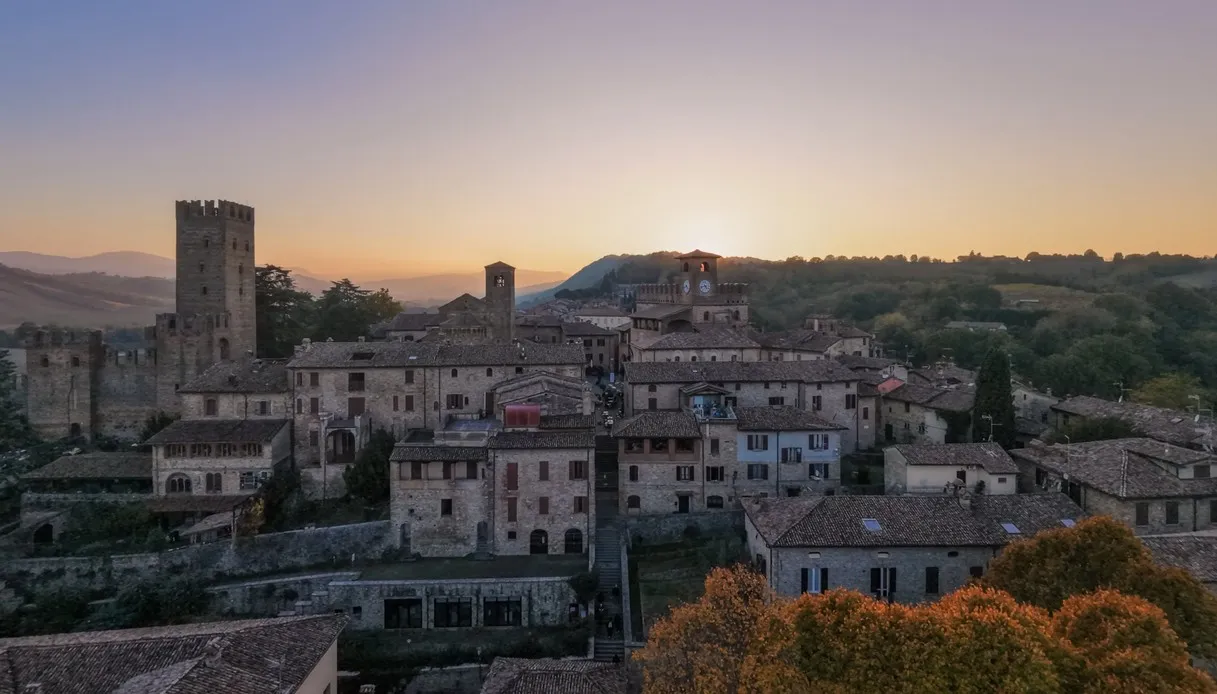
Some villages are visited for their castles, others for wine or fine dining. Then there is one, on the Piacenza hills, that besides all this guards an even older secret than its walls. Today from here you can see vineyards, calanchi (badlands) and, on clear days, the plain extending to the Po. A few million years ago, however, the view would have been decidedly more humid: where today rises a medieval village perched on a hill there was the sea and whales and dolphins even swam there. To tell this story is a museum which, after two years of closure, has just reopened its doors.
The Giuseppe Cortesi Geologic Museum
After years of silence, Sunday November 22, 2026 the Giuseppe Cortesi Geologic Museum of Castell’Arquato reopened to the public. It had been closed since autumn 2024 for a series of urgent works: securing a portion of the roof, improving energy efficiency, and upgrading the facilities. The intervention cost about 138 thousand euros, of which 100 thousand came from the Emilia-Romagna Region. Thanks to funds from the Ministry of Culture, and in collaboration with the Soprintendenza, the paleontological finds were also restored.
The route tells the story of life on Earth and, in particular, that of the Padano Gulf, the ancient arm of sea that until about a million years ago stretched from the Adriatic to the foothills of the Western Alps. The display cases house over a thousand fossil mollusks, along with corals, sea urchins, shark teeth and above all cetacean remains that resurfaced from the calanchi between Val d’Ongina and Val Chero. Among the most spectacular finds is the skeleton of a whale that lived about 2.2 million years ago. This territory is so important for geology that it gave its name to an entire period, the Piacenzian.
The museum bears the name of Giuseppe Cortesi, a scholar who lived between the eighteenth and nineteenth centuries and who was among the first to explore these deposits: in 1793 he discovered in Val Chiavenna the skull of a dolphin, later destroyed during World War II. Even the building is worth a visit. It is the ancient Hospital of Santo Spirito, created to welcome pilgrims traveling toward Rome along the Via Francigena. It houses the only street-facing portico remaining in the village, a room with a 16th-century wooden coffered ceiling, and a loggia from which the view extends all the way to the Po.
Where Castell’Arquato is located and how to reach it
Castell’Arquato sits on the first hills of the Val d’Arda, in the province of Piacenza, about 30 kilometers from the provincial capital and some 40 from Parma. It is part of the Borghi più belli d’Italia and carries the Orange Flag of the Touring Club. Its medieval center, gathered around the Visconti Fortress of 1342 and the Collegiate Church, deserves to be explored at a relaxed pace after visiting the museum.
By car you reach it via the A1 motorway, at the Fiorenzuola d’Arda exit, then follow signs for Castell’Arquato. By train, the most convenient stations are Fiorenzuola d’Arda and Piacenza, from which you continue by bus. The museum is located at 57 Via Sforza Caolzio. For hours and tickets after the reopening, it is advisable to contact the Castell’Arquato IAT tourist office.