
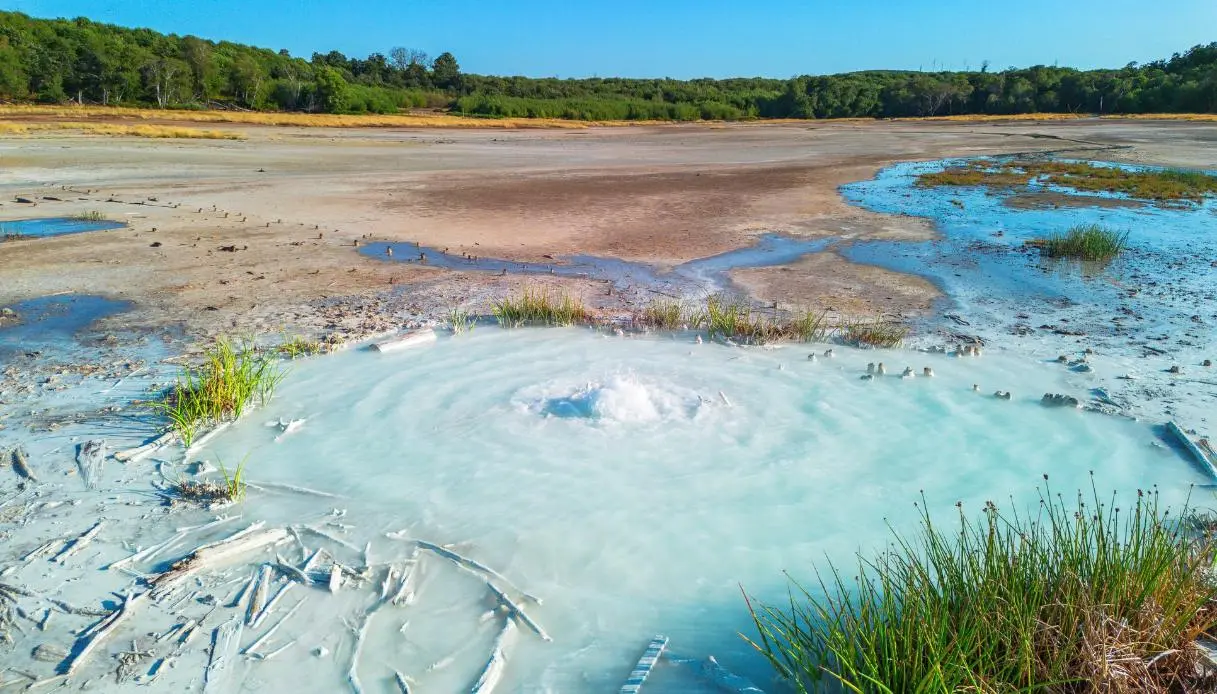
As you approach the Caldara di Manziana, a Natural Monument spanning about 90 hectares within the Bracciano-Martignano Regional Natural Park, you notice the ground growing damper, the air taking on a deep mineral scent, and, beyond the trees, a clear clearing marked by milky waters and small, moving pools.
It won’t surprise you to learn that the popular name is “callara,” meaning a large vessel for boiling water. And, after all, just look at the ground to sense the connection: bubbles, gas emissions, sulfurous muds, and mineralized streams transform the depression into a landscape that Lazio finds unexpected. Where the green of the oak forests would normally dominate, pale white patches emerge, gray soils, opaque puddles, and tufts of stubborn grass.
To make the scene even more singular, there is a small stand of white birch trees, trees tied mainly to the cold climates of northern Europe and the Alpine arc. So often, comparisons with Iceland abound. It should be noted, however, that in Manziana these plants appear beside a sulfurous Mediterranean setting.
Light-colored trunks, damp meadows, low vapors, and the scent of sulfur construct an almost uncanny scene. It is precisely this coexistence of elements so distant from one another that makes the Caldara one of the most peculiar biotopes in central Italy.
Origin, Formation, and Legends of the Caldara di Manziana
The Sabine volcanic district, in very ancient times, encompassed a broad stretch of northern Lazio and, over the centuries, left deep marks on the landscape: Lake Bracciano, volcanic rims, deposits of tuff, ancient craters, and areas marked by gas emissions.
In this context, the Manziana depression stands as one of the most evident testimonies of the late stage of that volcanism. The feature barely forms a circular shape, and in its central sector springs rise fed by mineralized waters and gases seeping from the subsoil. Among these are carbon dioxide and hydrogen sulfide, responsible for the unmistakable rotten-egg odor detectable from afar.
Clear clays and poorly permeable sediments trap the water and foster the formation of marshy pools. In just a few hectares, the landscape shifts from a humid prairie to stagnant pools, from oak groves to alders, down to ferns and birches. Among the botanical rarities is Agrostis canina subsp. monteluccii, a native Italian grass tied to moist environments. Small aquatic organisms also attract numerous birds, among which the grey heron stands out.
The birches deserve special attention: in the Manziana dialect they are called “albanelle,” and their presence at these latitudes long fueled the hypothesis of an ice-age relic, a population isolated after much colder climatic periods. Today the origin of the grove is viewed with more caution, and the Park Authority itself labels it doubtful.
The charm, however, remains intact because the white trunks set among Mediterranean vegetation form one of the Caldara’s most recognizable images. Then the legend enters: tradition links this land to the Etruscan underworld deity Manth, who became Mantus in Latin.
From that name, the designation Silva Mantiana would have arisen, referring to the vast forest that once occupied the western hills surrounding Lake Bracciano and from which Manziana would also derive. There is also another tradition that even Roman soldiers are said to have used these springs on their return from military campaigns.
The Visit Through Sulfurous Pools, Birches, and Forest Trails
Visiting the Caldara requires a slow pace. From the car park you enter the protected area and reach the volcanic depression via a straightforward route. The transition from forest to clearing already constitutes a portion of the experience, with trees thinning out and the ground changing texture, while areas saturated with water, pale clays, and small pools churned by gas rising come into view.
The pools represent the most spectacular aspect, especially when the bubbles reveal subterranean activity. Water that seems calm can suddenly ripple, never letting go of the sulfur odor that accompanies a large part of the visit.
A little further ahead you meet the birches with their white bark, slender branches, and light canopies that create a strong contrast with the darker green of the surrounding vegetation. On gray days this corner perhaps takes on its most intense character: the soft light highlights the pale trunks, the damp ground grows almost black, and the clearing seems to belong to a Northern European landscape.
Spring and autumn offer two different moods. Between April and May the gorse blooms turn some sectors bright yellow and the meadow gains vigor. With autumn come deeper tones, wet leaves, and a rugged atmosphere that enhances the site’s volcanic character. After periods of rain, of course, proper mud-friendly footwear is a practical must.
Those wishing to extend their hike can combine the Caldara with the Macchia Grande of Manziana. The Park marks the CAI 262B trail, a link between the large forest and the Natural Monument. It is a route that allows traversing one of the forest fragments tied to the ancient cover of vegetation that stretched between the Sabatini Mountains and the Tolfa ridges.
It is also worth paying attention to small details, including ferns, alders, aquatic insects, tracks left by birds, and the color variations of the ground: all are elements that explain much more than the central pool alone.
Location and How to Reach
The Caldara lies within the municipal territory of Manziana, in the Metropolitan City of Rome, on the southwestern edge of the Sabatine volcanic district. Bracciano Lake comes into view a little to the east, while to the west the hilly landscapes begin that lead to the Tolfa Mountains.
By car, the main reference point is the center of Manziana. From there you proceed toward Via Lazio and Via della Caldara, up to the parking area used also for activities organized by the Park Authority.
For a longer day you can pair the visit with the Macchia Grande, the village of Manziana, or the nearby Canale Monterano. Yet it is easy that, in the end, the most vivid memory remains that of the Caldara: water that softly boils, the pungent sulfur odor, the white trunks, and the exceptionally pale mud tell a Lazio quite different from the usual image.