
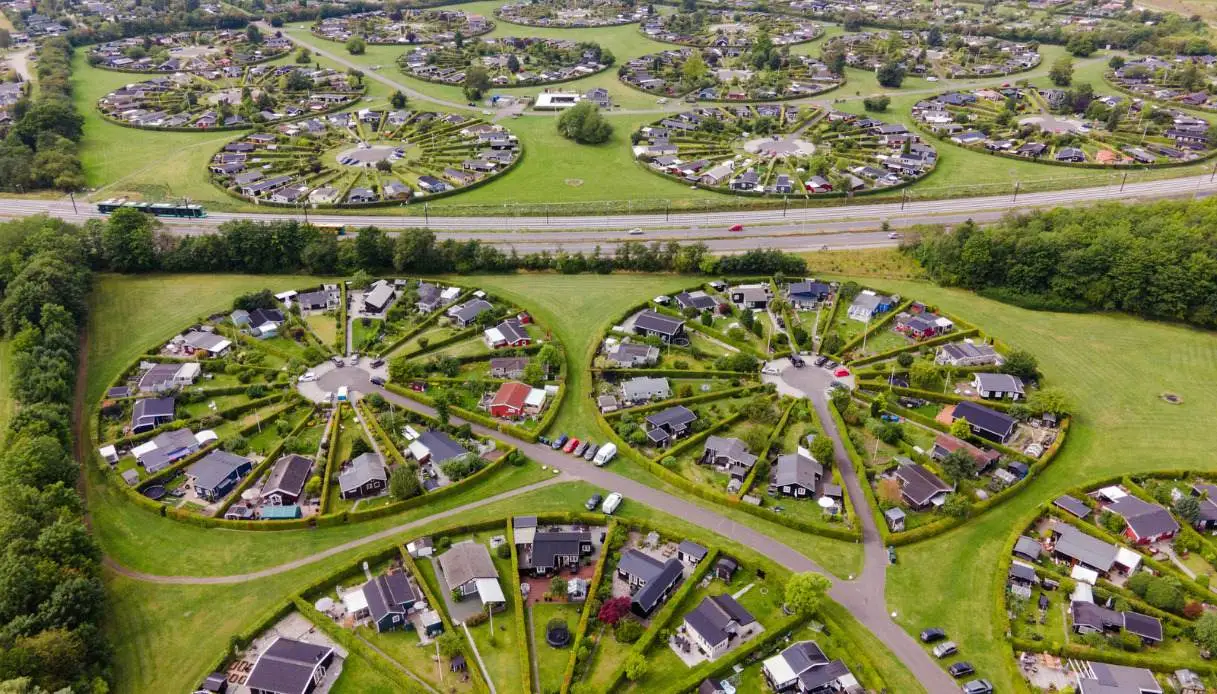
Some people are ready to define it as the set of a Scandinavian science-fiction film, while others see it as something like a Kandinsky abstract painting drawn directly on the fresh grass. In fact, it is none of that, because Brøndby Haveby is a singular garden-city on the outskirts of Copenhagen. Famous for aerial photographs that have brought its unusual architecture to worldwide fame, this community (of private gardens) represents one of the most curious experiments in Danish urban planning of the 20th century.
Its layout is indeed so precise that it seems it could have been created with a ruler and compass. Yet behind those perfect shapes lies something far more everyday: families tending their allotment, neighbors meeting at the gate, and small cottages surrounded by flowerbeds and hedges.
From an aerial view it stands out with 12 large circles, divided into plots that recall slices of cake. Small houses, allotments and ornamental plants occupy the spaces bounded by hedges, while the surrounding meadows create wide green gaps between one settlement and another. If you also consider the nearby garden colonies, the circles total around 20, distributed on both sides of Søndre Road. From the ground, the geometry gives way to a decidedly more intimate atmosphere: it is a place designed to bring people closer together through landscape architecture.
A Brief History of Brøndby Haveby
In the early decades of the 1900s, Copenhagen was growing rapidly and green spaces were becoming increasingly precious. Families living in urban neighborhoods sought small plots to cultivate during their leisure time, but away from the buildings and traffic of the capital.
Thus spread the tradition of the kolonihaver, the Danish family allotments, organized into associations. Then, during the 1960s, the need to identify new lands reached Brøndby, the western suburb of the Danish capital. For this reason the association Brøndbyernes Haveby Afd. 1 was founded, with the landscape project entrusted to the architect Erik Mygind.
He chose a decidedly original solution: instead of distributing plots along straight roads, he devised large circles divided into 24 radial sectors, resembling slices of cake. The gardens thus developed around a central space and precisely with the aim of promoting neighborly encounters.
With the residential expansion of Brøndbyøster, some gardens were eliminated and their users moved to the new sections of the garden-city. One of these even kept the name Rosen, belonging to the previous association.
A Visit to Brøndby Haveby and What to See
When visiting Brøndby Haveby, to fully appreciate it you need to understand its nature: it is a true community of allotments and seasonal residences. The plots thus belong to the private lives of their users, while streets and common spaces follow the rules of the individual associations.
The visit allows you to admire especially the organization of the circular settlements, which are undoubtedly the genuine distinctive feature of the complex. From the center of the roundabouts, paths branch off that separate the gardens, creating an unusual sequence of entrances and hedges. The plots can reach about 400 m² and house small buildings intended for leisure, fruit trees, vegetables and flowers.
Particularly interesting is the variety hidden behind the apparent uniformity. The historic design anticipated circles with 24 sectors, but the different sections present different configurations. Brøndbyernes Haveby Afd. 4, for instance, comprises 104 gardens, many of which are grouped into roundabouts of eight plots each.
The hedges constitute another fundamental architectural detail: hawthorn historically characterizes the design of the circles, while the associations’ regulations govern the heights and maintenance of the vegetative boundaries. The green barriers separate the allotments without erasing the collective identity of the complex, and from the streets you can spot small buildings of different shapes and colors (but all strictly integrated into an orderly landscape structure).
Also noteworthy are the large grassy areas that surround the houses. They are part of the Den Grønne Kile, the green corridor of nearly 285 hectares that runs through the municipal territory, including sports fields, equestrian paths, outdoor activity areas and other garden colonies.
A less-known aspect concerns the community’s traditions: in section 4, the beginning of the season is celebrated by hoisting the Danish flag, the Dannebrog, on the main pole. At the end of the summer period the flag is lowered, symbolically signaling the return of residents to their usual homes. But this is just one example.
Spring and summer are the most interesting periods to observe the gardens in full vitality, with crops and blooms. The autumn landscape presents a warmer palette, with hedges and trees changing color. It is nevertheless important to know that the residences remain subject to precise seasonal limitations and that municipal regulations prohibit staying there overnight from November 1 to March 31.
For a visit it is advisable to use exclusively the accessible streets and paths, respecting the on-site signs and the residents’ privacy. The private allotments, clearly, are excluded from tourist access.
Where It Is Located and How to Arrive
Brøndby Haveby is located in the municipality of Brøndby, in the Danish Capital Region, to the west of Copenhagen. The complex occupies part of the green belt near Brøndbyvester and is crossed, in its various sections, by the important thoroughfare Søndre Ringvej.
From central Copenhagen you can reach the area by public transport, such as the reliable S-train suburban railway from København H to Glostrup, served by Line B, then continuing with the light rail Hovedstadens Letbane toward Ishøj. The Brøndbyvester station, located at the intersection of Søndre Ringvej and Vallensbækvej, allows you to walk to the nearby green areas and the circular garden colonies.
By car, the destination is reachable by following the western road network of the Capital Region’s metropolitan area. For parking, refer to the authorized spaces and to the signage of the individual associations, avoiding occupying the internal lanes and the entrances to the allotments.
To plan the journey with buses, suburban trains and light rail, the official Danish portal Rejseplanen is available, useful for checking connections and updated timetables.