
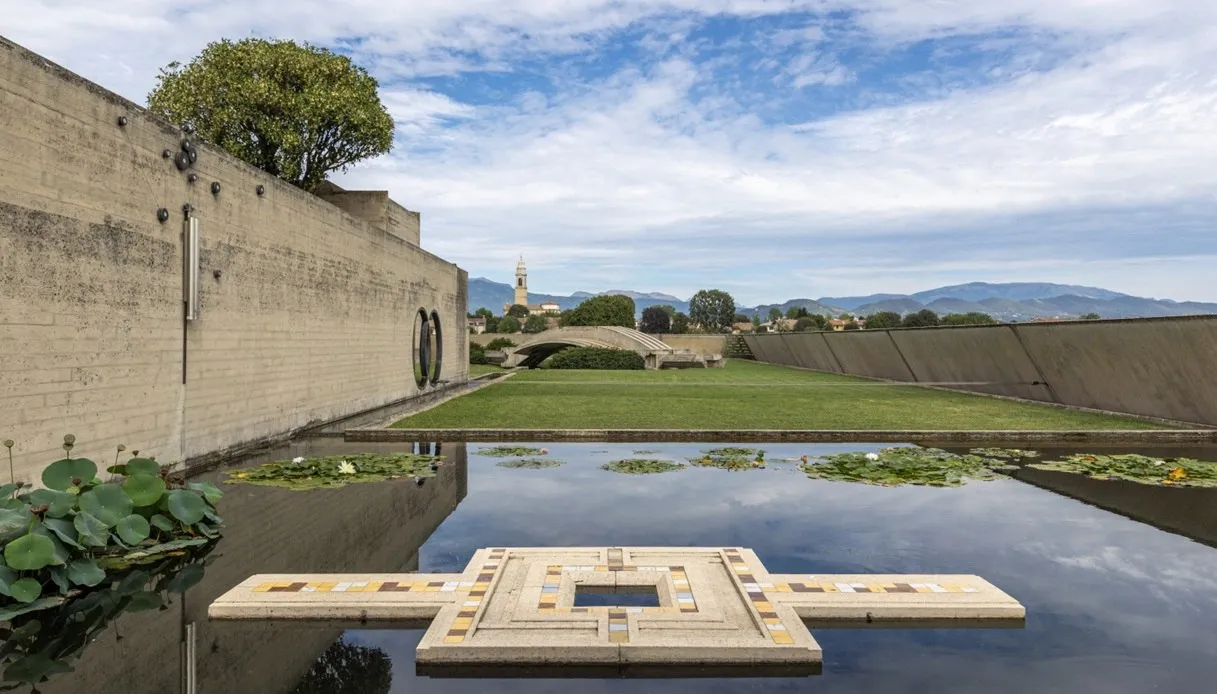
As you cross its threshold, for a moment you leave behind the noise of the world and immerse yourself in a place where every form, line, and detail holds a deep meaning, between memories and feelings. It is the Brion Memorial, set in the Veneto countryside, Scarpa’s last grand work by the renowned architect Carlo Scarpa.
Concrete, water, light, and vegetation are the elements that compose it, fused inseparably to give shape to emotions difficult to express in words. Here, indeed, architecture becomes a language through which to tell love, absence and the deepest bond between people.
The Story of the Brion Memorial, Scarpa’s Last Great Work
The story of the Brion Memorial began out of love: in 1969, Onorina Tomasin Brion entrusted the Venetian architect Carlo Scarpa with the project of a monumental tomb in memory of her husband Giuseppe Brion, an entrepreneur from San Vito di Altivole and founder of Brionvega, the Italian company famous for producing electronic devices and design objects.
Until 1978 Scarpa worked on it, the year in which he died in Japan, and from that moment the project was completed following his drawings and design instructions, becoming his last great work and one of the most representative of his architectural research.
The Memorial covers an area of about 2,200 square meters, in an L-shaped site that embraces two sides of the San Vito municipal cemetery. The structure is conceived as a kind of enclosed garden, separated from the surrounding countryside by a slanted wall, yet in constant dialogue with the landscape.
Inside are the burials of the Brion spouses, those of family members, and a chapel for funeral ceremonies. In a more secluded corner rests Carlo Scarpa himself, together with his wife Nini Lazzari, in a tomb designed by their son Tobia.
In 2022 the Memorial was donated to the FAI by Ennio and Donatella Brion, becoming part of the Foundation’s heritage and making it accessible to the public.
What to See at the Brion Memorial
Entering the Brion Memorial means immersing yourself in an intimate and quiet journey, where every detail invites you to pause, observe, and reflect, while the boundary between art, nature, and memory seems to slowly dissolve. One traverses a succession of spaces where nothing is left to chance: Scarpa worked on materials, geometries, light, and water, creating an ensemble of architectures that converse with each other and with the garden.
At the entrance, the first sight is already striking: two interlaced rings, called propylea, symbolically recalling the union between Giuseppe and Onorina Brion. The two circular shapes, one inside the other, tell of love, an infinite bond that continues beyond life.
The heart of the complex is then the arcosolio, an arched structure that protects the Brion spouses’ sarcophagi. The two tombs are positioned with a slight tilt toward one another, almost to come closer for one last time. Also striking is the arch, internally clad with glass tiles and sheets of gold: a dramatic contrast with the cement used for the rest of the structure.
Another particularly evocative space is the Meditation Pavilion, a small building placed at the center of a water mirror dotted with water lilies. Also inspired by Japanese architecture, it seems to float on the surface, offering a sheltered place to pause and reflect while observing the landscape.
Continuing the visit one can also admire the funerary chapel and the edicule dedicated to the family burials, while the garden, crossed by paths and water basins, completes the project. The surrounding greenery is a fundamental element of Carlo Scarpa’s work: it was conceived to guide the visitor through a suggestive experience of silence and contemplation.
The Ennio Brion Pavilion, the New Space
To accompany the public in discovering the Memorial, on November 28, 2026 the Ennio Brion Pavilion opened as a welcome center and cultural services hub designed by Michele De Lucchi and the AMDL CIRCLE studio. Born from the redevelopment of an existing villa, it sits at the start of the traditional cypress avenue that leads to the San Vito cemetery: this is where the journey into the history and beauty of this place begins in earnest.
Inside, an immersive video storytelling guides visitors through the Memorial and its protagonists through historical images, photographs, and projects, offering the first keys to understanding the architectures and symbols encountered along the way. The Pavilion also houses classrooms for schools, students, and cultural activities, as well as a refreshment point and a bookshop. Outside, a garden opens to the quiet of the surrounding countryside, between shaded pergolas and an agora intended for meetings and performances: a space designed to make the Memorial speak with the territory and its community.
Location and How to Reach It
The Brion Memorial is located in San Vito di Altivole, a small town in the province of Treviso, at the heart of the Veneto countryside and a short distance from Asolo. For those traveling by car, Altivole can be reached from Treviso and Castelfranco Veneto, following signs to San Vito. Those arriving by train can stop at the Castelfranco Veneto or Montebelluna stations, from which a taxi can be taken to continue the journey.