
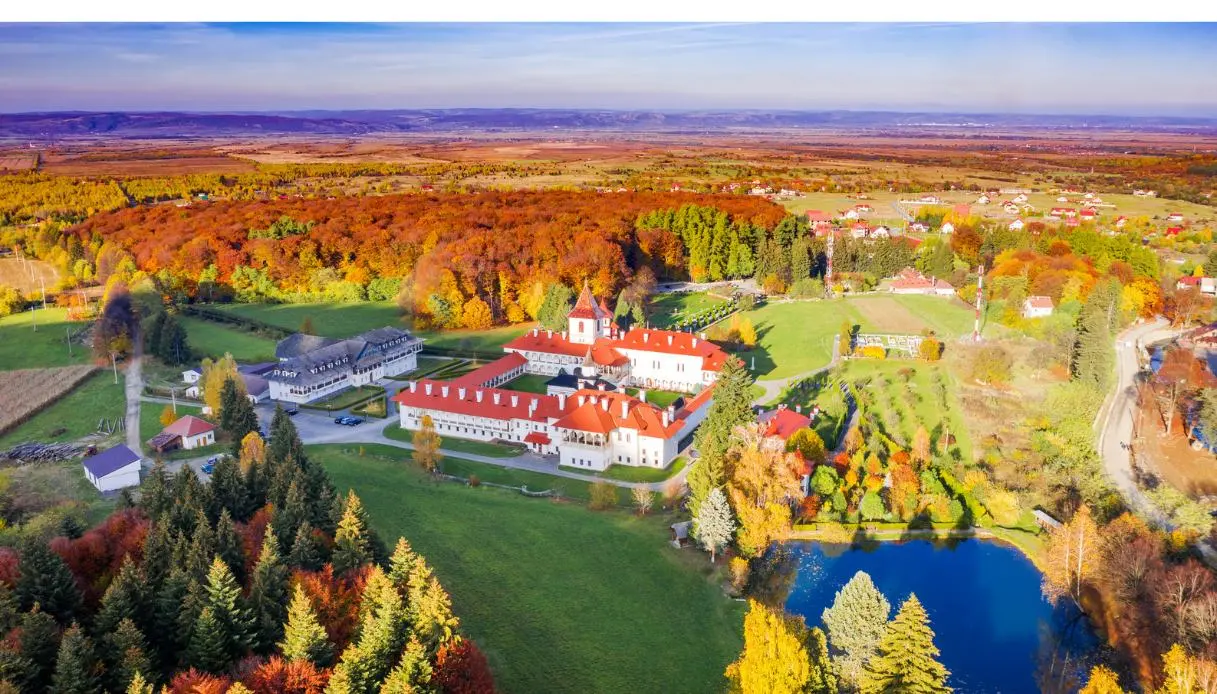
At the slopes of the Făgăraș Mountains, the highest mountain range in Romania, the green of the trees accompanies the road, and gradually the first buildings of a monastic complex appear, as if silencing any noise. This is the Brâncoveanu Monastery, also known as the Monastery of Sâmbăta de Sus, one of the most important places in Romanian Orthodox identity.
Beyond the monastic life, however, there was a school, a printing press and even a workshop for painting icons. The most remarkable fact is that it still preserves this vocation: only a few monks live inside the monastery, while the church remains the spiritual heart of the complex.
At the same time, the silence, the proximity of the mountain, and the almost meticulous care of the gardens create a distinctive atmosphere, easier to feel on site than to put into words.
A Brief History of the Brâncoveanu Monastery
The monastery’s story is marked by one of the harshest chapters in the region’s religious history. After the beheading of Constantin Brâncoveanu in 1714, following his refusal to convert to Islam, measures against monastic orders were issued.
In 1785 the Court of Vienna ordered General Preiss to destroy the complex. The monks’ quarters were demolished and the church left in ruins. For about 140 years the place remained abandoned, while its structures underwent a long phase of decay.
The revival arrived in the 20th century. Work began in 1926 and continued between 1929 and 1936. The intervention restored life to it, preserving the church’s architecture and interior paintings. In this phase the bell tower and other architectural elements were restored, while the distinctive stone colonnades were added.
A particular attention is given to the running water source: its origin goes back to the 16th century and the spring has been restored over time. Religious tradition attributes miraculous properties to it, and even today visitors can collect holy water from the dedicated containers.
The memory of Brâncoveanu remains tied to the figure of the founding prince, depicted in a fresco on the western wall of the pronaos. His image accompanies the visit along with the memory of a sovereign who supported the Orthodox Church, education, and the arts.
On August 15, the Feast of the Dormition of the Mother of God, the monastery celebrates its patronal feast. For the occasion pilgrims come from various parts of Romania, creating an atmosphere very different from the usual quiet of the complex.
The Visit to the Monastery Between Art, Faith and Nature
The visit begins at the church, recognizable for its architecture tied to the Brâncoveanu tradition. The term denotes the artistic style developed during Constantin Brâncoveanu’s era, characterized by a unique fusion of local elements, Byzantine influences, and Ottoman hints, enriched by highly elaborate ornamental decoration.
The carved columns and the bell tower catch the eye, while inside the murals draw the gaze. The decoration also includes apocalyptic scenes, particularly evocative due to the contrast between the frescoes’ rich colors and the sobriety of the sacred spaces.
The bell tower, for its part, has a curious architectural feature: externally the structure appears octagonal, while inside it takes a cylindrical form. It’s one of those details that can go unnoticed during a quick visit, yet helps illuminate the building’s complexity.
The Icon Museum
A key stop is the complex’s icon museum. The collection preserves icons painted on wood and glass dating mainly from the 18th and 19th centuries, together with ancient books and objects used in Orthodox liturgy.
The glass painting represents one of the most characteristic aspects of the local artistic tradition. The sacred, delicate and luminous images belong to a technique closely tied to Romanian culture and constitute one of the most interesting testimonies kept by the monastery.
The icon painting workshop has a long tradition. The artistic school active at Sâmbăta de Sus produced mural and glass paintings still appreciated today. The activity was revived in modern times, and the workshop is considered among the most important in the country.
The Gardens and the Spring
Outside the church, paths and green spaces thread through gardens rich with flowers, orchards and trees. Roses, marigolds and poet’s carnations add color to the surroundings and contribute to the sense of order that characterizes the entire area.
The 16th-century spring represents another significant stop. The water still flows today and is regarded as holy: for many visitors the most natural gesture is to fill a bottle and carry a small portion of this tradition with them.
The relationship with nature reaches its most distinctive expression in the spaces set aside for outdoor celebrations. The monastery is described as a kind of altar in the forest, with religious rites performed amid the vegetation.
Inside also houses the so-called “Academy from Sambata,” a center devoted to Christian spirituality, art, science and culture. Conferences, congresses and theological symposia thus broaden the monastery’s role beyond its strictly religious dimension.
Where It Is Located and How to Get There
The Brâncoveanu Monastery is located in Sâmbăta de Sus, Romania, at the foot of the Făgăraș Mountains, in the historic Transylvania region. The setting gives the complex a particularly dramatic natural backdrop, with the mountains rising behind it and a sea of green surrounding the buildings.
Sâmbăta de Sus is connected to the Brașov area and the rest of the region via the local road network. The visit can therefore become a stop on a broader itinerary in the Făgăraș Mountains area, especially for those looking to alternate villages, historical testimonies and mountain scenery.
Nearby there is also the Brâncoveanu Castle, linked to the same princely family. The paths of the two complexes followed different trajectories, but together they help reconstruct the Brâncoveanu dynasty’s presence in the region.
Yet the monastery remains the most intense place to experience at a leisurely pace: between the silhouette of the mountain, the carved stone, the church’s paintings, the icons on glass, the scent of flowers, and the spring’s water, history feels closer.