
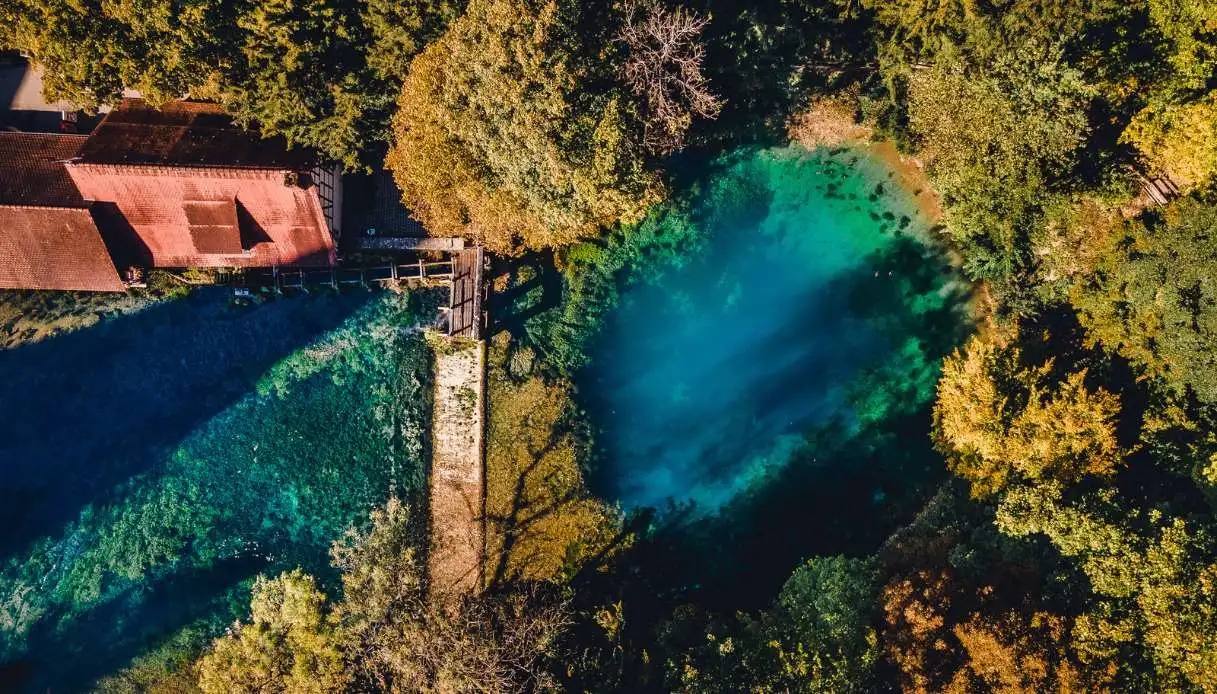
It seems almost as if someone deliberately chose to pour an entire jar of azure blue color into the heart of the forest, to the point that even the photographs look heavily retouched. Instead, it was the mastery of Mother Nature, because Blautopf is truly one of the most spectacular karst springs in Germany, to the extent that it holds a color so vivid that it becomes difficult to distinguish the depths of the water from the reflections of the sky.
This spectacle arises in the town of Blaubeuren and is set among the calcareous hills of the Swabian Jura. Just a short walk from a medieval monastery and an old mill, it rises at the foot of a wooded slope, forming a basin almost circular that resembles more a fantastical landscape. Its name, literally translatable as blue pot, recalls precisely the shape of this great natural vessel.
Behind so much beauty lies, however, an even more astonishing reality: Blautopf constitutes the entrance to a gigantic underground cave system. Speleologists and divers have explored over 18 km of cavities, discovering monumental halls and passages carved by water over extremely long geological times.
Origin, Formation and Legends of Blautopf
The Swabian Jura, known in German as Schwäbische Alb, is a limestone plateau shaped for millions of years by erosion. Rain and snow seep into the rock cracks, slowly dissolving the limestone and widening fissures that, over time, can transform into true caves.
The water gathered across an area of about 160 km² reaches a complex underground network and resurfaces right at Blautopf, through a funnel-shaped opening located at the bottom of the spring. Flow and appearance change markedly depending on rainfall: under normal conditions the average discharge exceeds 2,000 liters per second, while during floods it can reach values above 30,000 liters per second.
But, to be completely honest, it is color and depth that form the real spectacle of this fairy-tale corner. Sunlight, indeed, passes through the water and interacts with its optical properties and with tiny calcareous particles, contributing to the predominance of blue hues. The clarity, illumination and the amount of water influence the intensity of the coloration.
It should come as no surprise that for its scientific value, Blautopf is recognized among Germany’s national geosites and belongs to the UNESCO Global Geopark Swabian Jura. Beneath the tranquil surface of Blautopf unfolds, among other things, a world that remained inaccessible for centuries, namely a gigantic chamber nicknamed Mörikedom, in honor of the writer Eduard Mörike.
Let us speak of a natural cathedral, about 125 meters long and 30 meters high, which represents only one of the wonders of the underground system. Much of this universe remains reserved for scholars, as powerful currents, flooded tunnels, and extreme conditions make diving particularly dangerous.
Long before scientific discoveries, there was a tale that at the bottom of Blautopf inhabited a beautiful and deeply unhappy creature. Schöne Lau, that is, the Beautiful Lau, was a nymph with long tresses and delicate membranes between her fingers, daughter of a aquatic being and a human woman.
According to the story, the young woman was married to the Donaunix, a sovereign of the waters of the Black Sea. Plagued by a sorrow apparently incurable, she had borne only lifeless children. Her husband then decided to exile her to the depths of Blautopf, condemning her to remain there until she could learn to laugh heartily five times.
She lived in a submerged palace, surrounded by maidservants and fantastic creatures. The salvation came thanks to Betha Seysolffin, the innkeeper of the nearby Nonnenhof, who managed to involve her in the small daily affairs of humans. Between jokes, misunderstandings and funny situations, the nymph finally regained joy and broke the enchantment. Even today a sculpture near the spring commemorates this legendary figure.
What to See and Do at Blautopf
On sunny days, after relatively dry periods, the turquoise hue often reaches its maximum intensity. In autumn the contrast with the golden leaves offers a different scene, while the spring greenery frames the basin with particularly vivid reflections.
Next to the spring stands the historic Hammerschmiede, a forge powered by water, recognizable by its half-timbered structures and the characteristic wheel. A visit is also worthwhile to the Blaubeuren Monastery, founded in 1085 by the Benedictines and not far away.
The current complex largely preserves the imprint of late Gothic transformations carried out between the XV and XVI centuries. Particularly valuable are the wooden stalls of the choir and the high altar, consecrated in 1493, with sculptures and paintings linked to the Ulm school of art.
Blaubeuren also guards an extraordinary archaeological heritage: in the Urgeschichtliches Museum, dedicated to prehistory and Ice Age art, lies the famous Venus of Hohle Fels, one of the oldest known representations of the human figure. Prehistoric flutes and other artifacts testify to the presence of human communities in the region over 40,000 years ago.
For nature enthusiasts, some hiking trails cross the surrounding calcareous hills, among forests, rocky outcrops and views over the Blau valley. However, one important detail to consider when planning a visit: since 2024 the Blautopf area has been affected by a broad redevelopment project, with completion anticipated in December 2028.
The spring remains accessible through temporary accesses, while some sections of the path, the historic structures and the banks may be affected by construction. Temporary access is currently not fully accessible for people with reduced mobility.
Where It Is Located and How to Get There
The magnificent Blautopf spring is located in the town of Blaubeuren, in the Alb-Donau district, about 20 km west of Ulm and 80 km southeast of Stuttgart. The region belongs to the Swabian Jura, a land characterized by plateaus, woods, deep valleys and important prehistoric testimonies.
By car, Blaubeuren can be reached via the Federal Road B28, using the parking areas indicated in the town center. The spring is really a short distance from the monastery, on Blautopfstraße, and can be reached through the town’s streets.
For those who prefer public transport, regional train connections from Ulm allow reaching Blaubeuren station in about 15 minutes. From there, roughly a 20-minute walk crosses the historic center to the monastery area and the spring.
