
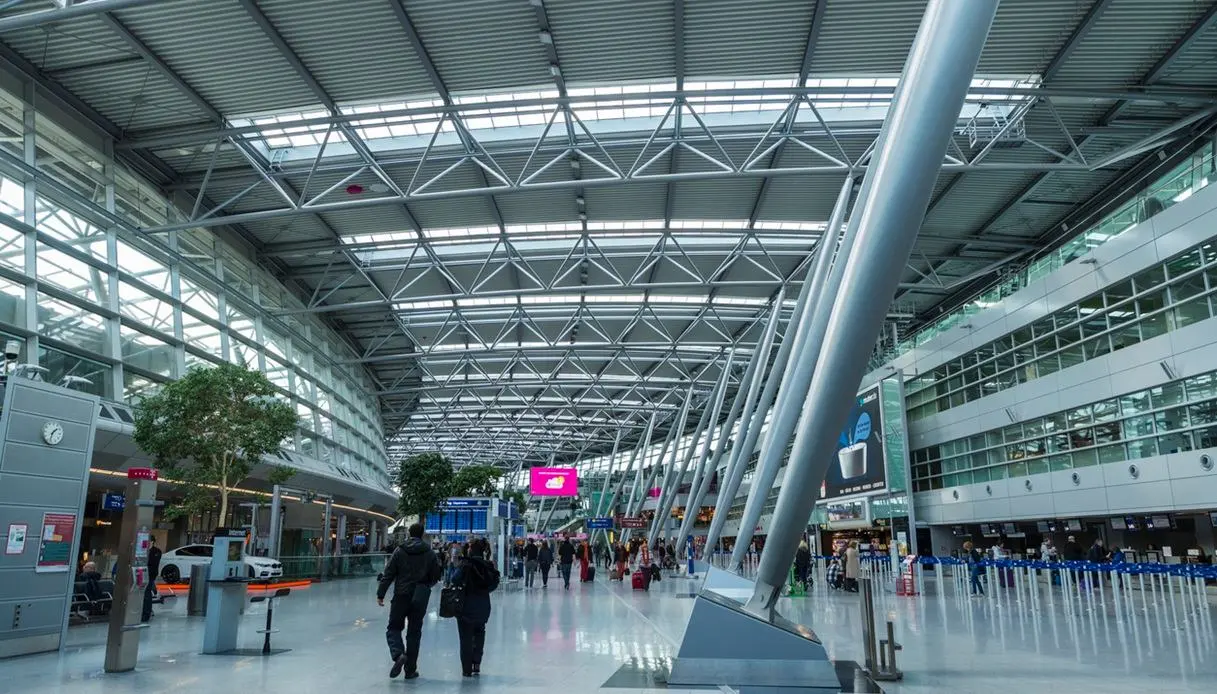
The best airports to travel to are not necessarily the largest in the world: what makes a difference, more and more often, are the connections, the speed of security checks, the infrastructure, and the ease of movement.
But what is the best airport of the year? Revealed by the World Consumer Airport Index 2026, prepared by the Consumer Choice Center, which analyzes 60 international airports divided into two categories based on passenger numbers. For Italy there is a particularly interesting surprise: two airports enter the ranking of the world’s best airports.
The best airport in the world
The rankings that emerge from the World Consumer Airport Index 2026 are two: one referring to smaller airports, with less than 47.2 million passengers, and another dedicated to airports above such threshold.
To win overall in the first category is Düsseldorf Airport, which stands out for its network of 67 airlines and 171 destinations served, as well as security screening wait times that are almost nil.
Among the large hubs, the first place goes to Barcelona-El Prat, which can count on a wide choice of airlines and destinations and on an average security checkpoint wait of just three minutes.
According to the research, it is precisely connectivity, efficiency and infrastructure that separate the best airports from the weaker ones. But not only that: the ability to reach the airport easily by public transport and to move quickly between terminals and gates also weighs heavily on the passenger experience.
Two Italian airports honored
Within the two classifications, Italy earns two notable positions. Rome Fiumicino is second among the 25 large airports analyzed, behind only Barcelona-El Prat and ahead of Los Angeles, Paris Charles de Gaulle and London Heathrow.
Milano Malpensa is instead fifth among the 35 smaller airports in the ranking and markedly improves its position compared to 2025: it rises by as many as 11 places.
The complete top 10 of the best airports
Below we present the top 10 of both categories, namely the major hubs and the smaller airports.
Best large airports above 47.2 million passengers per year:
- Barcelona–El Prat Airport (Spain);
- Rome Fiumicino Airport (Italy);
- Los Angeles International Airport (United States);
- Bangkok-Suvarnabhumi Airport (Thailand);
- Paris-Charles de Gaulle Airport (France);
- King Abdulaziz International Airport (Saudi Arabia);
- London Heathrow Airport (United Kingdom);
- Madrid-Barajas Airport (Spain);
- Tokyo-Haneda Airport (Japan);
- Dubai International Airport (United Arab Emirates).
Best smaller airports, under 47.2 million passengers per year:
- Düsseldorf Airport (Germany);
- Zurich Airport (Switzerland);
- Copenhagen Airport (Denmark);
- Helsinki Airport (Finland);
- Milan Malpensa Airport (Italy);
- Oslo Gardermoen Airport (Norway);
- Munich Airport (Germany);
- Vancouver International Airport (Canada);
- Brussels Airport (Belgium);
- Berlin Brandenburg Airport (Germany);
The worst airports in the ranking
Looking at the lower end of the ranking, the airports with the lowest scores and notable issues appear. Among the large airports, the bottom three are Antalya (Turkey), Guangzhou Baiyun (China) and Frankfurt (Germany); among the smaller ones we find Seoul Gimpo (South Korea), Punta Cana (Dominican Republic) and London Stansted (United Kingdom).
Among the most significant problems are long distances from city centers, inefficient rail connections, long security checks and delays. Frankfurt, for example, suffers according to the index from certain infrastructural and operational issues, while night-flight restrictions penalize Heathrow.