
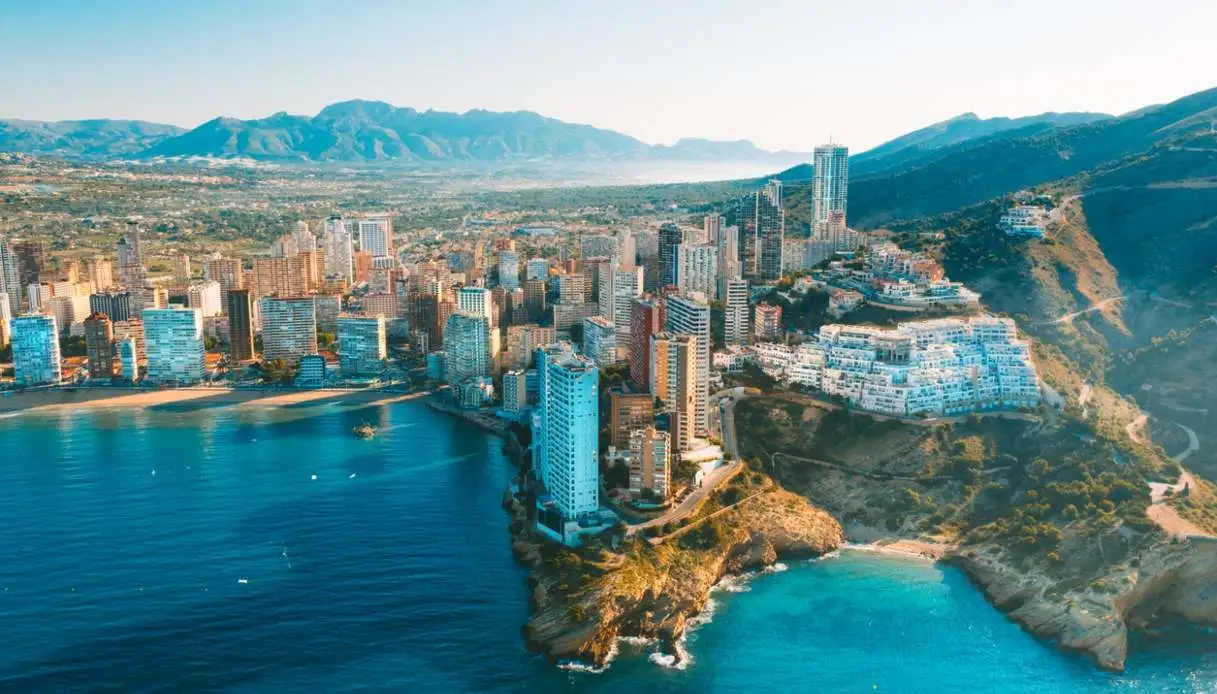
Benidorm is known worldwide for its beaches, mild climate, and the skyline of high-rise buildings facing the Mediterranean. But the renowned resort on Spain’s eastern coast is also earning a prominent place in sustainability. The European Commission has awarded it the title European Green Leaf 2028, a recognition that rewards cities capable of standing out for their environmental policies and their commitment to sustainable urban development.
The prize will be shared with Estarreja, in Portugal, while Zaragoza will be the European Green Capital 2028.
Benidorm, from Mass Tourism to a Sustainable Urban Model
From a small fishing village to one of the most frequented seaside destinations in the Mediterranean, Benidorm has undergone a profound transformation. Today it counts around 75,000 residents, a population that during the summer can swell to about 400,000 people. This growth tests the city’s infrastructures and resources, especially with regard to water supply, waste management, and ecosystem protection.
The city’s response is a compact urban model, concentrating buildings and services in a relatively limited space, reducing land consumption and the pressure on surrounding natural areas. The European jury has recognized precisely the ability to manage high tourism flows without sacrificing environmental protection.
Results are measurable:
- 61% of the municipal territory is under protection;
- 92% of residents live within 300 meters of a public green area of more than 5,000 square meters;
- about 75% of urban movements occur on foot;
- the city has 13.2 kilometers of pedestrian streets.
Special attention is also given to water, a precious resource in a Mediterranean destination characterized by hot summers and a strong tourist presence. Thanks to network renewal, monitoring, and management technologies, the efficiency of the water system reaches 95-96%.
In 2025, moreover, 36% of treated wastewater was reused. A significant figure considering that, over the last twenty years, despite a population growth of 12.7% and a 40.96% increase in tourists, the overall volume of water supplied has decreased by 6.14%.
Biodiversity, Innovation, and New Challenges
Benidorm’s sustainability extends beyond urban spaces to the richness of the natural environments that surround the town. The area includes five Natura 2000 sites and protects 173 hectares of Posidonia oceanica. The protection of these habitats is complemented by initiatives to reduce plastic waste on beaches, promote energy efficiency, and foster more environmentally respectful tourism practices.
A major role is also played by technological innovation. Benidorm uses open data, a digital twin, and real-time monitoring systems to analyze urban phenomena, control consumption, and guide administrative decisions. Tools that enable planning interventions based on concrete data and to verify the progress achieved. In 2025, greenhouse gas emissions had already decreased by about 18% compared with 2007.
The green transition also involves residents, accommodation facilities, and local businesses, invited to participate in the transformation of the destination. Tourism in this Spain destination, rather than being seen merely as a source of environmental pressure, becomes an opportunity to test more efficient and circular solutions.
The new European title reinforces an international path already recognized in 2025 with the European Green Pioneer of Smart Tourism award. In 2028, Benidorm will be asked to share its experiences and promote good environmental practices in urban settings, offering other coastal destinations a model to draw inspiration from.