
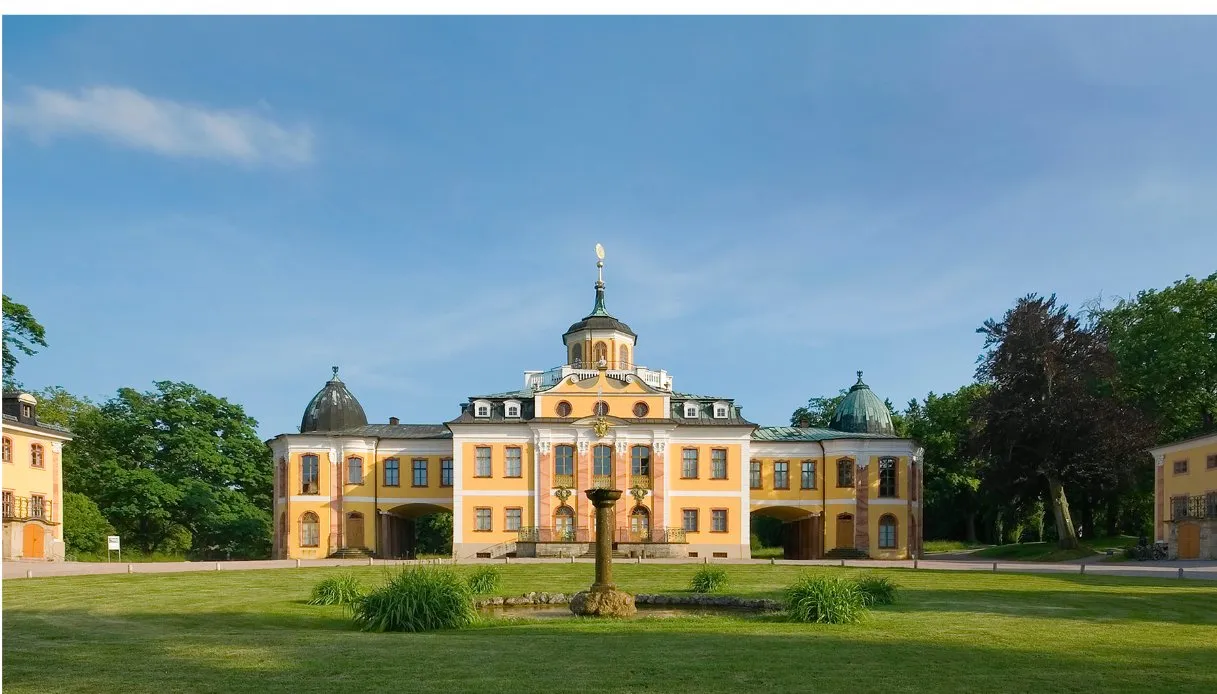
As one approaches Belvedere Castle, a special feeling emerges, as if the city of Weimar slips away behind you. Trees, vistas, meadows, and architecture spread along a vast park capture the gaze, while on the southern hill the residence rises, bearing its elegant Baroque façade, its side wings, and the grand entrance staircase.
The Belvedere complex sprang from princely ambitions, and its very position enhanced the property’s prestige. The castle sits on a wooded hill, surrounded by about 43 hectares of park, to the south of the historic center. The distance from urban life allowed the ducal family to spend the warmer season in a more secluded setting, enjoying hunting, receptions, botanical collections, and strolls through the gardens.
Belvedere has belonged since 1998 to the UNESCO World Heritage site of Classical Weimar, together with 11 other buildings and complexes connected to the city’s extraordinary cultural flourishing in the late 18th and early 19th centuries.
A Brief History of Belvedere Castle
Ernst August aimed to make Belvedere the most prestigious of his numerous hunting and pleasure castles. The project was entrusted to the architect Gottfried Heinrich Krohne, who designed several ducal residences in the region. The initial purpose was closely tied to hunting, a central activity in the culture of European courts of the era. The complex even included a menagerie, a collection of animals meant to emphasize the owner’s rank.
After the duke’s death in 1748, there was a period of decline. The revival came in the second half of the 18th century thanks to the duchess Anna Amalia, a pivotal figure in Weimar’s cultural history. Her summer presence helped bring life back to the residence and its gardens.
A few years later, Belvedere also adopted a scientific vocation. The duke Carl August developed a strong interest in botany and studied plants alongside Johann Wolfgang Goethe. The botanical collections grew substantially, and by around 1820 the botanical garden housed about 7,900 species from Germany and other countries.
One of the most fascinating stories concerns the Russo Garden. Carl Friedrich, son of Carl August, had this space created for his wife, , the Russian grand duchess. The project almost faithfully reproduced the garden the princess had known in Saint Petersburg, creating a small fragment of Russian garden culture within the Weimar landscape.
During the 19th century the transformation reached its decisive point. Between 1815 and 1830 the park took on a post-classical, romantic character. Fountains, sculptures, pergolas, the so-called Grande Grotta, and other ornamental structures entered the composition. Even Hermann Fürst von Pückler-Muskau, renowned garden designer and author of Muskau Park, admired the result in 1845.
The grand ducal family continued to oversee the property until the end of the monarchy. After the abdication of the last grand duke Wilhelm Ernst, Belvedere passed to the new Free State of Thuringia. Since 1923 the castle has been part of Weimar’s state art collections and has been designated as a museum of eighteenth-century decorative arts.
Visit, What to Do and What to See
The visit takes time, especially to understand the relationship between the building and the landscape. Entering the museum directly means missing a significant portion of the experience. It is worthwhile first to observe the complex from the outside, allowing the park’s perspectives to narrate the story of the residence.
The palace retains the elegance typical of a Baroque pleasure residence. The layout includes the main body and several buildings connected to court life. The knights’ quarters, the stables, and the orangery completed a small aristocratic fortress designed for the ducal family’s seasonal stay and for their guests.
Inside lies the museum dedicated to eighteenth-century decorative arts. The rooms house objects from the ducal courts, with particular attention to porcelains and glass. The collection enables a close look at the aristocracy’s taste between Baroque and Rococo, through German and French furniture, court accessories, and precious artifacts.
On the ground floor appear Oriental porcelains, Thuringian ceramics, and portraits of the owning family. As you go up, attention shifts to early Meissen porcelain, one of the most important manufactories in Europe’s history of this material, alongside productions from Berlin, Fürstenberg, and the Imperial manufactory of Saint Petersburg.
Beyond the castle, the larger part of the experience unfolds in the expansive park, which preserves traces of the different eras Belvedere has traversed. The first garden followed strict French principles, with straight avenues, geometric flowerbeds, and trimmed hedges that created orderly perspectives.
Anna Amalia, however, preferred a more natural approach, and Carl Friedrich advanced this transformation, giving the park a more free-spirited, landscape-style character. Among the most curious elements is the Rosenberceau, a structure devoted to roses, while the Grande Grotta, an artificial ruin, introduces the picturesque component beloved by Romantic culture.
The Russo Garden deserves a special detour and gives the park a distinctive silhouette, tied to the grand duchess’s personal history and the dynastic ties between the House of Saxony-Weimar and the Russian imperial family. Inside you’ll find a small hedge theatre and an ornamental labyrinth. Geometry returns in a zone of the park already dominated by the landscaped taste.
Even the orangery deserves attention. The large greenhouses served a practical and representative function, enabling the court to safeguard exotic plants during the cold season and to display the richness of its botanical collections.
Location and How to Reach
Belvedere lies south of Weimar, in Thuringia, in an elevated position that makes its scenic role evident even from the outside. From central Weimar, the ensemble can be reached along the Belvederer Allee, a historic tree-lined axis that leads toward the castle. The distance allows you to combine the visit with a day spent exploring the city and other Classical Weimar heritage sites.
For those arriving by car, the route leads toward the southern part of the city and then to the Belvedere complex. Those using public transport can depart from Weimar’s center and check the available urban lines serving the castle area before departure.
The most interesting option, however, remains to dedicate a substantial portion of the day to the park. Belvedere thus tells a story that the building alone can only partly convey. The castle speaks of the court, the collections recount aristocratic taste, the orangery recalls botanical passion, and the Russo Garden stretches as far as Saint Petersburg. Even the labyrinth preserves the idea of a place designed for pleasure and wonder.