
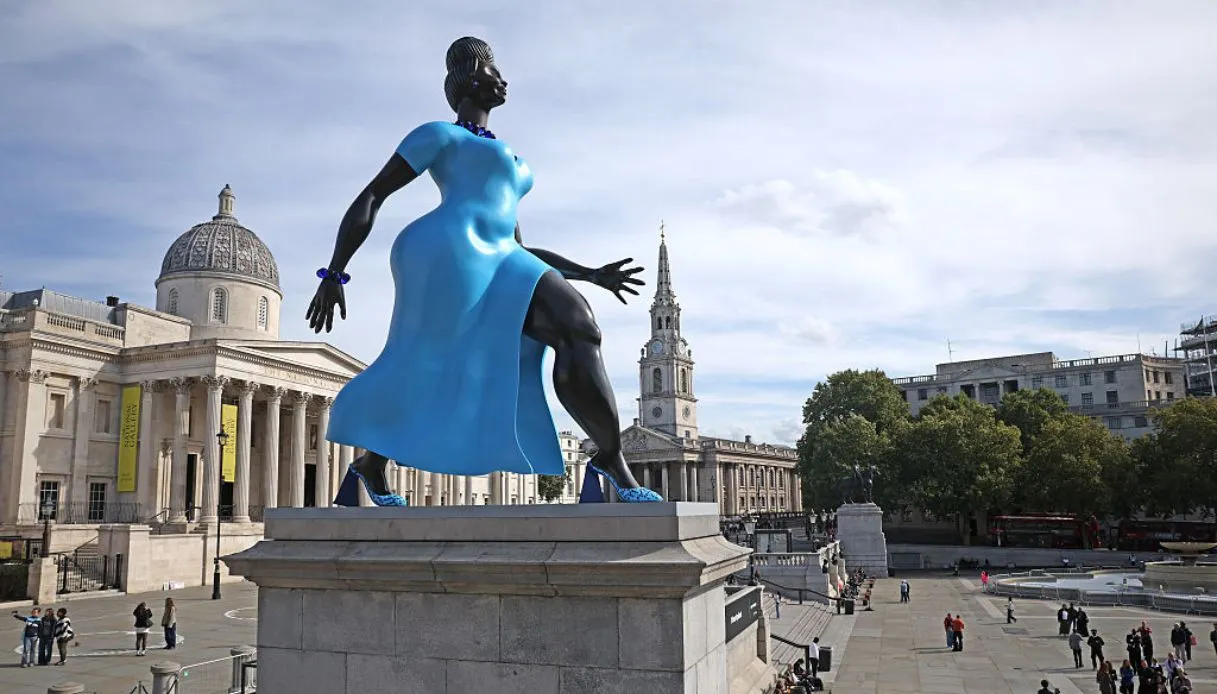
In London there’s a new figure that catches the eye of passersby in Trafalgar Square: it’s called Lady in Blue, a sculpture by the New York artist Tschabalala Self chosen for the Fourth Plinth, one of the square’s most recognizable spaces. Cast in bronze and distinguished by a vivid blue dress, the work brings to the heart of one of the British capital’s emblematic sites the image of a young contemporary woman as anonymous and metropolitan.
The sculpture will remain on the Fourth Plinth for the next two years, taking the place of Mil Veces un Instante (A Thousand Times in an Instant) by Teresa Margolles. It is the sixteenth artwork installed on the plinth since 1998, within a public art commission that over time has transformed this space into a place devoted to reflection on contemporaneity.
Lady in Blue presents itself as a female figure wearing a blue dress, blue heels, and jewelry made from glass beads. The bronze of the statue has been patinated using a refined pigment of lapis lazuli, the semi-precious stone used by artists for millennia.
The choice of Self introduces into the square a presence very different from those traditionally associated with Trafalgar Square: the statue confronts some of the main historical references, including the Nelson’s Column and the Landseer Lions, linked to figures and events of the past.
The artist’s intention was precisely to interrupt, at least in spirit, the tradition: Self imagined a recognizable figure in everyday life, a kind of “everywoman” contemporary, placed in a place usually associated with monarchs, military leaders and figures destined for collective memory.
Lady in Blue is not conceived as a monument in the traditional sense but is a woman who travels through the city and looks toward what is yet to come: Self explained that she wanted to direct attention to the future collective and described the sculpture’s protagonist as a woman in whom many people can recognize themselves, a Londoner walking toward the future with ambition and determination and who, by her presence, represents the spirit of the city.
The sixteenth work of the Fourth Plinth
Lady in Blue was selected in March 2024, when Tschabalala Self was named the winning artist together with Andra Ursuta, whose work will rise on the Fourth Plinth in 2028.
The selection was entrusted to the Fourth Plinth Commissioning Group, an independent panel chaired by the writer and curator Ekow Eshun, who stressed the sculpture’s ability to transform an everyday subject into a monumental presence and noted how Self has taken the familiar figure of a woman moving through the city to confer upon it an extraordinary dimension in the heart of London.
Even Justine Simons, deputy mayor for culture and creative industries, defined Lady in Blue as a surprising addition to a historic part of the city. The sculpture, indeed, does not merely occupy an empty space but enters into dialogue with the monumental identity of Trafalgar Square and introduces a figure belonging to the present.