
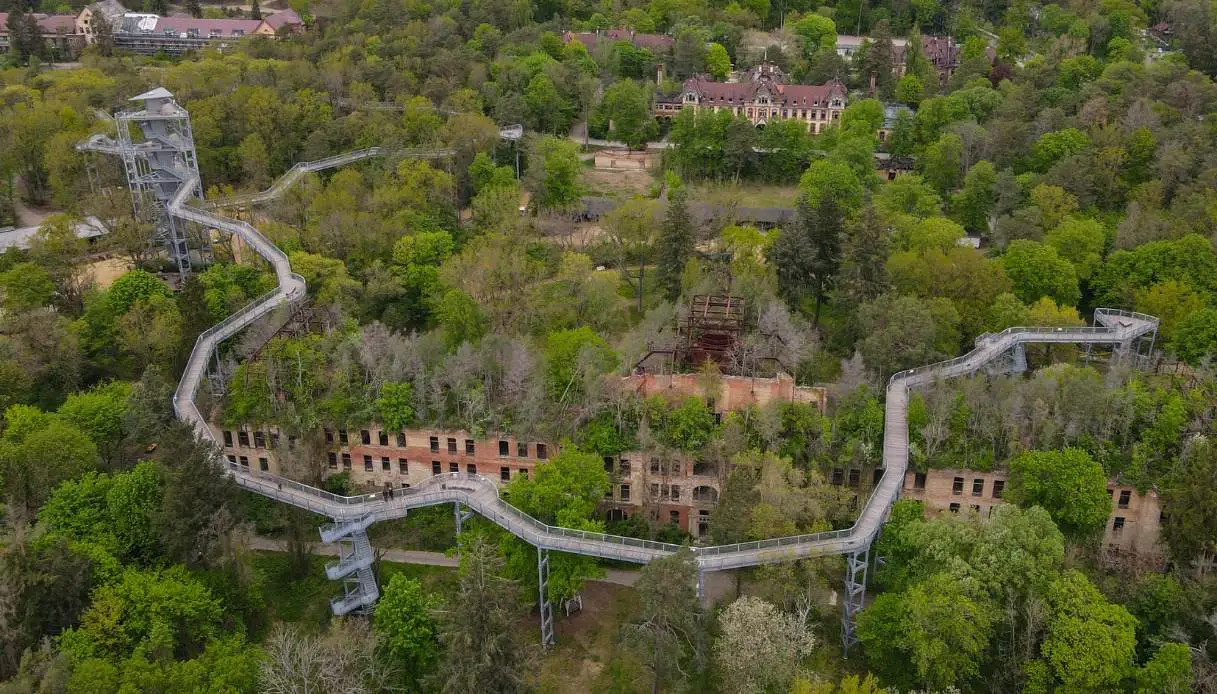
One of the first impressions is that you have arrived in a place that feels absurd, even, to some, truly alien: roofs pierced by roots, empty windows behind which you can glimpse peeling walls and long corridors that for decades safeguarded the stories of thousands of patients. In Brandenburg, about 50 kilometers from Berlin, an ancient hospital complex now abandoned has drawn numerous visitors for years.
But how is that possible? The clue comes by looking up at one of the buildings: on the roof of an old sanatorium grows a real forest, born spontaneously among the ruins dating from the Second World War, where, among other things, you can walk over it. This is Beelitz-Heilstätten, one of the largest historic medical facilities in Germany, originally intended to treat workers afflicted with tuberculosis.
Buildings reminiscent of aristocratic residences emerge from a park crossed by ancient avenues, while towers, brick façades, and large windows bear witness to the ambition of the project. Next to the restored structures survive pavilions weathered by time, some wrapped by vegetation up to the upper floors. For years considered one of Europe’s most fascinating lost places, today a portion of it has become accessible again through organized routes and a spectacular panoramic walkway among the treetops.
A Brief History and Legends of Beelitz-Heilstätten
It was 1898 when the Berlin Institute for Provident Insurance purchased roughly 140 hectares of woodland near Beelitz. At the time, the German capital was in the throes of industrial expansion, but tuberculosis represented one of the major health emergencies. Before antibiotics, treatments mainly relied on rest, nourishment, and exposure to open air.
For this reason a location surrounded by woods, sufficiently distant from pollution but easily reachable by rail, was chosen. The opening of the first facilities began in 1902 and then, in the following decades, about 60 buildings were erected, turning the complex into a self-sufficient hospital town.
Alongside the medical wards appeared laundries, kitchens, workshops, a power station, a small shopping area with a bakery, a tailor’s shop, other stores, and even gardens: the designers laid out geometric boulevards, ornamental flowerbeds, shaded paths, and pavilions opened for outdoor care.
During World War I, Beelitz-Heilstätten became a military hospital, to the point that one of the soldiers admitted in 1916 was Adolf Hitler, then a private in the German army, who came for treatment after being wounded. The Second World War brought new admissions and serious damage to the buildings. In 1945 the Red Army occupied the complex, later transforming it into the largest Soviet military hospital outside the Soviet Union.
The area then remained a military zone until 1994, the year of the Russian troop withdrawal that also marked the start of a long era of abandonment. Thefts, vandalism and water infiltration compromised many buildings, while vegetation claimed rooms, façades and roofs.
It was precisely in those years that the most unsettling stories were born: tales of mysterious presences, unexplained noises, and apparitions fed the fame of the haunted sanatorium. Among the local legends is Schleicher von Beelitz, a mysterious figure associated with accounts of the eerie experiences endured in the former hospital. Guided tours address these narratives, explaining the real origins of phenomena once interpreted through a paranormal lens.
Visit to Beelitz-Heilstätten, what to see among ruins and ancient trees
Since 2015 the former women’s sanatorium hosts Baum & Zeit, a scenic route built to observe from above the historic architecture and the forest landscape. Yes, you read that correctly: there are metal walkways weaving through the treetops to reach the famous Alpenhaus, one of the most evocative buildings in the complex.
Partially destroyed during World War II, a forest of trees began to grow on its damaged roof, gradually forming a small treetop forest. From above you can spot trunks, branches and shrubs sprouting directly from the ruins. The building’s walls break through the vegetation, while windows without glass reveal interiors now reclaimed by nature.
The elevated walkway stretches for hundreds of meters, reaching heights above 20 meters. There is even a panoramic tower from which to observe the entire park and, on clear days, to gaze toward Berlin. At the foot of the walkways you can find other elements of the old garden, including the Beelitzer Alpen and Schlucht landscapes, together with stretches of the original network of avenues.
To explore the interiors of some buildings, there are guided tours dedicated to history, architecture, and daily life of the patients. Access to the historic structures is regulated and varies according to the available itineraries. Many pavilions belong to private owners or host health and residential activities. The abandoned buildings, in particular, may pose hazards.
This curious corner of Germany has also served as a setting for some film productions, such as Roman Polanski’s The Pianist and Valkyrie with Tom Cruise. Today, Beelitz-Heilstätten is undergoing a transformation: some buildings have been restored, others host apartments, studios, and creative activities. Surrounding the ancient complex is growing a residential district with services, schools, and commercial spaces.
To arrange a visit, one must purchase a ticket for Baum & Zeit park. Guided tours generally require an additional fee, with prices varying according to the chosen experience. Hours and reservations can be found on the official Baum & Zeit website.
Where it is and how to get there
Beelitz-Heilstätten is located in Brandenburg, about 50 kilometers from downtown Berlin, in the Potsdam-Mittelmark district. The area belongs to the municipality of Beelitz, a town not far from Potsdam and the natural landscape of the Fläming.
From the German capital you can reach the complex by train using direct regional connections to Beelitz-Heilstätten station, a journey that takes around 1 hour (depending on the starting station and the chosen rail service). From the station, the entrance to the Baum & Zeit park is just a short walk away, following signs to the Baumkronenpfad.
Those who prefer driving can take the A9 motorway and use exit 2, Beelitz-Heilstätten, continuing toward the P1 parking area indicated for the park. For cycling enthusiasts, the area is crossed by the Europaradweg R1, part of the network of bike routes across Brandenburg.