
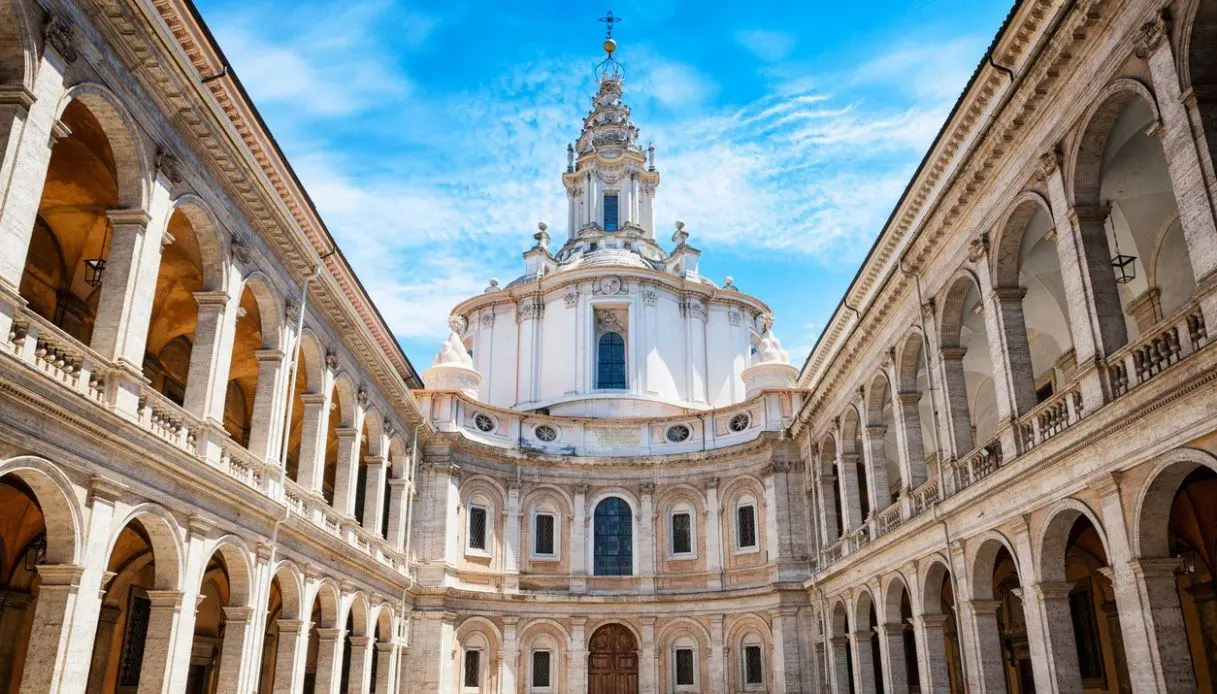
The Church of Sant’Ivo alla Sapienza, a masterpiece by Francesco Borromini, remains almost hidden to those walking by, tucked inside the courtyard of the ancient university complex that today houses the State Archives of Rome. Now, after years of closure and following a long restoration process, it finally reopens to the public.
In this church Borromini, who in 1632 was appointed architect of the Sapienza after receiving the commission from Pope Urban VIII Barberini, “revolutionized the architectural language of his time, turning geometry into a form of beauty and light into an essential component of space: a place where mathematical rigor meets the freedom of imagination,” as Alessandro Giuli, the minister of culture, stated.
The “virtuoso” restoration of the church
The special superintendent of Rome, Daniela Porro, described it as a “virtuoso” restoration. The intervention indeed brought to light the diverse tones of white in the interior spaces, from warmer to cooler, exactly as Borromini had conceived them. It isn’t merely an aesthetic detail: it is precisely the dialogue among these shades that creates the contrasts that highlight the shadows and depths of the stuccoes, giving rhythm and movement to one of the artist’s most emblematic architectures.
The result is a space that appears at once grand and intimate, where concave and convex surfaces chase one another up to the dome. A visit inside the church, however, is more than a simple tour of the artworks; it is an invitation to decipher an unresolved enigma in one of the most astonishing masterpieces of Italian Baroque.
The mystery of the star-shaped plan and the symbols of the popes
Almost four centuries after its construction, Sant’Ivo still guards many secrets. The first is its plan: a stellated hexagon born from the crossing of two opposing triangles, with the three apses at the points of the inverted triangle and the convex corners on those of the base triangle. A solution that turns the hexagon into a fluid and continuous space.
The origin of this shape has not yet found consensus among scholars. Some believe the plan stylizes the Barberini bee, the emblem of Urban VIII Barberini, while others tie it to the symbolic language of the Sapienza. Still others relate it to a triangle with added apses and shaved corners, in the model of other architectures such as the funerary hexagon on the Via Appia.
The fascination deepens when looking at the symbols that decorate the church, each with a double reading, religious and celebratory, linked to the three popes who followed its construction. The bees and the suns evoke divine wisdom, but also the Barberini heraldry; the doves with the olive branch refer to the Pamphili family of Innocent X; the mountains, visible in the vault’s stuccoes and on the façade, are the emblem of the Chigi family of Alexander VII. The six-pointed stars evoke King Solomon, a figure of wisdom, while the two equilateral triangles represent the Trinity.
If you’re curious and want to admire the beauty of this incredible church in person, from today, October 27, 2026, you can do so for free from Monday to Friday, from 9:30 to 13:30.
