
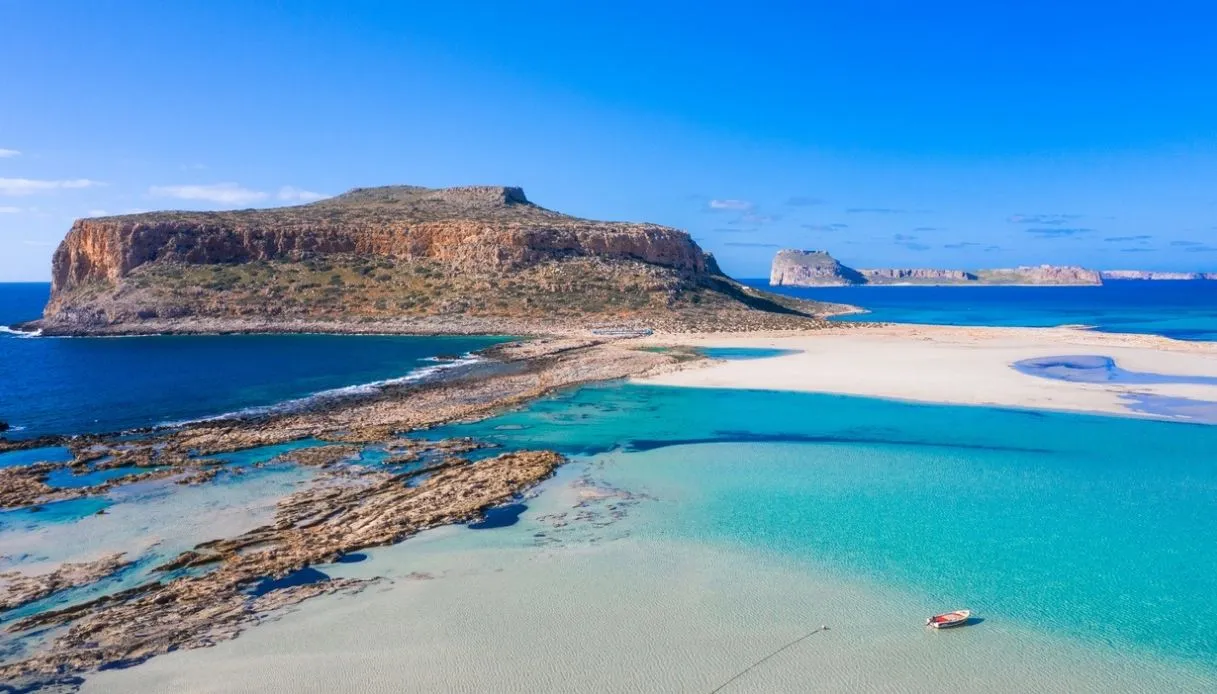
If everyone fell in love with the turquoise waters, the pink-tinged sands, and the bare, jagged mountains that plunge into the sea, then the image of Balos Lagoon in Greece has traveled the world, and for years this stunning Crete beach has been a postcard-perfect destination. But fame, as social media often does, came with a price: in the summer of 2026 the photos and videos circulating on Instagram and TikTok painted a nightmare scene, paradise turning into a hell with crowded boardwalks, an invasion of visitors, and even a towel struggling to find a patch of space.
Crete’s Balos Lagoon overrun by tourists
The problem isn’t limited to the perception of a beach that’s too crowded; Balos Lagoon on the island of Crete is at risk because the ecosystem’s capacity to sustain ever-stronger tourist flows is being exceeded. According to estimates reported by local authorities, during the peak season it can welcome between 2,000 and 5,000 people per day, and the most critical moment comes during the central hours of the day when a large number of sizeable boats from Kissamos arrive simultaneously.
The numbers threaten to clash with the fragility of the landscape; Balos is part of the European Natura 2000 network, and environmental assessments cited by the source indicate a daily sustainable capacity of roughly between 2,230 and 2,330 visitors.
The Balos case is a paradox common to many viral destinations: the more a place is promoted as pristine, the more it risks losing the very characteristics that made it famous. This isn’t a problem confined to this site alone; Greece has already faced similar issues in Santorini and Mykonos, adopting some measures to manage large tourist flows.
The measures to protect it
To prevent Balos from being suffocated forever, authorities are weighing a stricter access system. Among the proposals? online booking, entries divided into time slots, and a daily cap on visitors. The aim could be to allow 1,200 people for each 3-hour window; once the shift is over, travelers must leave to allow the next group to enter. If the model works, the plan for summer 2027 could be extended to other Crete beaches such as Elafonissi and Phalasarna.
A change that may appear revolutionary, because in Italy experiments of this kind are already a reality. Several coastal locations have introduced limited numbers, mandatory reservations, or access quotas precisely to protect highly delicate natural environments.
In Sardinia, the best-known examples include La Pelosa, Cala Brandinchi, Lu Impostu, and Cala Goloritzé; regulatory systems have also been adopted at Cala Violina in Tuscany, at the Spiaggia dei Conigli in Lampedusa, and in other Italian locations particularly vulnerable to summer pressure. For the Due Sorelle beach in the Marche, access is also tied to sea connections and requires advance planning.
Thus, the idea is not to prevent people from visiting extraordinary places like this, but to attempt to distribute the flows to protect the landscape.