
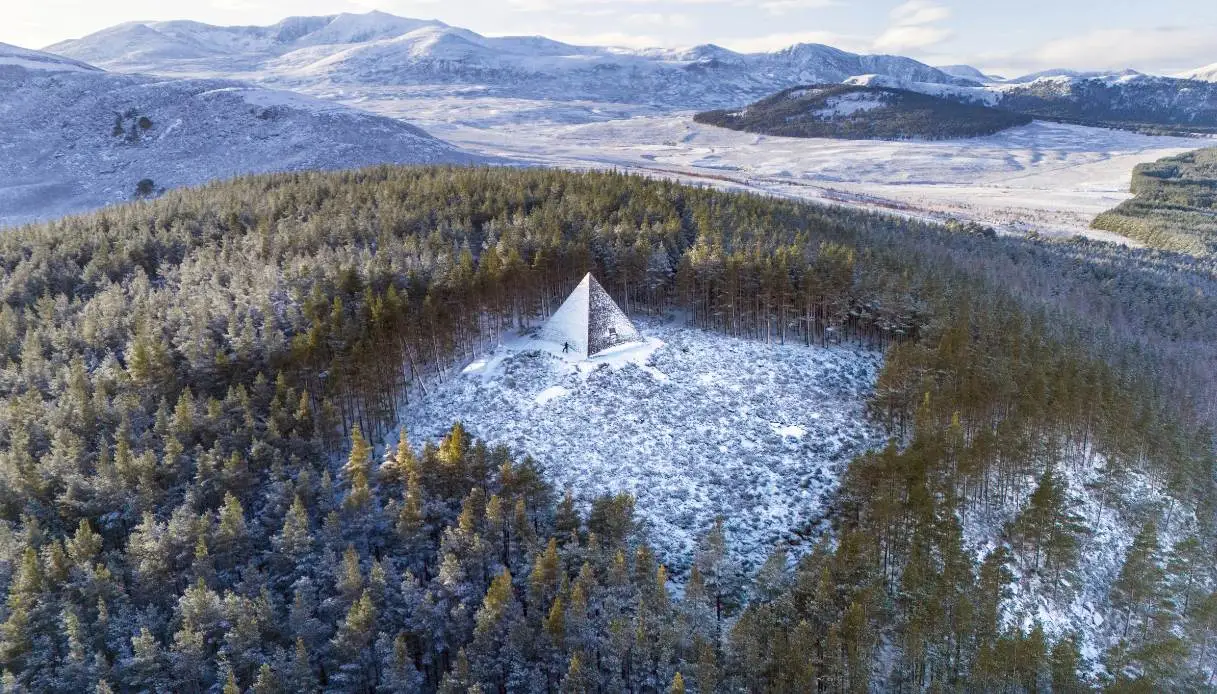
You must follow a path that cuts through dense vegetation as you climb up the hillside. At a point the trees begin to thin out and, almost as if by magic, a structure appears that seems to belong to another continent: a giant grey stone pyramid rises above the forests of the Scottish Highlands, its slanted walls reaching toward the sky and offering an extraordinary panorama of the valley below.
We are in the Balmoral estate, famous residence of the British royal family in Aberdeenshire, but the protagonist of this landscape has little in common with the towers and façades of the nearby castle. Known as Balmoral Pyramid, it is a monument about 11 meters tall, built in the 19th century to preserve the memory of one of the most famous love stories of the English monarchy.
A brief history and legends of the Balmoral Pyramid
Everything began in 1848, when Queen Victoria and Prince Albert took Balmoral on lease, in the Dee valley. The queen had visited Scotland for the first time in 1842, becoming deeply fascinated by its mountainous landscapes. Ten years later, Albert purchased the property and entrusted the architect William Smith with designing a new residence, completed in 1856 in the Scottish baronial style.
The prince’s death, on December 14, 1861, abruptly interrupted that happiness. Albert had just 42 years, and his passing provoked in his wife a grief that would accompany her for the rest of her life. For this reason, Victoria decided to remember him through numerous commemorative works, among which the great Scottish pyramid itself.
Thus, in 1862, atop Craig an Lurachain, was erected Prince Albert’s Cairn, a granite construction with a simple geometric form, four triangular faces converging toward a vertex. Unlike the funerary pyramids of ancient Egypt, it houses exclusively a symbolic memory: Albert’s burial indeed lies in the Royal Mausoleum of Frogmore, near Windsor.
One of the most moving testimonies is kept on the commemorative plaque. The inscription recalls Albert as a great and good prince consort and attributes the construction to his heartbroken widow. At the bottom, the date 21 August 1862 appears, the day when the queen personally reached the summit of the hill to observe the memorial’s foundations.
Visiting the Balmoral Pyramid and what to see
To reach Prince Albert’s Cairn you must undertake a route that passes through the royal estate’s woods, among dirt paths, exposed roots, and shaded stretches. Step by step you are entranced by tall pines, spruces, and other conifers, while the ground becomes progressively steeper.
You should allow roughly 30-40 minutes of ascent, depending on pace and ground conditions, but the final stretch requires a certain physical effort (note that it can be muddy after rain). Then, almost suddenly, the pyramid appears, which, when viewed up close, reveals the irregular surface of the stone blocks, assembled to form a compact and austere structure.
On the façade you can discern the commemorative plaque dedicated to Prince Albert, but also a second inscription that quotes a verse from the Wisdom of Solomon, chosen to recall a life short but complete. The panorama also deserves attention: from the hill the view reaches the Dee valley, the estate’s woods, and the Cairngorms National Park’s peaks, the largest in the United Kingdom.
Those who wish to continue exploring can choose the cairns circuit, a route of about 9.5 km, with a positive elevation of 371 meters and an estimated duration of 2 hours and 30 minutes to 3 hours (excluding possible longer stops). It is a path that crosses hills, glades, and forest trails, allowing you to reach several memorials of the royal family. Some rise on small rocky outcrops, others appear among the trees and require brief deviations from the main path.
For the pyramid alone it is preferable to allocate about 1 hour 30 minutes to 2 hours in total, including the return. The estate provides separate maps for the two itineraries: the complete circuit has some forks without obvious signage, making a downloaded map beforehand useful.
Location and How to Get There
The Balmoral Pyramid is located in Aberdeenshire, Scotland, inside the Cairngorms National Park. It sits on the hill of Craig an Lurachain, just south of the famed royal castle, in a landscape of mountains, forests, and wide moorlands. The reference point for visitors is Crathie, a small settlement along the A93 between Ballater and Braemar.
For those travelling by car, the most practical solution is to reach Balmoral’s car park near the Crathie tourist information centre. From the car park the route leads toward the Dee River, crossing it via a pedestrian suspension bridge. After crossing the watercourse, continue toward Easter Balmoral, following signs to the Royal Lochnagar Distillery and then those for Prince Albert’s Cairn.
Crathie is also reachable by buses connecting Ballater and Braemar; check local service times in advance. To organize the walk, consult the official Balmoral Castle site, which publishes maps of the itineraries and access information.
We recommend wearing sturdy trekking shoes with good grip, weatherproof clothing, and paying attention to the weather conditions (year-round). In winter months especially, the few daylight hours and the possible presence of ice require greater caution along the ascent.
