
One hundred ninety million dollars: that was the price required to secure Chestnut Trees in Bloom, Vincent van Gogh’s Chestnut Trees in Bloom, which thus becomes the Dutch painter’s most expensive work ever sold at auction. The sale also drew headlines for the lengthy dispute with the heirs of publisher Samuel Fischer, settled just hours before the auctioneer opened the bids.
But let’s set aside the figures and the auctions for a moment: behind that canvas measuring seventy by fifty-eight centimeters lies a real, walkable place. It is Auvers-sur-Oise, a small village in Île-de-France perched along the Oise River, about thirty kilometers from Paris. Here van Gogh spent the final months of his life and, once again here, painted those chestnut trees heavy with pink blossoms.
Auvers-sur-Oise, the village where Chestnut Trees in Bloom were born
When Van Gogh stepped off the train in Auvers in May 1890, the town was not a random choice. It had been suggested by Pissarro: from Paris it took less than an hour, and landscape painters like Corot and Daubigny had long since made it their countryside of choice. Here, too, lived Dr. Gachet, a physician and avid art collector who would have to look after him. Vincent took a room at the Ravoux Inn, directly opposite the town hall, and immediately began to paint.
Five days after his arrival he wrote to his brother Theo that he had completed two studies of chestnut trees, one with white blossoms and the other with those pink. And it is precisely the second that reveals the heart of the village: the main street, today named after Charles de Gaulle, just a few steps from the inn.
Under the flowering canopies three women chat while shielding themselves from the sun with parasols, as a farmer wearing a straw hat crosses the scene. It’s the only one among the chestnut trees painted in those weeks where people appear, as if the painter wished to capture the everyday life of the town.
Auvers captivated him from the start and, in just over two months, he transformed every corner into a subject to paint, giving life to over seventy canvases and more than fifty drawings.
What to See in Auvers-sur-Oise on Van Gogh’s Trail
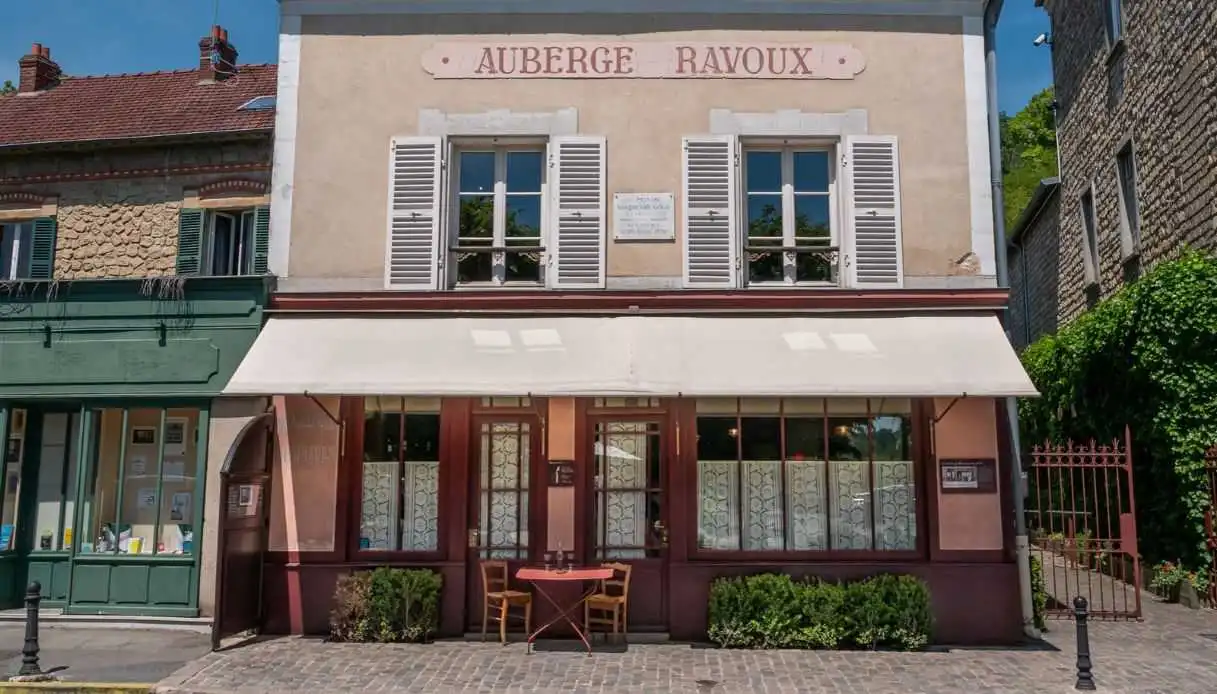
The first place to start discovering the village along Van Gogh’s trail is the very inn where he stayed. The Auberge Ravoux, known as the Maison de Van Gogh, preserves the small room on the top floor, barely seven square meters left almost as it was in 1890, the place where Vincent died on July 29 of that year. On the ground floor, the dining room still operates as a restaurant, so you can stop by for a meal.
Leaving the inn, cross the street and you’ll stand before the town hall, which Van Gogh painted festooned for the 14th of July. Continuing uphill, you reach the Notre-Dame Church, made famous by the canvas now on display at the Musée d’Orsay, and a little further, the wheat fields that inspired some of his latest works. On the edge of those fields, in the small cemetery, Vincent and Theo rest side by side, under a single ivy-clad cover.
To complete the visit you can climb up to the Château d’Auvers, where a multimedia route recounts the Impressionist season. Until January 3, 2027 it also hosts the exhibition “Van Gogh Influencer”, dedicated to the painter’s artistic legacy.