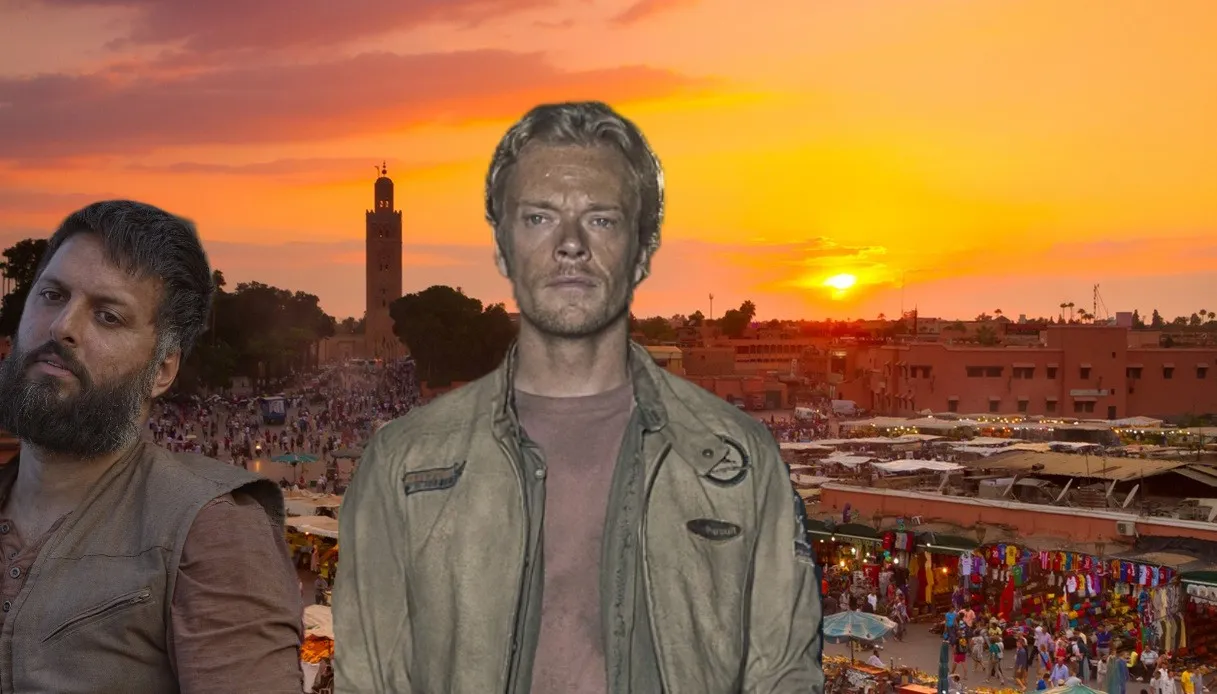
On August 20, 2026, an action-thriller series inspired by The Atomic Bazaar arrives exclusively on Sky and for streaming on NOW. The acclaimed novel by William Langewiesche tells a smuggling tale that, now, comes to life on screen thanks to the directing of Gregory Burke and the performances of Alfie Allen (who many will remember from the Game of Thrones cast), Shazad Latif and Samira Wiley among others.
Bazaars crowded, old abandoned warehouses, religious enclaves, rural villages where time seems to have stopped clash with modern financial districts that never sleep, but also dunes and boundless desert expanses form the backdrop to the protagonists’ race against time. The locations of Atomic appear to have been chosen, after all, with a single criterion: to keep the narrative tension high.
What it’s about
Max, a smuggler, recruits JJ, a stranger on the run, for a mission that proves riskier than expected: trafficking highly enriched uranium through North Africa and the Middle East while the CIA, MI6 and a ruthless international cartel close in on them. The two find themselves on a journey that is not only physical and on the road, but also psychological, forcing them to confront their past and the will to redeem themselves from it.
Where the series was shot
In an attempt to escape criminals and law enforcement, Max and JJ cross several countries: Libya, Syria, Guinea-Bissau, Morocco. For practical and logistical reasons the production (Pulse Films) opted to shoot the series exclusively in Morocco: the choice of Atomic’s locations was thus guided primarily by the need to recreate as faithfully as possible different settings and scenarios, as well as by the desire to bring on screen a more authentic Middle East, distant from overused clichés.
Casablanca
The port of Casablanca, one of the region’s most important, facing the Atlantic, was used for numerous scenes in which Max and JJ gear up for the smuggling operation. More broadly, the city with its refined mix of Moorish architectures, Art Deco-style buildings and modern residential constructions provides the backdrop for many passages of the series: artistically reimagined, it also stands in for Beirut and Guinea-Bissau on screen.
Among the places where the new TV series was shot, those who know the city best will be able to spot the old printing press—now out of use—of the tabloid “Maroc Soir”: here some scenes were filmed inside a warehouse where bombs are manufactured and other sequences show destroyed religious buildings.
Marrakech
Most of the action in Sky’s new thriller takes place in Marrakech; not surprisingly, then, that several parts of the city were transformed into sets and involved in filming. Of this former imperial center, today a major tourist hub, the production sought to portray mainly the multifaceted spirit that manifests in atmospheres and colors that continually change as one moves from one neighborhood to another, from the center toward the outskirts and the hinterland.
The Jewish quarter, in particular, is depicted in the series in all its dusty glory of artisan workshops where it feels like stepping back in time: Tinsmiths Square (or Place des Ferblantiers, as it is otherwise known) is easily recognizable in the shots thanks to the shops selling Moroccan lanterns and other metal crafts.
Tameslouht
About twenty kilometers from Marrakech lies Tameslouht, another Atomic location: here were filmed mainly flashback sequences concerning JJ’s past, scenes meant to tell what drove him to flee and made him a tragic hero with whom audiences can empathize more easily.
This Moroccan village is the ideal destination for those who dislike bustle and appreciate a more authentic atmosphere and to live the places they visit as a true local would.
In Tameslouht, for example, the tangia (or tanija), one of the most representative dishes of Moroccan cuisine, originated: tasting it here is a completely different experience than elsewhere and is worth indulging in. Once a relatively important Sufi center, Tameslouht does not lack natural attractions such as the splendid mountains of the High Atlas, in which it is nestled.
Agafay Desert
At a certain point in the chase, the two Atomic protagonists find themselves wandering in the African desert: what, in fiction, is the Sahara desert, in reality is the Agafay Desert that hosted the series’ sets. Located about thirty kilometers from Marrakech, it is an unusual desert: not made of sand, but mainly of rock and stone which gives the landscape a nearly lunar quality. The wind-eroded dunes and the valleys of the Agafay Desert are easily recognizable in the opening sequence of Sky’s new series, adapted from William Langewiesche’s novel and—for those who can wait—even in the finale.
The production chose to shoot, in particular, in the Oumnass area: at the foot of the Atlas Mountains, it is a small, tranquil village where one can immerse in the daily life of rural Morocco, even though, for some time now, eco-lodges and luxury resorts have been popping up as destinations for more exclusive tourism.
A screen-worthy tidbit about rural habits and elements that make the Moroccan landscape unique are the khettaras: ancient hydraulic systems used to collect both drinking water and water to irrigate fields.
Other locations
Among the other locations there is M’Nabha: a rural municipality, located within the Marrakech prefecture, where the two series leads find themselves facing a ruthless gang of criminals and miraculously surviving them.
Further north, the small center of Sidi Badha was used as a base to shoot chase scenes, crashes, checkpoints that fill Max and JJ’s desert escape with tension.
The airport scenes, which show the two smugglers attempting to save themselves at high altitude while being hunted by police and criminals, were finally shot at Ben Slimane Airport: a small landing strip that for a long time was believed to be a U.S. military base.