
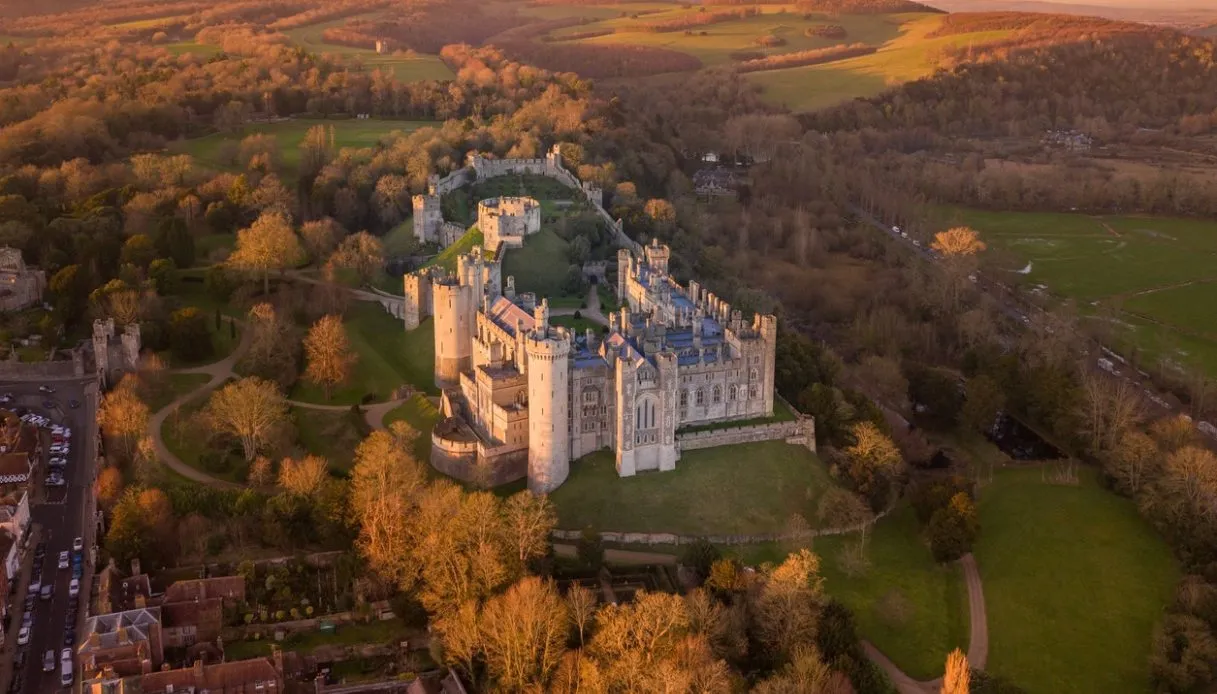
Overlooking the landscape of West Sussex, Arundel Castle reveals an elevated position that makes it impossible to overlook, with its towers and walls rising above the town and views opening onto green hills. It presents itself to visitors with the grandeur typical of grand medieval manors, a marvel that deftly blends the imposing strength of a defensive fortress with the refined elegance of a noble residence.
Those who arrive here must approach it as if one could embark on almost a journey through several centuries, all concentrated in the same place: stone, battlements and narrow stairs recall the castle’s original fortress, while worked woods, monumental halls, and 19th-century decorations recount the era of the great Victorian aristocratic home.
Brief History and Legends of Arundel Castle
The history of Arundel begins with a political and military choice. After the Norman conquest of 1066, William the Conqueror entrusted a substantial portion of Sussex to Roger de Montgomery, asking him to build a fortification near the Arun estuary. The first core of the castle thus arose with a defense- and territory-control function.
In the centuries that followed, the ownership passed through various hands and was also tied to the Crown. Among the monarchs associated with the history of this castle in the United Kingdom appear Henry I, Henry II and Richard I. The dynasty of the Dukes of Norfolk would later leave a profound imprint on the complex and on its long family saga.
The medieval portion suffered serious damage during the English Civil War of the 17th century. In 1643-1644 it was drawn into the conflict and the Fitzalan Chapel bore heavy damage. The chapel, founded in 1380 by the 4th Earl of Arundel, later endured a long period of neglect before its 19th-century restoration.
The great transformation arrived between the 18th and 19th centuries, when the defensive fortress was progressively converted into a sumptuous residence. The reconstruction undertaken between 1870 and 1890 gave the dwelling much of its current appearance, with a highly elaborate Gothic Revival architecture that is regarded as one of the great works of Victorian England.
A particularly fascinating figure in the family history is Thomas Howard, the 14th Earl of Arundel, who lived from 1585 to 1646 and was known by the nickname “The Collector.” A famed collector of art and antiquities, he is still remembered today through the Collector Earl’s Garden, one of the most scenographic spaces of the complex.
The garden was conceived as an imaginative reinterpretation of a Jacobian formal garden inspired by Howard’s London residence. Pergolas, fountains, pavilions, a central canal and a rocky structure evoke the theatrical taste of the era. The most curious feature, however, is Oberon’s Palace, built in green oak and inspired by a design by Inigo Jones for a 1611 production.
There are also legends, such as that of Bevis of Hampton, a gigantic warrior tasked with guarding Arundel’s gates and who supposedly dwelt in the tower that still bears his name. His weapon was Morglay, a huge sword said to be almost 1.75 meters long, which is still shown in the armory today.
At the end of his life, the legend says, Bevis hurled it from the tower and asked to be buried at the spot where it would fall. The indicated place is an ancient mound in the park, known as Bevis’s Grave.
The Visit Through Historic Rooms, Medieval Walls, and Gardens
The visit allows you to alternate between completely different settings, following a route that carries you from the Norman fortress to the grand aristocratic residence. As you ascend toward the Keep, you have the opportunity to enter the oldest, military part of the complex: there are stone stairs that lead upward, as well as narrow passages that deliver a very concrete sense of the defensive structure.
Inside, the atmosphere changes completely. The Regency Library is characterized by refined mahogany panels and an especially elaborate ceiling, while the Barons’ Hall presents a more solemn dimension. In the Drawing Room you encounter decorations, furnishings and works of art that recount the family’s taste across different eras.
The collection includes paintings attributed to celebrated artists, among them Van Dyck, Gainsborough and Canaletto. Tapestries, furniture and sculptures complete the environments, creating a clear contrast with the sternness of the medieval walls. The rooms deserve attention as well: the Victorian and Edwardian bedrooms are individually furnished, allowing a view into a more everyday side of aristocratic life. Beside the ceremonial spaces lie bathrooms belonging to different periods of the house’s history.
The Private Chapel represents one of the finest examples of the English Catholic revival of the 19th century. Not far away, in the gardens, the Fitzalan Chapel preserves the family’s funerary memory. The 14th‑century chapel is the burial site of the Dukes of Norfolk and their ancestors, and it is also one of the most striking surprises of the green area.
The gardens cover about 15 hectares and impress with a variety that continually shifts atmosphere: the Collector Earl’s Garden introduces formal geometries, pergolas, water features and exotic vegetation; the Rose Garden emphasizes David Austin roses, their scents, and Gothic elements that dialogue with the castle’s architecture.
Then there is the White Garden, adjacent to the Fitzalan Chapel, where light tones predominate. The Kitchen Garden, for its part, follows a more productive setup, with vegetables, fruit and four central beds arranged according to crop rotation. The restored Glasshouses include the Vine House, with vines and peach trees, as well as the castle’s geranium collection.
Particularly curious is the Stumpery, a garden built around old trunks and ferns, while the Water Gardens encompass the Stew Ponds, with over 1,500 aquatic plants, a gazebo and a boathouse connected by paths and bridges. In 2025, a Dipping Pond was added to enhance biodiversity in the aquatic environments.
Where It Is and How to Reach It
Arundel Castle is located in the town of the same name, in West Sussex, in the south of England. From London, the train is a practical option, since Arundel station is served by regular services and is about a 10-minute walk from the entrance. Trains also depart from London Victoria; the journey takes roughly 90 minutes. Another option is from London Bridge, with a trip of nearly 1 hour and 15 minutes.
Anyone arriving by car can use the paid Mill Road Car Park, located right opposite the main entrance. The useful postal code for navigation is BN18 9PA. It should be noted, finally, that visiting the castle requires a few hours to be truly appreciated.