
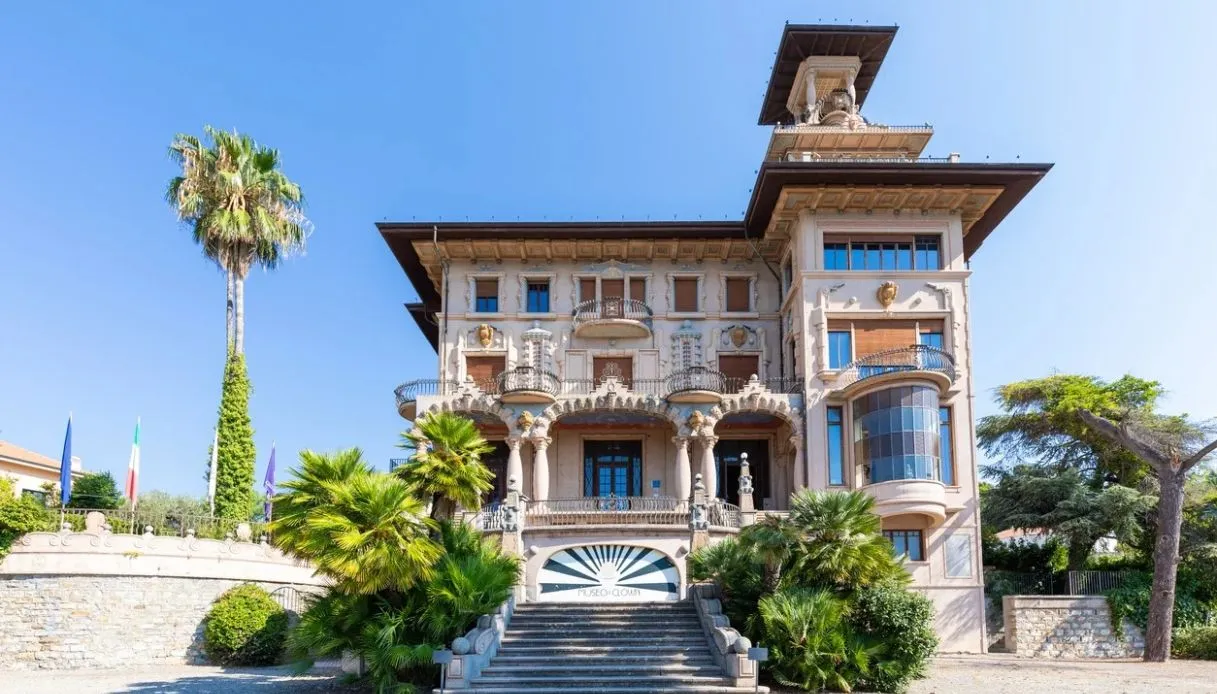
From November 18 to 24, 2026 takes place the inaugural edition of Art Déco Week, a new festival dedicated to exploring Art Déco through architecture, decorative arts, painting, and the culture of travel.
The program includes forty guided itineraries spread across nineteen Italian regions and seven online scientific conferences, designed to deepen understanding of the protagonists, languages, and cross-pollinations of this creative era.
Forty guided itineraries in nineteen Italian regions
The heart of Art Déco Week will be a large map of guided visits conducted by licensed tour guides, spanning Italy from major cities to provincial centers, and down to seaside resort towns.
The week will begin Wednesday, November 18 with events in Pescara, Reggio Calabria, Naples, Ferrara, Forlì, and Salsomaggiore Terme. Notable venues include Aurum, the Naples Maritime Station, Palazzo Panfilio in Ferrara, and Terme Berzieri. In Salsomaggiore Terme, in particular, the route dedicated to the dream of the baths will allow an in-depth look at Galileo Chini’s role and the decorative arts.
Thursday, November 19 the visits will touch Sogliano al Rubicone, Gorizia, Trieste, Udine and Rome. The itineraries in Friuli-Venezia Giulia will juxtapose Secession, Déco taste, and the architecture of the 1930s, while in the capital the starting point will be the Hotel Mediterraneo, from which a narrative dedicated to hotels, cinemas, and luxurious spaces will unfold.
Friday, November 20 will bring Liguria and Lombardy into the spotlight, with routes in Genoa, Imperia, La Spezia, Brescia, Busto Arsizio, and Milan. In Genoa, Villa Canali Gaslini will take center stage; in Imperia the focus will be on Villa Grock; in La Spezia the itinerary will be dedicated to Bibbiani. In Brescia, Piazza della Vittoria will be explored, and in Busto Arsizio the shift from Liberty to geometries through the works of Silvio Gambini will be examined. In Milan, the route will begin at the former Albergo Diurno Venezia to delve into Portaluppi’s work and its relationship with the underground city.
Saturday, November 21 the program will cover Ancona, Ascoli Piceno, Pesaro, Senigallia, Campobasso and Turin. Day hotels, public buildings, and metropolitan geometries will offer varied perspectives on the urban culture of the period. Among the most meaningful stops will be Senigallia’s Rotonda a Mare, a testament to the seaside modernity of the 1930s.
Sunday, November 22, the festival will move to the South and the islands, with visits to Bari, Cagliari, Catania, Messina, Palermo and Trapani. Among the buildings to discover are Kursaal Santalucia, Palazzina Scano, and Galleria Vittorio Emanuele III. In Palermo, the route will begin at the Palazzo delle Poste to deepen the dialogue between Futurism, Déco, and public arts.
Monday, November 23 will involve Florence, Viareggio, Bolzano, Merano, and Perugia. The Odeon cinema and Villa Argentina will allow exploration of the culture of show business and the relationship between Chini, Liberty, and the taste of the twenties. In South Tyrol, attention will turn to modernist architectures, while in Perugia the itinerary will feature Sala Lippi and the world of applied arts.
The event will conclude on Tuesday, November 24 with stops in Aosta and in Veneto, between Lido di Venezia, Padua, Venice, Verona, and Vicenza. From the Lido cinema palace to the architectures and arts of the interwar period, the final day will revisit some of the festival’s central themes: travel, sociability, and new public spaces.
Seven online scientific conferences on the protagonists of the Déco
Alongside the on-site visits, Art Déco Week offers a cycle of seven scholarly conferences, one per day from November 18 to 24, all scheduled online from 11:00 to 12:30.
The program will open on November 18 with Piero Portaluppi and the geometries of Art Déco, a session devoted to the architect’s architectures, interiors, materials, and decorative inventions, from the experiments of the 1920s to Villa Necchi Campiglio.
On November 19 it will be the turn of Chini between Liberty and Déco, retracing the family’s ceramic production, from Arte della Ceramica to Fornaci San Lorenzo, with particular attention to Galileo and Tito Chini, without neglecting the contribution of Chino and Augusto. The conference will also explore the lustre majolica of Villa Lydia in Viserba, Rimini, attributed to Galileo Chini by Andrea Speziali, and will broaden the comparison to other Tuscan manufactories, including Richard-Ginori, and Gio Ponti’s creations.
November 20 will present the theme “The masters and the Déco sculpture between Italy and New York,” tracing Fortunato Depero, Libero Andreotti, Umberto Bellotto, and Gio Ponti, in dialogue with the research of Alessandro Mazzucotelli and Silvio Gambini. The discussion will reach as far as Paul Manship’s Prometheus at Rockefeller Center, linking myth, modern energy, and architecture.
On November 21 the focus will move to Gio Ponti between architecture and decorative invention, to deepen the connection between buildings, interiors, and objects, starting from the ceramics made for Richard-Ginori and the design research related to living.
Sunday, November 22, with From Paris to the World in the Roaring Twenties of Art Déco, will depart from the 1925 International Exposition of Modern Decorative and Industrial Arts. Posters, illustrations, typography, fashion, and everyday objects will narrate the international diffusion of a new visual culture, also tied to consumption and the geometric reinterpretation of natural motifs.
The 23 November will be dedicated to “America Art Déco and tourism from Miami Beach to Italy,” an in-depth look at leisure-time and hospitality architecture through hotels, signage, lobbies, and furnishings. Among the comparison sites are Rome’s Hotel Mediterraneo, the Casa del Passeggero, and Milan’s Diurno Venezia.
Finally, on 24 November, the focus shifts to Tamara de Lempicka and the painting of modernity: portraits, figures, and the construction of the public image will deepen the relationship between classical painting and modern simplification, through volumes, surfaces, light, fashion, and photography.
