
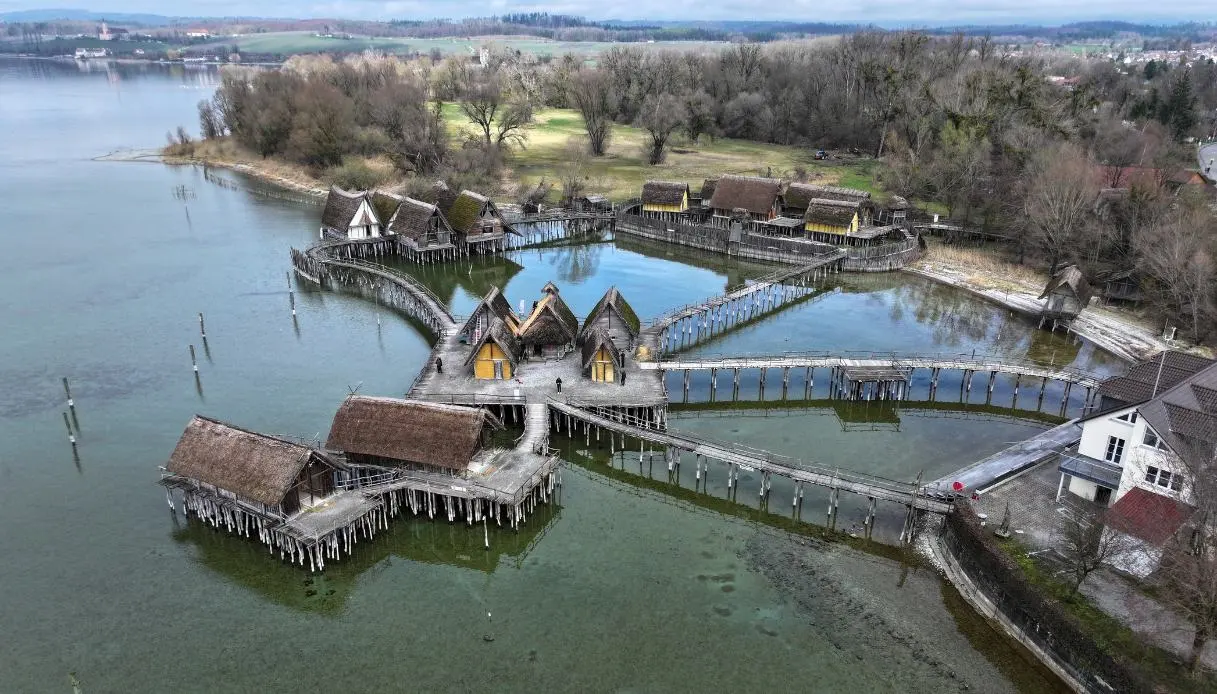
Even before stone villages, paved roads, and fortified towns, water stood as a resource around which to build life was organized. For this important reason, along the shores of the Alpine lakes, in wetlands and near the waterways, prehistoric communities found a favorable environment for agriculture, animal husbandry, fishing and exchanges. With the aim of adapting to a landscape subject to changes in water level, they built dwellings supported by piles, sometimes rising directly above the basin, other times right on its shores.
Today, traces of those villages remain mostly hidden under the water or protected by sediment layers. Yet their extraordinary value: liquid-saturated soils have preserved organic materials that, under ordinary conditions, would have disappeared millennia ago. Wood, fabrics, plant remains and fragments of tools allow us to reconstruct tangible aspects of daily life in the past, with a precision rare for prehistoric times.
The UNESCO recognition of 2011 brings together 111 archaeological sites distributed across Switzerland, Austria, France, Germany, Italy and Slovenia, with chronologies spanning from 5000 to 500 BCE. This is a shared testimony of more than four millennia of history, capable of telling the evolution of the early agricultural societies of the Alpine Europe. In Italy, there are 19 sites, concentrated mainly around Lake Garda and Lake Varese, but also present in Piedmont, Veneto, Friuli Venezia Giulia and Trentino-Alto Adige.
Isolino Virginia, the oldest pile-dwelling village in the Alpine arc
A small island rises from the waters of the Lake of Varese, surrounded by a Lombard landscape of calm shores, vegetation and mountains in the background. It is Isolino Virginia, in the municipality of Biandronno, one of the most important places to understand the prehistoric settlements of the area.
Their origins trace back to the Neolithic, a time when some human communities began practicing agriculture and animal husbandry more steadily, gradually transforming their relationship with the land. On the islet, in fact, the oldest pile-dwellings in the Alpine area have been identified, a feature that makes the site particularly significant within the UNESCO framework.
The houses were built with wooden posts and beams, supported by an horizontal platform. The structure could rise over the water or near the shore, depending on the village’s needs and the environmental conditions. Wood, reeds, and straw formed materials that were readily available, but required significant technical knowledge to fashion walls, coverings and walkable surfaces.
The lake level fluctuations forced the communities to adapt the dwellings, moving or rebuilding the homes in different areas of the island. The Isolino Virginia Archaeological Museum allows a deeper exploration of this history through artefacts and reconstructions of Neolithic houses.
Ledro, the journey through time on the Trentino basin
The fresh mountain air welcomes the traveler on the eastern shore of Lake Ledro, a crystalline basin perched at an altitude of 655 meters. In 1929 its level fell sharply due to works at the Riva del Garda hydroelectric plant, uncovering a field of more than 10,000 piles driven into the silt.
The archaeological area today presents itself as fascinating, dominated by the local museum and by faithful life-size reconstructions of prehistoric dwellings. Reed-thatched roofs rise above walls of wattle and daub, arranged along walkways suspended over the water.
The walk among the reproduced huts allows visitors to touch stone tools, grinding stones, remnants of fabrics and even breads burned and preserved for more than thirty centuries. The sight of the sun setting behind the surrounding peaks, reflecting on the wooden structures, gives a suspended, almost magical atmosphere.
Palù di Livenza, the landscape that transformed with humanity
Between the towns of Caneva and Polcenigo, in the province of Pordenone, the Palù di Livenza preserves a singular history, linked as much to prehistoric communities as to the ongoing transformation of the environment. The area is one of Italy’s oldest pile-dwelling sites, with evidence dating mainly to the period roughly 4400/4300 to 3650/3600 BCE.
Over the millennia, the basin passed through several phases, evolving from lake to marsh, then to a semi-dry peat bog and finally into a forested environment rich in oaks. This succession makes the place particularly interesting, because it shows a landscape in continual evolution.
The posts sunk into the ground and the horizontal beams uncovered during archaeological research attest to the use of wooden structures to build dwellings and platforms. The choice of materials responded to the availability of local resources, while the construction had to account for soil consistency and the presence of water.
Palù di Livenza is also important for its long chronological sequence: the finds allow following the evolution of settlements from the ancient Stone Age through the Neolithic, observing the relationship between environmental changes, building techniques and the organization of daily life.
Unteruhldingen, the German gem of Lake Constance
On the northern bank of the great Constance basin rises the complex of Unteruhldingen, the “Lake Swabia,” one of the oldest and largest open-air museums in Europe dedicated to prehistory. No fewer than 23 cottages, rebuilt with scientific rigor, tower on stilts immersed in the crystal-clear waters, linked to the shore by sturdy wooden piers.
The sight is spectacular: the thatched, pitched roofs stand out against the clear horizon, their shapes reflected on the surface of the water mirror. Inside the buildings, carefully arranged exhibits show daily life scenarios, with hearths, looms, bronze tools and storehouses full of provisions.
Laténium, the archaeological giant of Neuchâtel
On the shores of the Swiss town of Neuchâtel comes to life Laténium, the largest archaeological museum in the country, luxuriously set along the lake’s edge. The outdoor park features an extraordinary naturalistic and archaeological path where ancient wooden structures constantly converse with the water.
The region gave its name to the famous La Tène culture, and the quality of the artefacts kept in the museum’s cases leaves visitors breathless: perfectly preserved boats, amber jewels, decorated swords, wooden wheels and even edible plant seeds narrate the habits of highly evolved agricultural communities.
Looking toward the Alps from the Neuchâtelois shore, the deep bond between man, stone, wood, and water appears in all its millennial strength.