
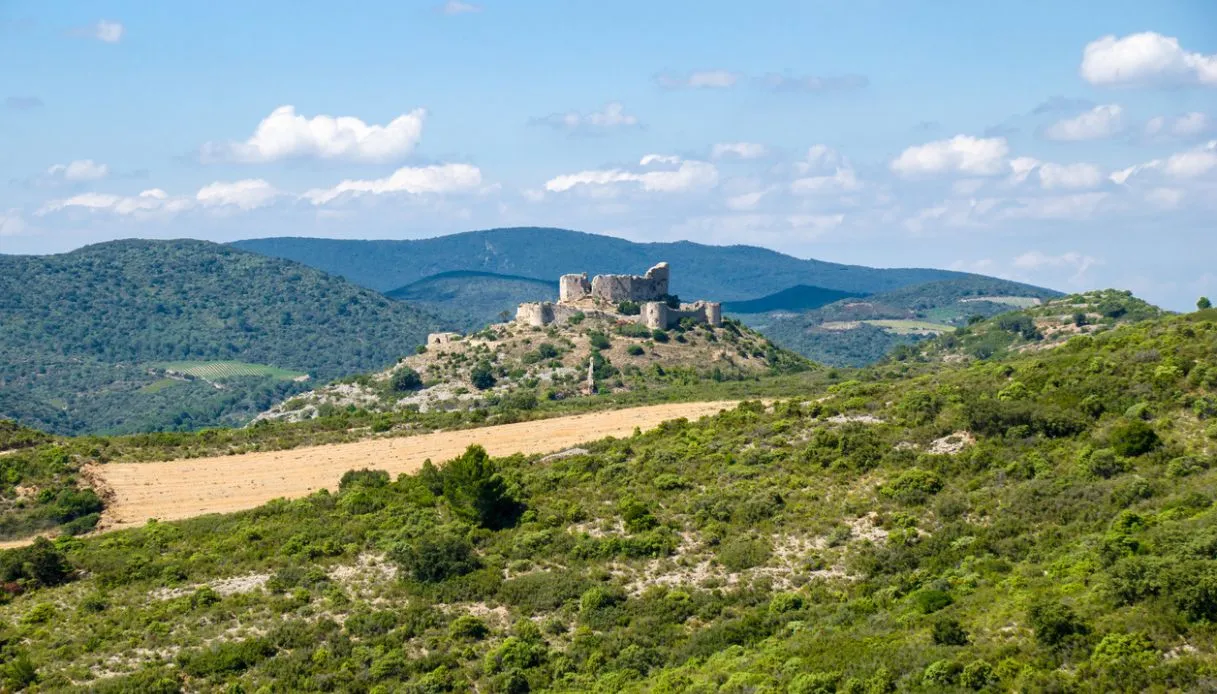
Perched on a rocky hill about two kilometers from the village of Tuchan, in the French department of the Aude, Aguilar Castle still seems to watch over the landscape that unfolds all around. It is no accident that it is nicknamed the “Eagle’s Nest”: at an altitude of 296 meters, it dominates the vineyards of Haut Fitou and a plain enclosed by ridges, limestone cliffs, and mountains.
The ascent to reach it is short and, once you arrive, you’ll be rewarded by a panorama that stretches toward Mont Tauch, the cliffs of Vingrau, the tower of Tautavel and, on clear days, as far as the unmistakable profile of Canigou, one of the emblematic mountains of the eastern Pyrenees. Aguilar was a strategic fortress, contested by lords and sovereigns and finally incorporated into the defensive system that entered history as the one of the “five sons of Carcassonne.”
Aguilar, the Sentinel of the Corbières Between Lords and Kings
Looking at Aguilar Castle from the outside, the first feature you’ll notice is the powerful double enceinte that follows the shape of the rocky spur.
The location was not accidental: in the Middle Ages, a small garrison held the territory from up there and, in case of danger, could transmit the alarm to Carcassonne in less than twenty minutes, using smoke signals or flashes of light relayed by the other fortifications scattered across the Corbières.
The manor was initially tied to the Catalan counts, then to the House of Carcassonne and, from the 12th century, to the Termes family; one central figure was Olivier de Termes, an Occitan knight who opposed the Crusade against the Albigenses and made Aguilar one of his centers of power.
After alternating fortunes, Aguilar definitively entered the domain of the French Crown in 1261, was enlarged and strengthened according to the latest military techniques of the era, and became one of the fortresses charged with guarding the border with the Kingdom of Aragon.
Its strategic role ended after the Treaty of the Pyrenees of 1659, when the frontier between France and Spain moved south: it thus lost the function for which it had been transformed and began its slow abandonment. Since 1949 it has been classified as a Monument Historique and over the years has undergone several restoration and enhancement interventions.
Inside the Eagle’s Nest Between Double Walls and Panoramas
The oldest circuit, dating from the XII century, enclosed the spaces arranged around an inner courtyard, with the castellano’s residence, a tower, and a cistern; at the most vulnerable point of the spur, the masonry reached a thickness of about 2.80 meters and took the shape of a spur designed to offer greater resistance to projectiles.
Outside, the defensive system built between the late 13th and early 14th centuries is marked by six semicircular towers arranged along the parapets at the points where the terrain made the fortress more exposed. The towers faced inward, a solution that prevented potential attackers from using them as refuges once conquered.
Just outside the walls you will also encounter the remains of the Cappella di Sainte-Anne, a small building with a simple structure, a broken barrel vault and an apse; all around, among the vegetation, remain traces of the old castle village that once developed at the foot of the fortress.
If, after the visit, you still feel like walking, you can follow the Aguilar 360° route, a circular itinerary that goes around the hill and allows you to observe the castle from different perspectives: the route measures about 2.7 kilometers, takes a little more than an hour and features a rise of about 130 meters. The walls rise above the garrigue while the vineyards lie at their feet and, farther away, the Corbières overlap up to the Pyrenees.
The castle is open to visitors from mid-February to mid-November, with days and hours varying according to the time of year. Before setting off, consult the official website of the Town Hall of Tuchan, especially in the less touristy months.