
Ten years after the earthquake that struck Central Italy, Abruzzo opens the doors to some of its most significant historic sites, offering the public the opportunity to discover up close the work of the restoration of cultural heritage. Between October and November 2026, four monumental complexes in Teramo, Capitignano, and Isola del Gran Sasso will be the protagonists of extraordinary openings and free guided tours, to tell the wounds of the seismic event, the restoration interventions, and the artistic testimonies that are resurfacing thanks to safeguarding activities.
The initiative, included in the national program “A dieci anni dal sisma (2016-2026)”, invites visitors to enter places usually not accessible or undergoing recovery works and turns construction sites into opportunities for knowledge and participation.
Cultural heritage as a memory of reconstruction
The proposed route goes beyond simply showing damaged buildings and the works affected by the restoration: the aim is to illuminate the complexity of the interventions required to secure the structures, restore decorative interiors, and return to the community treasures that shelter centuries of history.
The event is promoted by the Ministry of Culture, through the Department for the Protection of Cultural Heritage and the General Directorate ABAP, with the Archaeology, Fine Arts and Landscape Superintendence for the provinces of L’Aquila and Teramo. Collaborating are the Prefecture of Teramo, the Diocese of Teramo-Atri, and the Municipality of Teramo. All the appointments are also part of Radici 2026, the Valorization Plan promoted by the Superintendence.
The Sanctuary of Madonna delle Grazie in Teramo
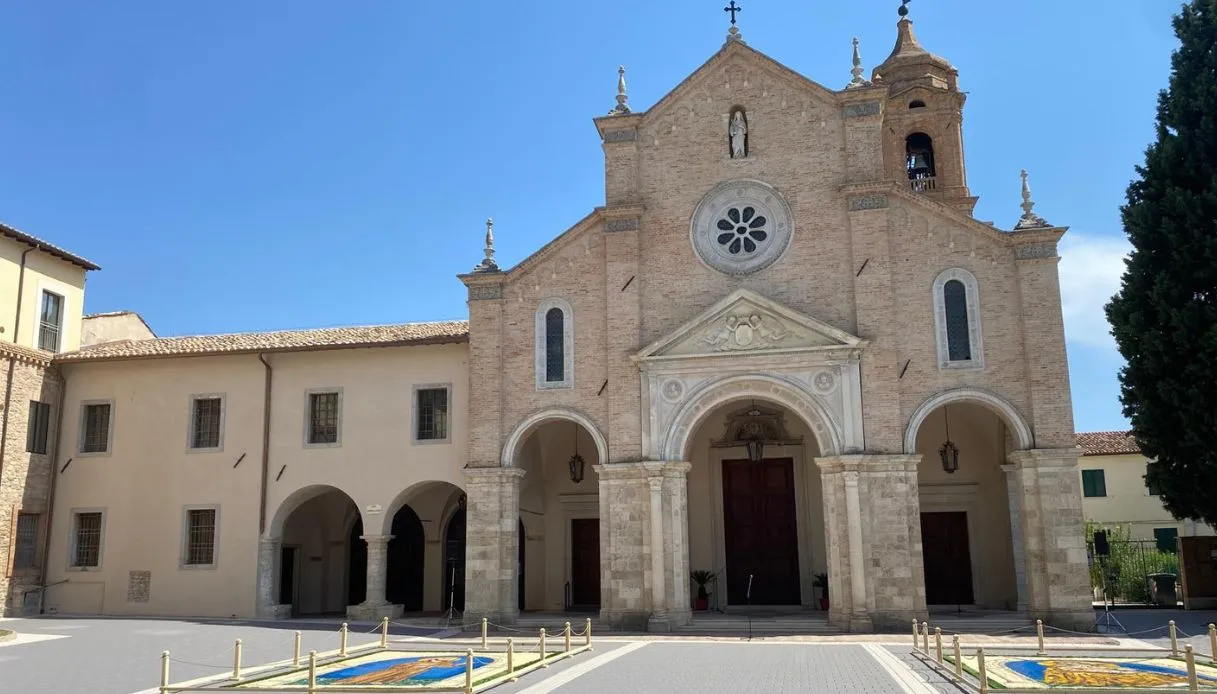
The first event is scheduled for Saturday 17 October at the Sanctuary of Madonna delle Grazie in Teramo, open from 11:00 to 18:00. Tours will depart every hour and can accommodate a maximum of 20 people per session.
The route will allow a deeper exploration of the complex’s history and an viewing of some of the works that define its artistic value, including the Renaissance statue of the Madonna and Child, attributed to Giovanni di Biasuccio. The visit will continue in the cloister and in the former refectory, where restoration work has brought to light new testimonies and wall paintings of particular interest.
The sanctuary’s origins date back to 1153, when a Benedictine monastery dedicated to Sant’Angelo delle Donne was founded. The complex was later transformed into the seat of the Friars Minor Observant by the will of Fra Giacomo della Marca, while the current appearance of the church is linked to the eighteenth- or nineteenth-century reconfiguration.
On the same day it will also be possible to visit the nearby Madonna delle Grazie archaeological area, open from 9:00 to 13:00 and from 14:00 to 18:00, and recently involved in valorization and restoration interventions conducted by the ABAP Superintendences for the provinces of Chieti and Pescara and for those of L’Aquila and Teramo.
Palazzo Ricci and the Church of San Domenico
Saturday 24 October the initiative moves to Capitignano, in the province of L’Aquila, where Palazzo Ricci and the Church of San Domenico will be open from 9:00 to 13:00 and from 14:00 to 18:00, with hourly departures and groups of up to 15 participants.
The route will illustrate the ongoing restoration works and will allow visitors to learn about the decorative elements of the residence and the adjacent church, once a private chapel connected to the palace.
The complex is one of the most significant examples of palatial architecture in Abruzzo. Its origins date to the 15th century, but it underwent important transformations between the 18th and 19th centuries, to which architects such as Giovanni and Raffaele Stern and Giuseppe Valadier contributed: it was precisely during this period that Palazzo Ricci also became the summer residence of Pope Pius VI.
The historical stratifications of the former Convent of San Giovanni
The program will resume on Saturday 14 November in Teramo, at the ex-Convent of San Giovanni, open every hour from 9:00 to 13:00 and from 14:00 to 18:00, with a maximum of 15 people per group.
The visit will offer the opportunity to read the various historical phases of the monastery through the transformations still recognizable in its architecture. Particular attention will be given to findings that emerged during the repair and structural consolidation works started after the earthquake damage.
Founded in the 14th century in the area of the ancient Roman center, the convent maintained its religious function until the 1861 suppression. Subsequently, the spaces were adapted to house a school.
In Isola del Gran Sasso, a sixteenth-century pictorial cycle
The final event will take place on Sunday 15 November in Isola del Gran Sasso, at the Church of Santa Maria delle Grazie, open from 9:00 to 13:00 and from 14:00 to 18:00, with hourly visits and groups of up to 15 participants.
At the heart of the route will be the structural consolidation works needed to repair the damages from the 2016 earthquake and the new discoveries that emerged from the preliminary investigations. The small Renaissance building, on the edge of the town, preserves traces of an important sixteenth-century painted cycle, which the ongoing interventions are bringing to light.
