
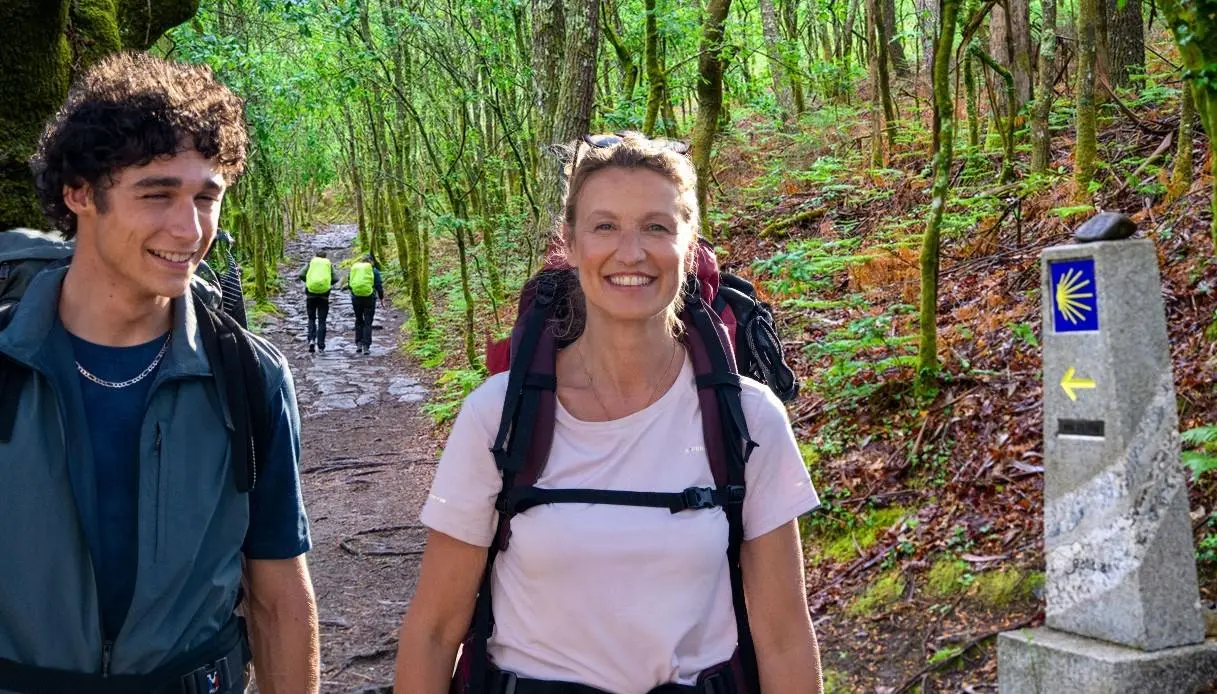
More than a film about the Camino de Santiago, Yann Samuell’s movie, newly released in theaters, is about how to set out on a journey and, even if only temporarily, move away from certain knots in one’s life and how that can help unwind them. The landscapes, even stunning, that the two leads, played by Julien Le Berre and Alexandra Lamy, traverse with backpacks, remain above all a reassuring and consoling backdrop to a journey that is first and foremost interior.
This doesn’t mean that the choice of locations for Santiago – A Path to Begin Again was left to chance: trails, albergues, and medieval villages where the film was shot have the power to make the viewer feel, in some sense, as if they are on the road too.
What it’s about
The film is inspired by the book “Marche et invente ta vie” by the French writer and by the experiences of the association (Seuil) founded by him, which organizes solitary marches for troubled adolescents, with criminal records or entrusted to social services. Adam, one of the two protagonists of Santiago – A Path to Begin Again, is one of them: a boy scarred by a past of abandonment and anger that threatens to compromise his future. Fred, the other protagonist, is a high school teacher facing a failing marriage, a teenage daughter who seems unable to tolerate her, and a big problem with a student in her class: perhaps for this reason she accepts a friend’s invitation to accompany Adam on the Camino de Santiago. The three months spent side by side and the inevitable hardships of the journey will demand self-control from both, but more than anything they will lead them to (re)discover who they are and who they truly want to become.
Where was the film shot
Le Puy-en-Velay
Adam and Fred’s journey in Samuell’s new film begins at Le Puy-en-Velay, a historic starting point of one of France’s most important pilgrimage routes, the Via Podiensis.
This town in Haute-Loire, notable for the volcanic origin of its landscape, which is reflected in the characteristic use of the dark local stone as a preferred building material, exudes spirituality. It does so especially in places like the Chapel of Saint-Michel d’Aiguilhe, iconic for its perch on the rock, from which the Camino officially begins for many pilgrims.
The Via Podiensis
Especially if, like the film’s protagonists, you decide to embark along the aforementioned Via Podiensis (also known as the Le Puy Way or, in official nomenclature, the GR®65 route). Completed for the first time around the year 950 by the Bishop of Le Puy, this path was forgotten for centuries before being rediscovered in recent years—primarily by French and German pilgrims—thanks to the growing interest in the Camino de Santiago.
For more than seven hundred and fifty kilometers—the distance that strictly links Le Puy-en-Velay with Saint-Jean-Pied-de-Port, where one reconnects with what is effectively the French Camino—the Via Podense crosses regions of southern France such as the Haute-Loire, but also Lozère, Aveyron, and Lot, which are also the places where Santiago – A Path to Begin Again was filmed.
Here, landscapes of varied kinds—from valleys lush with vegetation to medieval villages where time seems to have stood still, mixing naturally with abbeys, monasteries, and other sacred places—alternate, allowing the pilgrim’s gaze and that of the viewer watching on screen to continually marvel.