
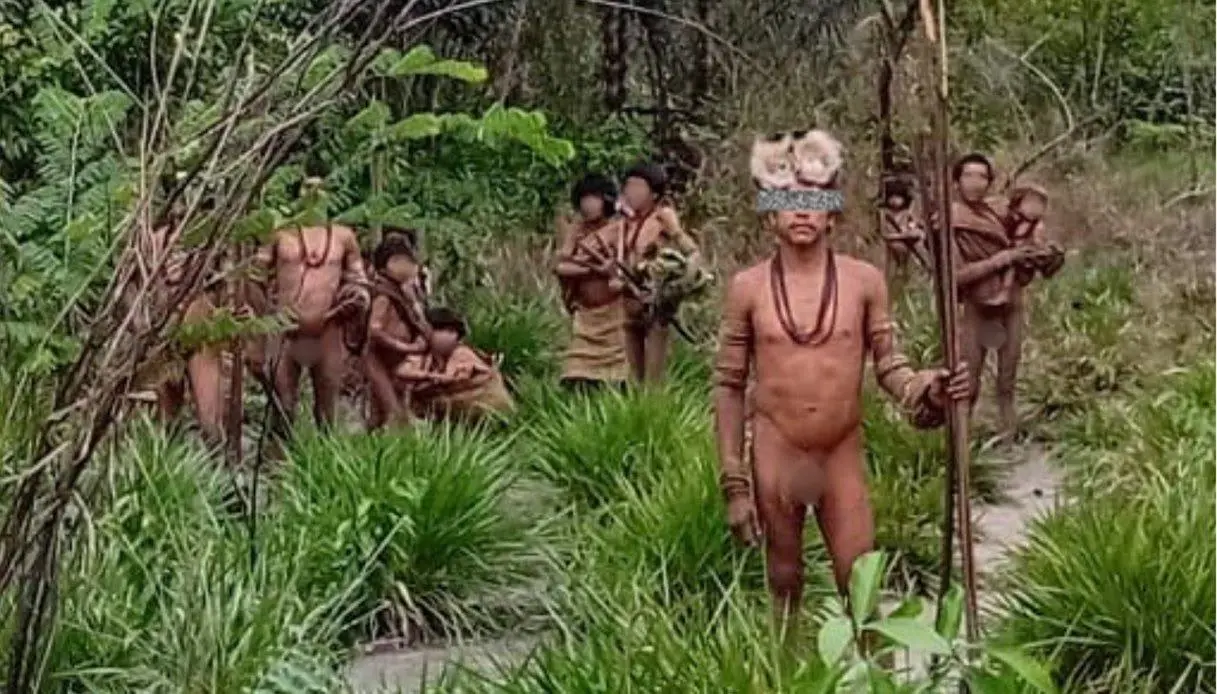
You can see the necklaces and the long arrows, alongside the faces of men, women, and children peering out from among the leaves. It is Monday, November 16, 2026 when about twenty Awá emerge from the Arariboia Forest in the Brazilian state of Maranhão to approach a FUNAI base in the Arariboia Indigenous Territory.
What they are seeking is yam, a tuber similar to a potato. The Guajajara who live there share it with them, and the Awá carry it with them among the trees, from where they continue to observe without moving away. It was the Guajajara themselves who filmed the scene, and the video, released by Survival International, is one of the few documents showing a people who chose to live apart from the world and who, for a moment and out of necessity for survival, decided to reveal their faces.
Who are the Awá
The Awá are expert hunter-gatherers: they hunt with bows and arrows, gather wild honey and babassu nuts, and their culture is deeply tied to the forest.
Contacts with the outside world have been marked by violence and disease, with outbreaks of influenza and measles. Also for this reason, in 1987, FUNAI adopted a policy of non-contact, which envisions the intervention of dedicated teams only when an isolated group is in imminent danger.
The encounter with Tawari also raises concerns. According to COAPIMA, the organization representing the indigenous peoples of Maranhão, some members of the group, especially children and elders, showed evident signs of severe malnutrition, and an unplanned contact would expose them to diseases to which they have little or no defense.
A shrinking forest surrounded by destruction
According to Survival International, the push for food by the Awá may be driven by the increasing invasions into Arariboia, now increasingly besieged by illegal loggers, hunters, and ranchers. The pressure on their territory has deep roots: between the late 1970s and early 1980s, the Carajás railway had split it in two, bringing settlers and ranchers with it.
In 2018, according to National Geographic, Maranhão had already lost about 75% of its original forest. For Caroline Pearce, executive director of Survival, invaders are advancing from all sides and cornering the Awá into an ever-smaller island of forest, surrounded by destruction. Hence the call to the Brazilian government to allocate the resources necessary to protect Arariboia.
Faced with the government’s inability to protect the territory, it is the Forest Guardians, a group of Guajajara, who have been opposing illegal loggers and ranchers for years. It was they who asked Survival to disseminate the images. They report that climate change, fires, deforestation, and invasions are directly affecting the Awá lands and their way of life, which depends entirely on hunting and gathering, and they call for immediate intervention by the authorities.
The story of the Awá is not an isolated one. Between 2012 and 2014 another of their territories, not far away, was at the center of Survival’s campaign, which labeled them “the most threatened tribe on the planet.” Today, the organization counts about 196 uncontacted peoples and groups across 10 countries. More than 90% live in the Amazon, primarily in Brazil, while the others are in Indonesia and India. As COAPIMA has stressed, this episode underscores how vital it is to protect them, respect their autonomy, and safeguard their territorial rights.
