
Breathing clean air in European cities remains a privilege for a few. And Italy, once again, does not shine. None of the Italian cities examined appears among the top twenty for air quality, while Milan and Turin end up in the lower ranks. It is the City Ranking 2026: Free to Breathe, published by Clean Cities, that takes stock of air quality across 40 major European cities. And the overall picture that emerges is far from uniform.
The data analyzed do not concern only the levels of nitrogen dioxide and fine particles, but also the changes implemented in recent years through measures introduced to limit pollution. The comparison is between data from 2023-2025 and those from 2016-2018. The North is progressing, while much of the Mediterranean region lags behind. And with the new European limits on air quality to be met by 2030, the window to intervene is tightening.
The European cities with the cleanest air
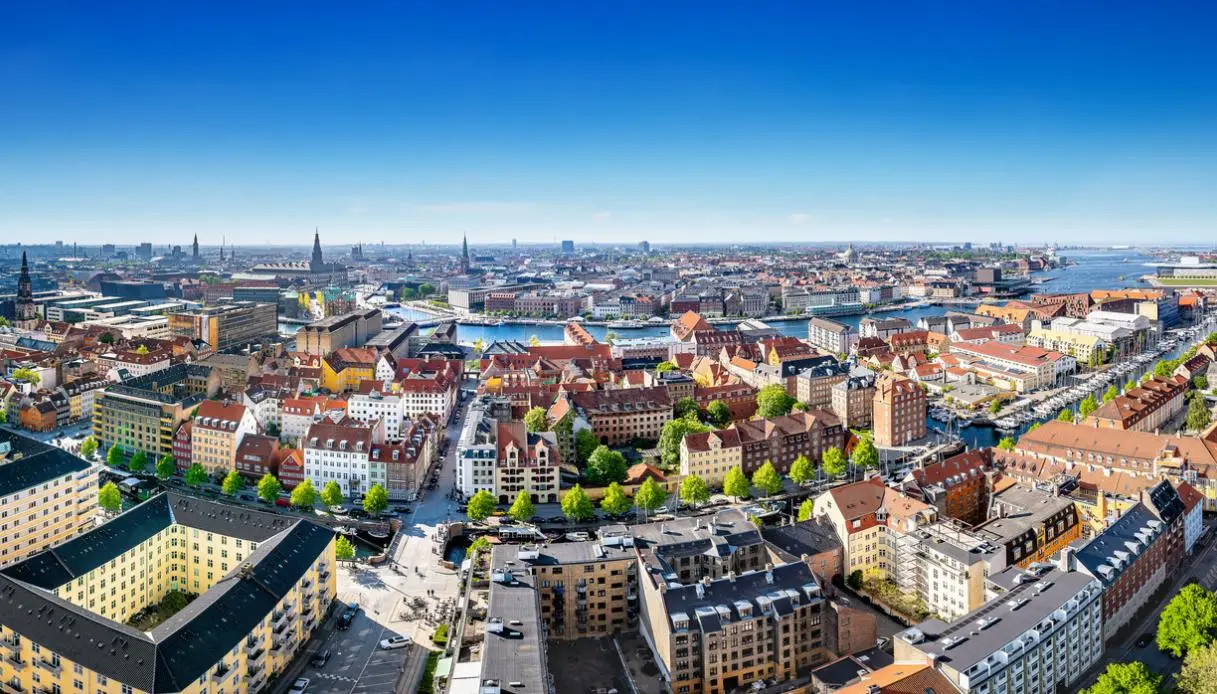
Taking first place is Copenhagen, with a score of 91.3% and an A rating. The Danish capital stands out not only for relatively contained pollutant concentrations, but also for its mobility choices. Electric buses, widespread bike lanes, restrictions on the most polluting vehicles, and safer streets near schools have contributed to the result.
Right behind it are Stockholm, second with 84.7%, and Helsinki, third with 81.5%. It is precisely these three Nordic cities that are the only ones among the forty analyzed to already meet all four daily and annual thresholds considered by the study for NO₂ and PM2.5.
Off the podium, Belgium claims two notable spots: Ghent is fourth with 70%, Brussels fifth with 68%. They are followed by Bilbao, Munich, Cologne, Vienna and Amsterdam, which closes the top ten with 63.5%.
The top 20 European cities with the cleanest air:
- Copenhagen, Denmark;
- Stockholm, Sweden;
- Helsinki, Finland;
- Ghent, Belgium;
- Brussels, Belgium;
- Bilbao, Spain;
- Munich, Germany;
- Cologne, Germany;
- Vienna, Austria;
- Amsterdam, Netherlands;
- Berlin, Germany;
- Hamburg, Germany;
- Lisbon, Portugal;
- Stuttgart, Germany;
- Oslo, Norway;
- London, United Kingdom;
- Valencia, Spain;
- Barcelona, Spain;
- Bratislava, Slovakia;
- Dublin, Ireland.
The most polluted cities in Europe
At the opposite end of the ranking sits Athens, in the fortieth place with only 23% and a rating of F. A little higher is Bucharest, thirtieth-ninth with 29.8%. Zagreb occupies the thirty-eighth spot with 31.8%. Notably, Poland appears at the tail end of the ranking with three cities: Warsaw, Wrocław and Kraków, ranking from 33rd to 35th respectively.
The Italian Situation
To find the first Italian city, one must descend to the twenty-second position, held by Florence, which earns 54.2% and a D rating. Bologna is twenty-seventh with 48.3%, while Rome slips to the thirty-second position, at 40%.
Even worse are Milano and Torino. The Lombard capital is thirty-sixth with 35.5%, followed immediately by the Piedmontese one, thirty-seventh with 35%. Both receive an E. The main reason for this disappointing performance? Certainly road traffic, which, especially in the Po Valley basin, remains a problem despite some interventions to improve mobility.
