
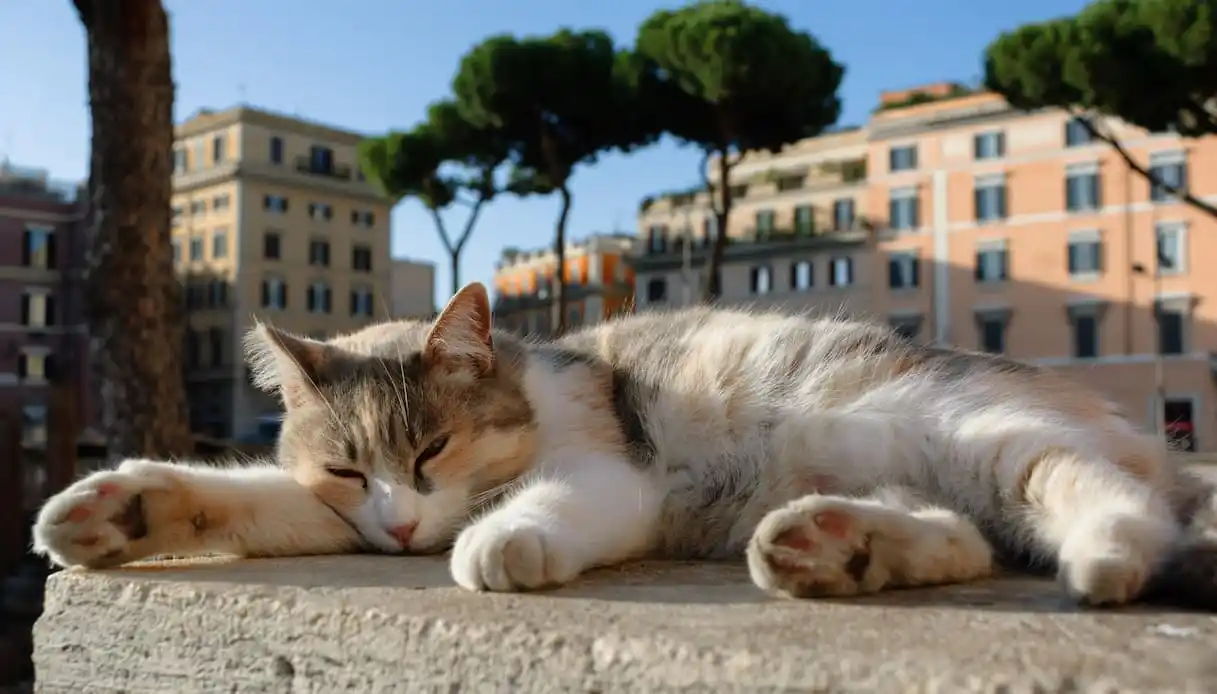
Those who love cats know it: just spotting one at the end of an alley is enough to change course and press on toward its path in search of a cuddle. In Manhattan there’s a hotel where the most famous resident has four paws and is named Hamlet VIII. In Japan you take the ferry to reach an island with a sanctuary dedicated to cats and cat-shaped houses. In Rome you only need to veer toward Largo di Torre Argentina to discover a feline colony among the ruins.
Certainly this is the most curious side of Catnomics, the economy that revolves around cats and that, when tourism meets it, can even decide the next destination.
Catnomics, the phenomenon that is taking over the world
In Japan they call it Nekonomics, from neko, “cat.” The term denotes the economic impact of felines, ranging from the expenses for those who own one at home to the activities that revolve around their popularity. For 2026, Katsuhiro Miyamoto, emeritus professor at Kansai University, estimated an impact of nearly 2.95 trillion yen in Japan alone. The figure concerns the feline economy as a whole, of which tourism is a component.
In travel the phenomenon takes on diverse forms. Some opt for a hotel for the story of its resident cat, some make a stop in a neighborhood to search for , and some visit a shelter to learn about the volunteers’ work. From here emerges our selection, spanning from the Japanese islands to the bookstores of Istanbul.
The most incredible places in the world to visit for those who love cats
Hotels where cats are the honorary guests
At The Lanesborough in London, at Hyde Park Corner, lives Lilibet, a Siberian cat whose name echoes Elizabeth II’s nickname. In Manhattan, conversely, The Algonquin Hotel has carried on for nearly a century the tradition of resident cats. The current host is Hamlet VIII, a domestic shorthair adopted by the hotel, presented as its feline concierge.
Libraries and shops where cats take center stage
From Shakespeare and Company, the English-language bookstore on the Seine a few steps from Notre-Dame, cats are also part of the place’s history. In Istanbul it’s worth exploring the booksellers of Sahaflar Çarşısı, the Beyazıt used-book market. At the Dilmen bookstore, among the volumes, cats like Naciye and Sado are at home. In Tokyo, along the shopping street Yanaka Ginza, the game is to spot feline figurines among the shops and browse cat-themed objects.
Streets and neighborhoods where cats feel at home
Among the colorful houses and cafés of Balat, in Istanbul, cats are part of neighborhood life. In Rome, instead, the stop is Largo di Torre Argentina, where volunteers take care of the feline colony beside the archaeological area. It is possible to visit the shelter and support the association’s work with a remote adoption.
The cat islands, from Japan to the Cyclades
On Tashirojima, in Japan’s Miyagi Prefecture, cats already meet at the port of Nitoda. The island has a sanctuary dedicated to felines and even a campground, Manga Island, with cat-shaped cottages. Also Aoshima, in Ehime Prefecture, has become famous for its colony, now much smaller than in the years when the island went viral. In the Cyclades the stop is Syros, where the Syros Cats association cares for strays and welcomes visitors by appointment at the Kini shelter.
Cat cafés and restaurants for a break among the purrs
In Tokyo, Temari no Oshiro seems like a fairy-tale castle hidden among the shops of Kichijōji. In Milan, the Crazy Cat Café has brought the Japanese neko café model to a bistro near Milano Centrale station. In Paris, finally, Le Café des Chats is a restaurant and tea room near the Bastille, where cats adopted through animal-protection associations live. The beauty of the pause is watching who approaches on their own initiative, perhaps just as dessert arrives.