
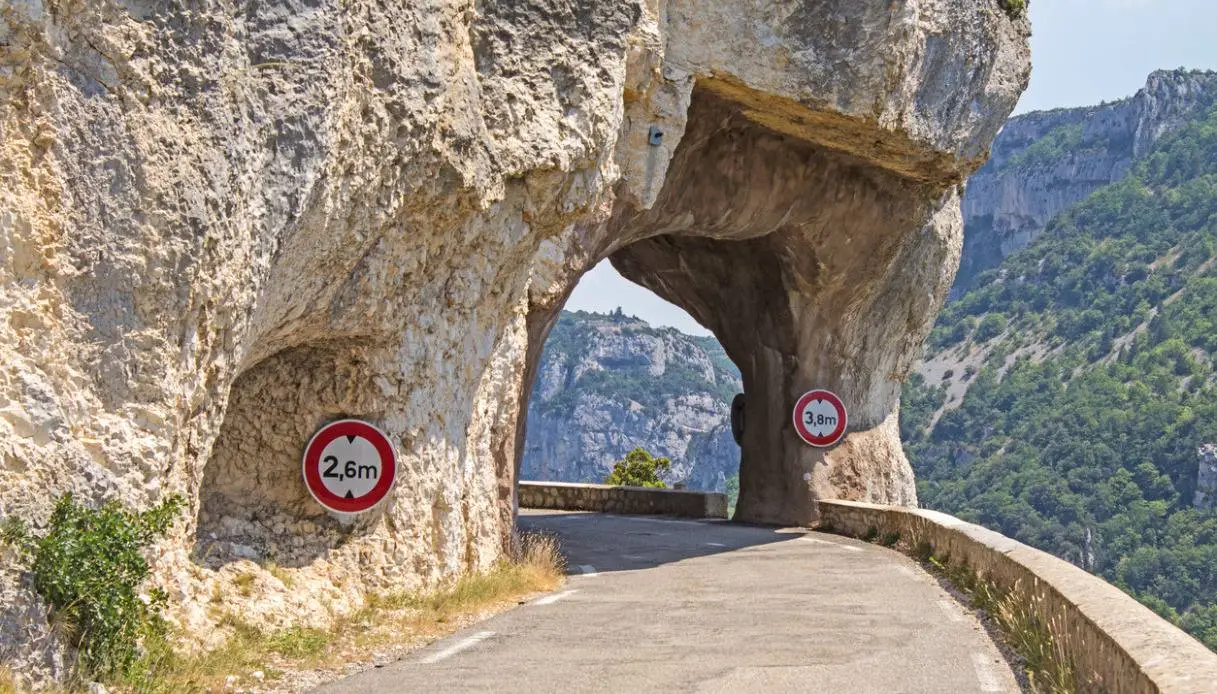
Provence is often associated with lavender and the summer sun, but this magical French region hides natural settings that can enchant even the most skeptical. You only have to round a bend to understand it, because that is where the mountains open up, the road tightens against a limestone cliff, and beyond the edge of the asphalt an impressive drop appears. They are the Nesque Gorges, one of the most spectacular natural landscapes in southern France.
Hidden among the Monts de Vaucluse, it is a canyon that in places reaches depths of over 400 meters. Shaped by a relatively modest watercourse, the Nesque, which over millions of years has carved an extraordinary limestone plateau. For about 20 kilometers, slopes cloaked in vegetation, enormous blocks of pale rock and sheer cliffs that seem to abruptly interrupt the continuity of the mountains alternate along the route.
To make the panorama even more distinctive is the D942, one of the most evocative balcony roads in the country, built along the canyon’s flanks and punctuated by short tunnels. But that’s not all: the Nesque Gorges also harbor prehistoric testimonies, a tiny Romanesque chapel carved under a natural overhang, and a biological heritage so precious that it is included in the Mont Ventoux Biosphere Reserve recognized by UNESCO.
Origin and formation of the Nesque Gorges
The limestone rocks that make up the walls of this French canyon come from ancient marine sediments, later raised and deformed by geological movements. On this structure, the Nesque acted, progressively carving a crack that grew deeper and deeper and gave rise to the present-day landscape.
Water and limestone, for their part, continued to interact beneath the surface as well, weaving a karst environment pierced with caverns, fissures and subterranean passages. During the drier months, the riverbed may appear almost completely dry, because part of the current seeps into the rocks. After heavy rainfall, instead, the torrent returns to show its strength.
This apparent absence of the river is one of the most curious aspects: from above you can clearly see the enormous groove carved by the water, while its course often remains invisible. Long before the road was built, however, these mountains were already frequented by humans.
In the area, archaeological excavations have indeed uncovered flint tools, bone remains and evidence of ancient hunters dating back to about 150,000 years ago. The particular name of one of the most famous formations carries a nature-related tale: the Rocher du Cire, literally Wax Rock, owes its name to the swarms of wild bees that once inhabited its cavities.
What to see and do during a visit to the Nesque Gorges
Besides being exceptional, the Nesque Gorges also allow you to choose between two very different viewpoints: the first follows the mountain profile along a roadside that offers spectacular viewpoints; the second descends into the heart of the canyon, thanks to steep trails and largely untouched wilderness.
The D942, between Villes-sur-Auzon and Monieux, is a carriageway that follows the irregularities of the walls, passes through tunnels carved directly into the rock and looks out onto deep natural incisions. What leaves you speechless is that, in certain sections, the stone seems to almost brush the vehicle, while a few meters later the view opens onto a completely opposite slope.
Among the most evocative stops is the Belvédère du Castellaras, also known in the Castellas variant, overlooking a precipice of about 300 meters. Opposite rises the Rocher du Cire with its typical shades ranging from gray to ochre.
Reaching the canyon floor, you then have the chance to notice beneath a vast natural shelter the Saint-Michel d’Anesca chapel, a small Romanesque building dating back to the 12th century. Its location is remarkable, because part of the structure is protected directly by the rock above that forms something like a natural roof. A little higher, additional rocky shelters opened that were already frequented in prehistoric times.
The gorges also stand as one of Provence’s most interesting areas for those who love outdoor activities. The trails wind through woods, scree and rocky slopes, with varying elevations. Some routes allow short panoramic hikes, while those directed toward the stream present more challenging sections. The GR9 trail crosses the Monieux sector and allows exploration of more secluded stretches of the landscape.
For cyclists, in turn, the about 21 kilometers of the road between Villes-sur-Auzon and Monieux are a dream: the climb unfurls gradually, accompanied by ever-wider panoramas. There are also longer cycling circuits that pass through Méthamis and Javon forest. Finally, a visit can also include the two towns connected by the scenic road:
- Monieux: with the atmosphere typical of the small hilltop villages of Upper Provence and full of cobbled lanes, stone houses and an agricultural landscape characterized by lavender and small spelt.
- Villes-sur-Auzon: historic nucleus with a distinctive circular layout, memory of the ancient medieval fortifications. Around the town lie vineyards belonging to the Ventoux AOC designation.
Where they are located and how to get there
The Nesque Gorges are located in the Vaucluse department, in the French Provence-Alpes-Côte d’Azur region, south of Mont Ventoux and a short distance from the Sault plateau. The easiest way to reach them is by car (also because the scenic road is worth it), driving along the D942 that connects Villes-sur-Auzon to Monieux.
Coming from Avignon or the A7 motorway, you can follow the direction toward Carpentras, continue toward Mazan and reach Villes-sur-Auzon, the ideal starting point for the panoramic traverse. Access to the natural site is free, while for hikes it is advisable to obtain route indications at the local tourist offices.
