
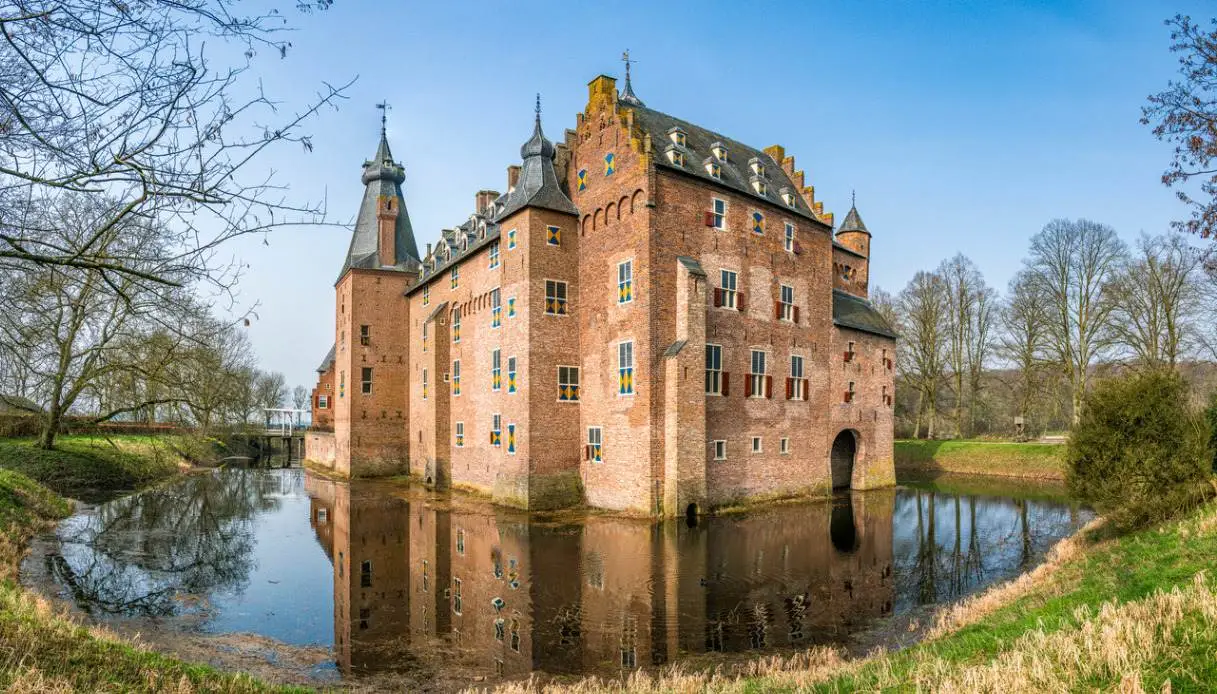
Leaving behind the windmills of postcard classics and Amsterdam’s crowded canals allows us to discover a decidedly wilder and quieter face of the Netherlands. In Gelderland province, a short distance from the city of Arnhem, there is indeed a wooden bridge crossing a nearly motionless pond, while tall red-brick towers rise above a moat and a stretch of woods covers the hills, before opening onto the plains crossed by the Rhine. It is here that Doorwerth Castle rises, one of the most fascinating testimonies of Dutch fortifications.
Unlike noble residences transformed over the centuries into sumptuous palaces, Doorwerth still today preserves the stern aspect of a medieval fortress, though it shows the adaptations introduced to make it a comfortable residence. And in its rooms, according to a local legend, the ghost of a young woman who died tragically would still roam.
Brief history and legends of Doorwerth Castle
In the XIII century the Van Dorenweerd family controlled these Dutch lands along an important waterway. Here a first fortification arose, but it was besieged and burned. It was thus replaced by another stone construction protected by a moat fed by the waters of the Rhine.
Also this new structure, unfortunately, faced difficult times: in 1280 it suffered another siege, during which the fortified courtyard was burned. Despite everything, part of that construction is still recognizable in the eastern wing. Throughout the Middle Ages, Doorwerth grew together with the power of its owners, but especially crucial were the interventions promoted by Daem Schellart van Obbendorf, under whom, around 1560, several building blocks were brought together and the living spaces expanded.
In the XVII century the new entrance complex, the service buildings and the embankments intended to protect the estate from floods were added. The result was an articulated architectural ensemble, with a main four-wing fortress and an external courtyard destined for daily activities.
Meanwhile, the castle had become the center of a lordship endowed with considerable privileges, including the right to administer justice. Among the figures tied to the estate is Charlotte Sophie van Aldenburg-Bentinck, an eighteenth-century aristocrat with an anticonformist personality. Her correspondence, comprising about 25,000 letters, includes exchanges with figures such as Voltaire and Frederick the Great of Prussia.
Over the years, however, the castle progressively lost its residential function and in 1837 was purchased by Baron Jacob Adriaan Prosper van Brakell. He launched an important restoration project and introduced Neo-Gothic elements. After his death, a new period of decay began, interrupted in 1910 thanks to the intervention of former artillery officer Frederic Adolph Hoefer. Doorwerth later became the site of the Dutch Museum of Artillery.
But to be perfectly honest, the deepest wound arrived during World War II, because in September 1944 the complex lay on the front line and suffered severe damage due to military operations. It took as many as 37 years of restoration, completed in 1983, to restore its historical appearance.
And the story of the castle is made even more singular by legends. The best known speaks of a young woman confined within the walls and starved to death, whose spirit would still appear in the northern wing (especially in the Hunting Hall).
Visiting Doorwerth Castle
To enter Doorwerth Castle, one must cross a bridge from which it’s possible to observe the moat surrounding the complex, the towers guarding the access points, and the brick façades that display windows of different sizes. There are colored shutters, slate-roofed coverings, and small decorative elements that in some way soften the fortress’s austere appearance.
Beyond the portal, a complex of buildings from different eras unfolds. The external courtyard housed the structures necessary for the estate’s operation, including stables, carriage storages, and service lodgings. Inside the main fortress, today transformed into a museum, the historic rooms help illuminate the daily life of its inhabitants.
Reception rooms, chambers, and domestic settings cradle furniture, objects, and works of art from different periods. Particularly interesting is the Hall of Armors, which is supported by the military equipment used in past centuries. Children can even wear a chain mail coat, discovering the weight of protection made up of thousands of interwoven metal rings.
The southern wing also hosts exhibitions dedicated to the castle’s history, to forest management, and to the Netherlands’ hunting tradition. Noteworthy is the Historic Garden, laid out according to principles inspired by the tradition of Dutch gardens: neat flowerbeds and cultivation highlight the importance of vegetables, aromatic herbs, and flowers in the economy of the old noble residences.
Not far away stands the famous monumental robinia, a tree with a decidedly singular history: according to the most widely supported reconstruction, it was planted around 1678 together with two other specimens to celebrate, probably, the Peace of Nijmegen. The other trees disappeared in the 19th century, while the surviving one even survived the devastations of war. The visit can continue in the park and the surrounding woods, along the paths of the Duno estate and the flat areas near the river.
Where it is and how to get there
Doorwerth Castle is located in the Netherlands, specifically in the Gelderland province at the address Fonteinallee 2B, in the municipality of Renkum. We are about 10 kilometers west of Arnhem, near the Nederrijn, the Lower Rhine.
To reach it by car you can use the A50 highway, taking exit 19 toward Renkum. A nearby, generally free parking is also available.
Those who prefer public transport can depart from Arnhem’s train station and continue by bus toward Doorwerth. From the stops Winkelcentrum de Weerd or Heveadorp Veerweg it takes about a 15-minute walk. For those who love cycling, the Rhine-side location also allows you to integrate Doorwerth into a route through Gelderland’s historic estates and river landscapes, following the bike paths that connect Arnhem to the surrounding villages and green areas.
