
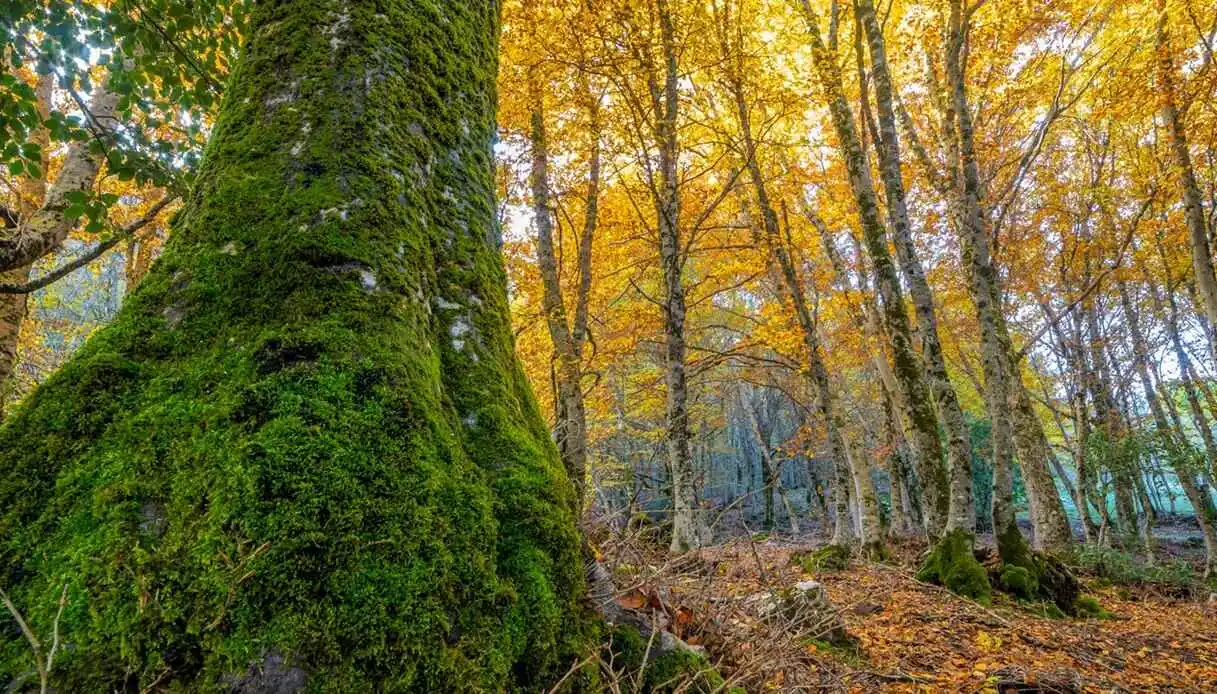
For many, the Sicily is synonymous with sunshine, sea, and a summer that seems to stretch on, extending into late autumn. Yet, sooner or later, the seasonal switch arrives on the island as well, and you can enjoy it by discovering its mountainous, wild, and quiet side, which in autumn fills with color: the Nebrodi Mountains, the forested spine that runs along the Tyrrhenian coast of Messina Province, offer a natural spectacle that is hard to match.
Here, indeed, foliage does not rush. Between 1300 and 1800 meters above sea level, beech forests shift to yellow, brown, and copper, but all this happens from the end of October into November, later than elsewhere. The spectacle is best enjoyed on foot, exploring the trails that branch across the slopes of the Nebrodi Nature Park. Golden beech woods reflect in the small, tranquil mountain lakes, while in the background, on the clearest days, the imposing and noble silhouette of Etna emerges.
The Nebrodi Nature Park
The Nebrodi Nature Park is the largest protected area in Sicily. Established in 1993, it covers over 85,000 hectares across the provinces of Messina, Catania, and Enna and involves a total of 24 municipalities, standing as a counterpart to the island’s northern coastline. Together with the Peloritani Mountains and the Madonie, the Nebrodi mountain chain forms the Sicilian Apennines: to the east it is bounded by the Alcantara River, famous for its Gorges, and to the west by the upper course of another river, the Simeto. The highest peak is Monte Soro, at 1847 meters above sea level.
These are mountains with gentle curves, whose terrain is mainly composed of clay and sandstone: there are no steep rock faces or sharp summits, but soft slopes and rounded crests, covered by dense forests. Historically a land devoted to shepherding, with scattered clusters of houses, the Nebrodi remain a rural life stronghold even today. It is no accident that they host three local breeds of some typical countryside animals: the black pig, the Nebrodi goat, and the Sanfratellano horse.
Another peculiarity of the Park is its pristine nature: over 50,000 hectares are forested, making it the island’s largest forested heritage. Up high, as noted, beech reigns, but in the undergrowth evergreens grow, such as holly, ivy, and yew (the shrub, not the animal).
The Nebrodi fauna includes the rare and elusive wildcat, the martora (pine marten), and other more common animals such as the porcupine and the wild boar. In the skies watches the eagle, but in recent years the griffon vulture has been reintroduced, a raptor that had been close to extinction in Italy and who, through a reintroduction project, was successfully saved and brought back to these zones, among others across the country.
The best foliage hikes on the Nebrodi
For foliage-focused hikes, the most convenient starting point is the side of the Park where Cesarò is located, a small municipality in the province of Messina particularly known for its traditional cuisine.
From Portella Femmina Morta, 1524 meters above sea level, easily reached along the SS 289 between San Fratello and Cesarò, begins a good portion of the trails, including the Nebrodi Ridge, the longest linear trek in Sicily, about 80 kilometers long and laid along the crest of the Sicilian Apennines, in the heart of the Nebrodi Nature Park.
From Maulazzo Lake to Biviere Lake
This is a great classic of the Nature Park, perhaps its most representative route, because it links the two symbolic lakes of the territory along a stretch of the Nebrodi Ridge, which itself is part of the Sentiero Italia.
From Portella Femmina Morta the hike begins and after about an hour reaches Maulazzo Lake, at an altitude of 1400 meters. It is an artificial basin of five hectares, built in the 1980s by the Forest Service, which the surrounding forest has since claimed as its own. It sits nestled in the Sollazzo Verde beech forest, at the foot of Monte Soro, and in autumn the yellow canopies reflect on the water.
From here you traverse an initially flat stretch, then reach Portella Calacudera, in a wooded area that becomes truly magical in autumn. Several streams are crossed as you skirt the silhouette of Monte Soro, and then with a long, gentle descent you continue to Lago Biviere, one of only five natural lakes in Sicily and considered the island’s most important high-altitude wetlands. Around rise the beech forests of Monte Soro, with the Rocche del Crasto and Etna on the horizon.
The route is not technically difficult, but it is fairly long: about 17 kilometers in total for an estimated total time of eight hours. The elevation gain is modest, around 600 meters. If you take your time and start early in the morning, you can easily complete it in a November day.
From Portella Femmina Morta to Monte Soro
For those who want to climb to the Nebrodi’s highest peak, Monte Soro, the journey still starts at Portella Femmina Morto. After about two kilometers you reach the aforementioned Portella Calacudera, where the road forks: to the left you head toward Maulazzo Lake, to the right you ascend to Monte Soro.
The final stretch is on asphalt, but what makes the difference is the surrounding environment: Monte Soro’s beech forest is among the park’s most expansive and is famous for its centuries-old specimens. Along the way you encounter the Acerone of Monte Soro, a maple estimated to be around five hundred years old, and a true spectacle of nature. From the summit, on clear days, the view stretches from Etna to the Aeolian Islands.
The Portella-to-summit route is about 5 kilometers long, with a positive elevation gain of 300 meters. A gentle and enjoyable climb through a forest enchanted by autumn colors, followed by a comfortable return via the same path or a detour all the way to the shores of Maulazzo Lake.
Santa Maria del Bosco Shelter
Along the Magna Via Francigena Normanna segment that runs from Randazzo to Floresta, you encounter Santa Maria del Bosco Shelter, a restored farmstead by the Forestry Company at about a thousand meters above sea level.
The shelter is a strategic stop along this historical trail, located about four kilometers on foot from the trailhead gate on the Randazzo side. From Santa Maria del Bosco, the more intrepid hikers can continue uphill toward Floresta, the highest town in Sicily, walking among beech forests, oak woods, and high-altitude pastures, for a total journey close to 17 kilometers.
Those who prefer a peaceful stroll can stop to enjoy the rustic comforts of the shelter. Not far away there is a always-open bivouac, with a fireplace and bunk beds, in addition to a large picnic area with fountains and playgrounds for children.
The forest around the shelter originated from a reforestation project, so pines and spruces, evergreen trees, predominate. Yet, precisely because of this, the autumn colors stand out: maples, ashes, beeches, and chestnut trees that intersperse the planted trees light up in yellows and ochers, contrasting with the dark green of the conifers.
