
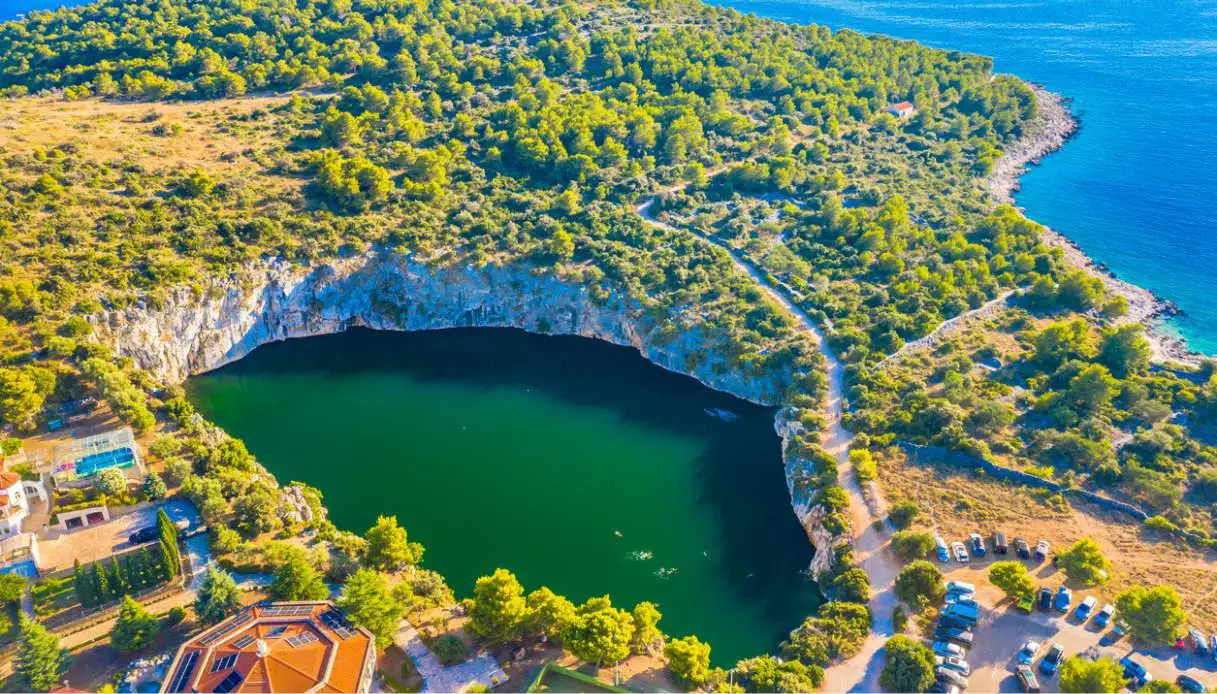
On one side lies the deep blue of the Adriatic Sea, and on the other a dark mirror of water ensconced within high walls of limestone rock. The sound also changes here, giving way to an unusual silence that accompanies the discovery of a natural hollow that, when viewed from above, resembles the wide-open eye of a gigantic creature. That is Zmajevo Oko, literally Eye of the Dragon, a small saltwater lake situated on the Gradina peninsula near Rogoznica, a coastal town in central Dalmatia.
Although it is very close to the sea, it appears completely separated from it, a kind of natural pool (though it is not) carved into the rock. Its waters, however, conceal a network of underground connections and chemical characteristics so peculiar that they have attracted the attention of scientists for decades.
But that’s not all, because in these parts there even occurs a periodic phenomenon during which the surface changes color, becomes turbid and seems to boil. Some swear that this is the waking of a legendary dragon, while science has identified a very different explanation, yet no less fascinating.
Origin, Formation and Legends of Zmajevo Oko
Thousands of years ago, the Adriatic landscape of this stretch of Croatia (and beyond) differed markedly from what it is today. The lake occupies a karst depression formed in the limestone ground, likely through dissolution and erosion of the rock and the collapse of an underground cavity. After the last glaciation, the gradual rise of sea level favored the intrusion of saltwater, transforming the hollow into a basin with an unmistakable elliptical shape.
Although it may appear isolated from open sea, it hides a network of fissures and underground passages that allow water exchange. One of these is the cavity known as Zmajevo Uho, the Dragon’s Ear. The maximum depth is about 15 meters, a seemingly modest measure that conceals extraordinary environmental conditions.
The waters actually form distinct layers by temperature, salinity and chemical composition. In the surface portion there is oxygen, while deeper down sulfur compounds accumulate and anoxic conditions develop, meaning the absence of dissolved oxygen.
These conditions also give rise to the different color tones, ranging from the green and blue of the upper waters to the reddish and purplish hues associated with chemical processes in the lower layers. The boiling phenomenon occurs when particular weather conditions provoke a sudden mixing: substances at the bottom reach the upper layers, oxidation of sulfides rapidly consumes oxygen, and the water may take on a turbid appearance, to the point of seeming to boil.
We are talking about a natural event that, though not to be underestimated, should not be taken lightly: the consequences can be serious for aquatic organisms, which risk dying from oxygen shortage. Then, with the restoration of favorable conditions, life gradually returns to colonize the basin.
Long before scientific research, however, the inhabitants of Rogoznica had already found a far more unsettling explanation: according to the best-known legend, Murin lived here, a fearsome dragon born from the union of the goddess Era and Poseidon, the Greek god of the sea. The creature ruled the island of Vela Smokvica and protected the inhabitants from enemy incursions, but demanded a terrifying sacrifice in return.
During the longest day of the year, the territory’s most beautiful girl was handed over to the monster to become its bride, but sadly none of the young women survived the first night of marriage. The situation changed with the arrival of Aristoles, a descendant of the hero Jason, who reached the land on the back of the winged horse Pegasus. Having fallen in love with the girl destined for sacrifice, he faced Murin and mortally wounded him with a specially tied spear, a rite linked to the goddess Athena.
Blinded by grief, the dragon ripped out his eyes with his claws. One eye rolled beyond the island of Mljet, while the other fell at his feet, melting the rock and creating a cavity that the sea immediately filled. From that episode would have originated the Dragon’s Eye. The story, however, also has a romantic twist: lovers who bathe together in the lake are said to be destined for a happy marriage and eternal fidelity.
Over time, even more fanciful interpretations have been added: some tales attribute its formation to the fall of a meteorite, while others imagine an alien spacecraft crashed to the bottom.
Visit to Zmajevo Oko
Access to the area is typically free, and the site can be reached throughout the year, although the summer season presents more favorable conditions for spending time outdoors. Once you reach the edge of the depression, the contrast between the water’s surface and the limestone walls is striking. Some sections are nearly vertical, others feature ledges, small natural platforms and irregularities shaped by erosion.
From the higher viewpoints the shape of the ancient karst basin is clearly discernible. Moving along the surrounding routes, the panorama continually changes, revealing glimpses of the vegetation and the Adriatic Sea—very close yet separated by a rocky barrier.
In summer, Zmajevo Oko is also frequented for swimming, as the surface waters can reach temperatures around 26 °C. The walls also attract cliff divers, but the height of the rocks, irregular seabeds and the particular chemical conditions demand great caution.
Before entering the water it is prudent to check local guidelines and any signs of mixing phenomena. The submerged cavities, on the other hand, require experience and specialized equipment. But the truth is that, even when remaining dry, the visit retains a special charm.
Where It Is and How to Get There
Zmajevo Oko is located in Rogoznica, in the Šibenik-Knin County, along the Dalmatian coast. The town lies between Šibenik, about 35 km away, and Split, at a distance of nearly 53 km. The historic nucleus sits on the former islet of Kopara, linked to the mainland by an artificial causeway. Stone houses, narrow alleys and fishing boats tell the maritime identity of this town, today also known for the modern Marina Frapa tourist port.
Right near the marina, on the Gradina peninsula, lies the Dragon’s Eye depression. From the center of Rogoznica it is possible to reach the site on foot by following the routes that lead to the natural area and its viewpoints.
For travelers by car, the main access is via the coastal road D8, which links the principal Dalmatian destinations. Rogoznica is also served by bus connections to nearby towns. For international travelers, Split Airport represents one of the most convenient gateways.
