
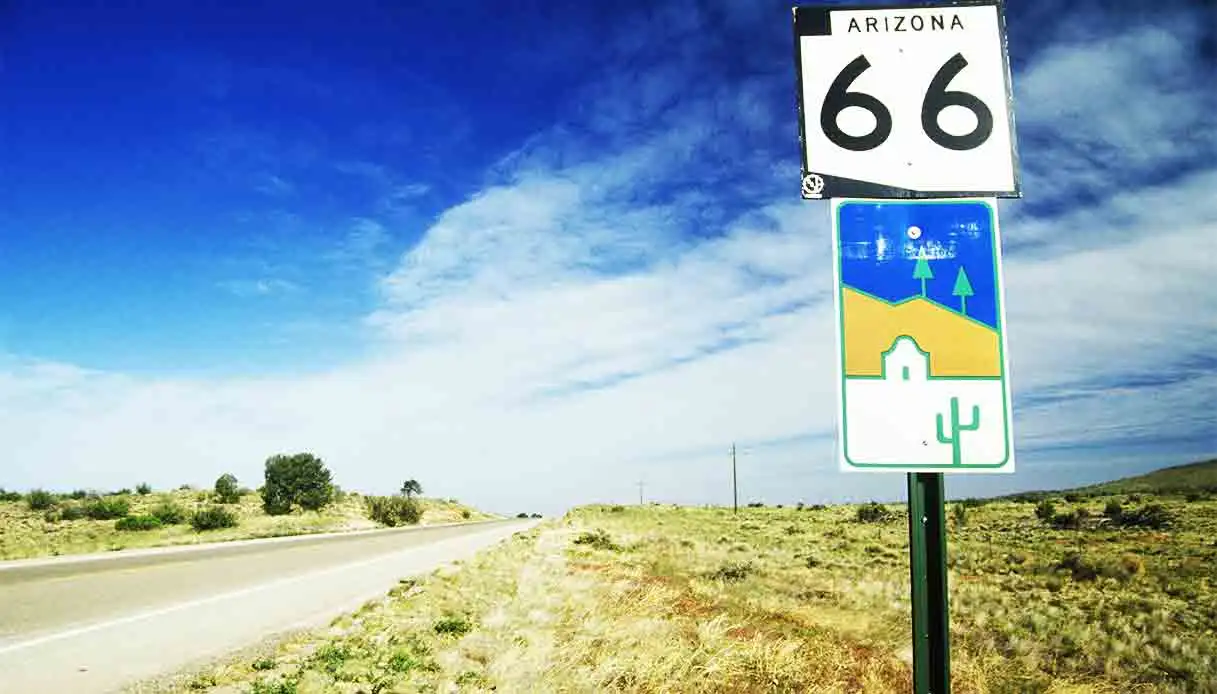
The Route 66 is the most famous road in the world. And everyone dreams of driving it at least once in life. Spanning about 3,940 kilometers, it crosses half of the United States, linking Chicago, Illinois to Santa Monica in California, and passing through Missouri, Kansas, Oklahoma, Texas, New Mexico, and Arizona. The first stretch was inaugurated on November 11, 1926, and this year – specifically on November 11, 2026 – it turns a hundred years old.
Today it is one of the most celebrated on the road itineraries – if not the number one in the world – but creating this road was no easy feat. Consider that for more than half of the journey it traverses lands belonging to more than 25 Native American tribal nations. And it is precisely this aspect we want to focus on, because beyond its historical value there is also a tourism side that deserves consideration if you wish to travel Route 66, but in an authentic way and off the beaten path.
For decades, motels, gas stations and souvenir shops sprung up along Route 66, exploiting a stereotyped western imagery and often distorting or ignoring the real cultural identity of local communities.
The Must-Visit Stops of Route 66 in Native American Lands
Route 66 is much more than a simple road: it is an enduring symbol of adventure, freedom, and connection. Long before it became an icon known as The Mother Road, these routes were ancient Indigenous trade corridors, hunting paths and migration trails used for centuries by Native peoples who linked these communities across the continent.
In New Mexico, Route 66 crosses, or at least brushes, numerous historic Pueblos such as Cochiti, Santo Domingo, San Felipe, Laguna, Acoma, and parts of the vast Navajo Nation, along with the Hualapai tribe in Arizona.
To mark the centenary of Route 66, the American Indigenous Tourism Association and Brand USA wanted to honor its deepest roots with the tour Roots of Route 66 (the roots of Route 66), an itinerary that runs from Arizona to New Mexico.
There are countless experiences tied to the Native American tribes that can be enjoyed along the legendary Route 66. Here are the most evocative ones.
Navajo Nation, the Largest Reservation in the United States
One of the first experiences is certainly the Grand Canyon Skywalk, located in the Hualapai Nation. Traveling along 66, in Arizona, you reach a town called Peach Springs, and it is from here that the road also heads toward the horseshoe-shaped transparent bridge that projects over the Grand Canyon. This bridge extends about 21 meters beyond the canyon rim, offering an unforgettable view of the Colorado River running 1,200 meters below. A place like no other in the world.
Another iconic stop linked to the Hualapai Nation and Route 66 in Arizona is the Peach Springs Trading Post, a cultural landmark built in 1928. It was once a general store serving as a hub for trade and cultural exchange. It remains a unique stop and today houses the tribe’s wildlife and fisheries management office. It inspired Radiator Springs in Pixar’s animated film Cars.
Route 66 also crosses Native lands in the area known as the Navajo Nation & Hopi Tribe, the largest sovereign indigenous reservation in the United States, spanning three states: northeastern Arizona, northwestern New Mexico, and southeastern Utah. Here lies the Walnut Canyon National Monument, ancient cliff dwellings of the Sinagua people – an ancient pre-Columbian culture dating to around 500 A.D. – set into the canyon’s steep walls. This very evocative (and educational) route highlights the resilience and ingenuity of the earliest Indigenous communities.
Just outside the eastern edge of the Grand Canyon lies the Little Colorado River Gorge, a spectacular canyon carved by the river of the same name, also known as the “Grand Canyon in miniature” and well worth a visit: it offers several breathtaking viewpoints and provides a quieter, less touristy alternative to the more crowded overlooks.
In the nearby Moenkopi Dinosaur Tracks, you can even observe ancient dinosaur footprints just outside Tuba City. These well-preserved tracks allow visitors to immerse themselves in a remote past, walking right alongside fossil footprints estimated to be more than 200 million years old.
In the Hopi Reservation
A wonderful tour is the Hopi lands, in northeastern Arizona, straddling the Navajo and Coconino counties. The Hopi are an ancient Native American people who live in this Reservation, surrounded by the Navajo Nation. The name Hopi means “peaceful people,” and for centuries this population has inhabited elevated mesas. So it will be a guided journey across the mesas, the agriculture on which they have long depended, and an opportunity to visit the Moenkopi villages. Guided tours are organized to explore nearby lands and Hopi villages, led by local guides.
The itinerary includes Coal Mine Canyon – a natural wonder rich in color and still relatively little known – and Dawa Park, accessible only with a certified Hopi guide who safeguards hundreds of petroglyphs from different eras. An HopI Arts Trail has also been planned, a journey through Hopi crafts where you can witness traditional basket weaving and discover the secrets of Hopi jewelry making.
The Wonders of the Navajo Nation
The historic Route 66 corridor (and the subsequent Interstate 40 that replaced it) runs near the eastern and southern borders of the Navajo Nation, which includes Apache County, always in Arizona. Here lies one of the most iconic places. The Window Rock Tribal Veterans Park houses Tségháhoodzání, better known as Window Rock, a sandstone arch. The nearby Veterans Memorial pays tribute to the tribe’s military service. If you’re traveling with children, a stop at the nearby Navajo Nation Zoo, the only zoo in the United States owned by a tribe, is worthwhile. This sanctuary hosts animals native to the region.
Among the Pueblos of New Mexico
Route 66 crosses New Mexico for more than 800 km, offering one of the most authentic stretches rich in Native history. One of the stops along the road is the Coronado Historic Site, which was the first state archaeological site opened to the public and is part of New Mexico’s museum system. It corresponds to the Tiwa pueblo of Kuaua. Here you can visit the remains of the Spanish settlement with a guided tour, including exclusive access to the painted kiva and the reconstructed adobe structures. The Indian Pueblo Cultural Center organizes exhibitions, murals, and cultural stories.
Not to be missed is a ride aboard the Sandia Peak Aerial Tramway, a cable car that, in just 15 minutes, takes you to about 3,163 meters of altitude, where you can enjoy a panoramic view of Albuquerque, the largest city in the state, and the surrounding mountain landscape—a setting very different from the deserts and red rocks encountered earlier on the itinerary.
