
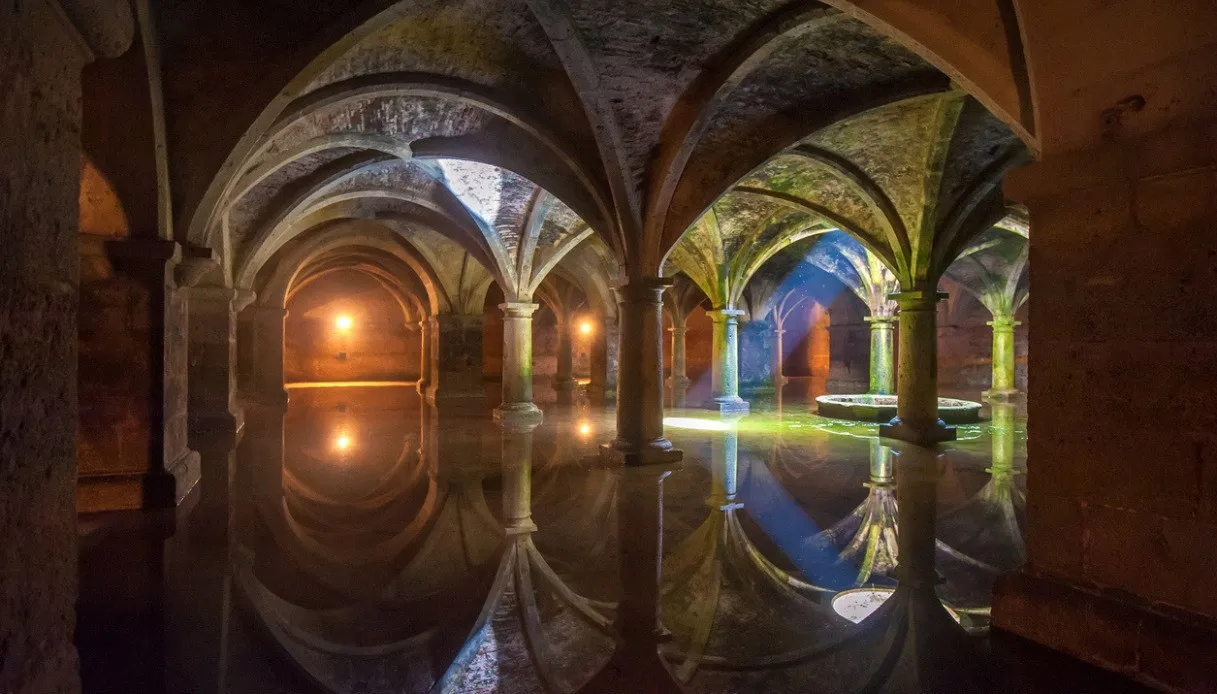
Among the alleys of the ancient Portuguese city of El Jadida (though located in Morocco) lies an underground space with a peculiarity so striking that it’s hard to believe it could be real. In these parts, a stagnant sheet of water remains, in which dozens of columns seem to float and support vaults that appear to extend beneath the floor, while a shaft of light slices through the gloom. An incredible place, so much so that even the slightest movement alters the proportions of the hall, turning a 16th‑century military fortress into a setting of extraordinary atmosphere.
It is the Portuguese Cistern of El Jadida, also known by its French name Citerne Portugaise, one of the most remarkable monuments along Morocco’s Atlantic coast. The most fascinating fact is that behind an architecture seemingly designed to astonish, there hid a vital necessity: providing drinking water to the inhabitants during sieges.
Brief history and legends of the Portuguese Cistern of El Jadida
The origins of the cistern and the fortress’s events are closely tied to the Portuguese presence in Morocco. In 1514, the brothers Francisco and Diogo de Arruda, architects in service of the Portuguese Crown, built Mazagan’s first citadel, intended to protect the kingdom’s commercial and military interests.
Architectural studies place the cistern’s monumental configuration between 1541 and 1547. Those were years in which Mazagan underwent a profound change: on the project of the Italian architect Benedetto da Ravenna, works directed by João Ribeiro and Juan Castillo expanded the fortress, transforming it into a bastioned stronghold capable of resisting the new firearms.
Inside this complex, the reservoir held decisive importance, because during any siege the inhabitants could rely on large quantities of fresh water. Its usefulness became particularly evident during the long period of conflicts that affected Mazagan, including the famous siege of 1562.
The Portuguese presence ended definitively in 1769, when the fortress was evacuated. After a period of abandonment, the settlement gradually repopulated during the 19th century and took the name El Jadida, which can be translated from Arabic as “The New.”
Around the cistern, moreover, a distinctly peculiar story circulates: in 1916 a merchant is said to have discovered it accidentally during works to enlarge his own shop. For decades this version has helped fuel the monument’s mysterious allure.
Yet research conducted by the Moroccan historian Mustapha Jmahri, through consular documents of the era, revealed a different but just as astonishing episode: by the end of the 19th century the cistern was already known, the problem was its severe state of degradation.
Thus, in 1916 authorities launched an extensive remediation operation, begun on January 23 and concluded on April 30, during which enormous quantities of stagnant water, mud and debris were removed. More than a chance discovery, this was the rediscovery of the architectural value of a space that had long remained hidden beneath the city’s transformations.
Visiting the Portuguese Cistern: what to see inside
The charm of the Portuguese Cistern centers on a single, extraordinary space. The main hall presents an almost square plan, with sides of about 33-34 meters, and an architectural organization based on 25 stone supports arranged in 5 rows of 5. Columns and pillars bear an intricate system of arches and vaults that recalls the late Gothic Portuguese style, while the sturdy surfaces, regular proportions, and the sequence of bays create a particularly scenic perspective.
One’s gaze tends to wander among the arches’ openings: from certain angles, the supports seem to multiply, while the farthest parts of the hall fade into darkness. There are those who would swear they are facing a forest of stone that is deeply ordered.
A thin layer of water, kept to enhance the visual effect of the space, makes the lower surface resemble a natural mirror. The architectural structures reflect with such precision that for a moment it becomes hard to tell the real shapes from their inverted images.
At the center of the ceiling opens a circular oculus, originally connected to the water collection system. Through this opening natural light enters, the only element capable of radically altering the room’s appearance throughout the day: during the brightest hours, the light reaches the floor and lights up the reflections, while along the margins the room takes on darker tones and the center adopts silvery and golden hues.
Even the acoustics contribute to the space’s distinctiveness, since the slightest sound can travel through the vaults, accompanied by an echo that heightens the sense of depth.
We are thus talking about a highly theatrical environment, to such an extent that it inevitably attracts (and we might say: inevitably) the cinema’s attention. Among its most famous admirers was Orson Welles, who selected it as a setting for some sequences of Othello, the film adapted from Shakespeare’s tragedy and presented at the Cannes Film Festival in 1952.
Indeed, part of the scene of Cassio and Roderigo’s confrontation was shot among the columns. Welles, among other things, used several Moroccan locations to shoot the film, including Essaouira. The underground hall of Mazagan, however, remains one of the most recognizable settings.
The traditional visit involves access from the Portuguese town and a descent into the subterranean environment. It is a relatively short route, whose main interest lies in observing the architecture from different perspectives. However, it should be noted that, as of November 2026, the Portuguese Cistern is closed to the public for restoration due to infiltrations caused by the heavy rains of 2021.
The project, funded by the Moroccan Ministry of Culture, includes securing the vaults, improving waterproofing, and a new lighting system. It also foresees the enhancement of the adjacent galleries, meant to house archaeological materials and deepen the history of the fortress. The works, currently, have a programmed duration of 18 months (although the actual reopening date remains to be confirmed).
Where it is and how to get there
The Portuguese Cistern is located in the historic center of El Jadida, a Moroccan city facing the Atlantic Ocean, in the Casablanca-Settat region, and the historic entrance lies along Rue Mohammed Al Hachmi Bahbah. El Jadida is about 100 km from Casablanca along the coastal road and represents an engaging destination for a excursion dedicated to the country’s history.
By car the journey takes roughly 1 hour and 20 minutes, with times varying according to traffic. The city is also reachable by train from Casablanca via the Moroccan ONCF railway network. From El Jadida station, located outside the historic core, you can continue by taxi to the ancient fortress.