
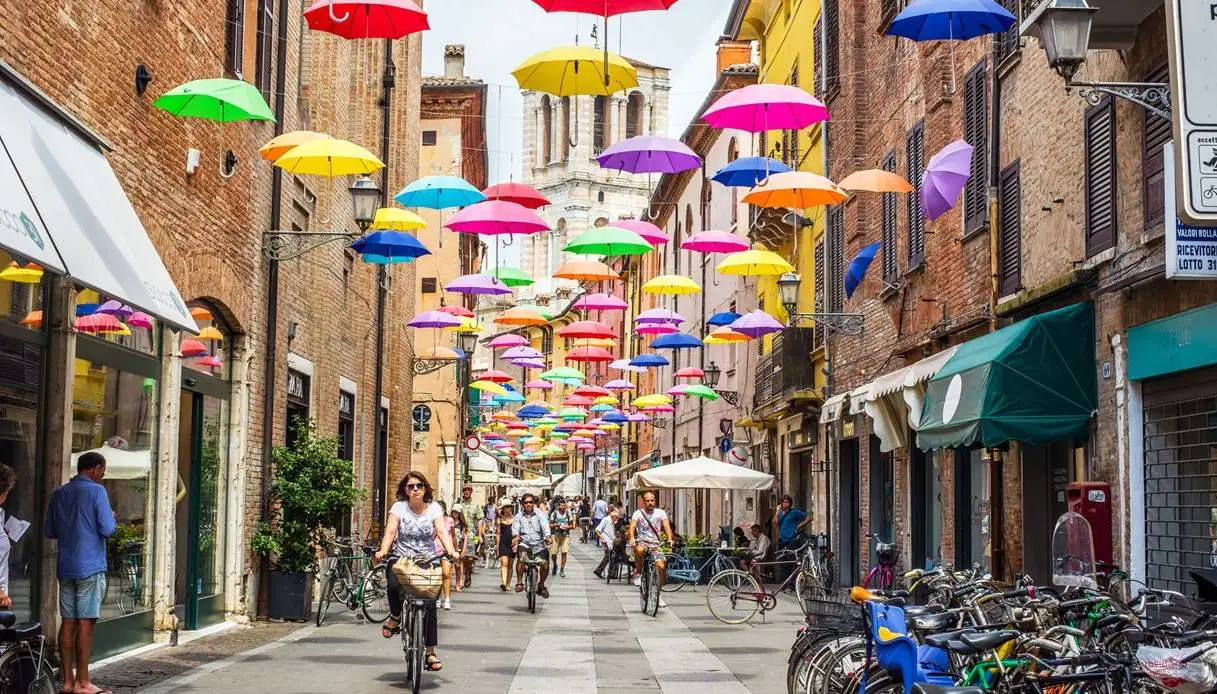
There’s an Italian city where bicycles are so numerous that they almost outnumber its inhabitants: there are at least one and a half bikes for every resident. In its historic centre cars yield to two-wheeled traffic, moving at a slow pace among ancient walls, crossing medieval squares and skirting Renaissance palaces.
It’s Ferrara, known precisely as the “Città delle biciclette“, that has captured the British press once again: the Sunday Times has dedicated a travel feature to it, telling of its charm through its streets, the Estense heritage, the stories of Lucrezia Borgia and Marfisa d’Este, and a gastronomic tradition that guards ancient flavors.
The Sunday Times celebrates Ferrara
It’s not the first time the Emilian city has found itself in the glare of British media. A few months ago the Guardian described Ferrara as an ideal destination for a city break away from the crowds of international tourism, highlighting its tranquil rhythms, Renaissance architecture and the possibility of discovering it by bicycle.
Now the Sunday Times also devotes space to this city, underscoring the strong presence of bicycles, which here are a constant feature, used by students, families and people of all ages to traverse the historic centre and reach the different districts. Its layout also encourages cycling, with regular streets and distances easily manageable.
Among the most evocative itineraries to ride are those along the Mura di Ferrara, a fortified belt that stretches for about nine kilometres and dates to a period between the 15th and 17th centuries. Today this defensive system has become a large linear park, with trees, gardens, bastions and cycle-walking paths, allowing one to admire the city from a different perspective.
Ferrara’s charm, however, goes far beyond its cycling vocation. The historic centre is recognised by UNESCO as a World Heritage Site in 1995, for the value of its Renaissance urban layout, developed mainly under the Este family’s rule. In 1999 the recognition was extended to the Po Delta and to the landscape of the Este Delights, the residences commissioned by the dynasty that deeply marked the region’s history.
Ferrara between history, art and flavors in the Sunday Times’ account
It is the story of the Este family that provides some of the most fascinating passages of the British reportage. The journey begins at the Estense Castle, with its four red-brick towers, moat and drawbridges, built in 1385 as a defensive fortress and later transformed into a refined court residence that still preserves today the charm of the family that governed Ferrara for centuries.
Among the central figures of this story is Lucrezia Borgia, who arrived in Ferrara in 1502 after marrying Alfonso I d’Este. Far from the notoriety tied to the intrigues of her family, in Ferrara she was a cultured woman and a generous patron of the arts, helping to make the court an important cultural center. Another figure remembered is Marfisa d’Este, linked to the Palazzina that bears her name, a sixteenth-century residence with frescoed interiors and testimonies of aristocratic life.
The Renaissance route also passes by Palazzo dei Diamanti, with its extraordinary façade clad in more than 8,500 marble elements shaped like diamonds, and by Palazzo Schifanoia, famous for the Hall of the Months and its fifteenth-century frescoes. The Monastery of Sant’Antonio in Polesine and the streets of the old Jewish ghetto are not missing, holding other pages of the city’s history.
Ferrara’s gastronomy also wins over the Sunday Times, with specialties such as pumpkin cappellacci, the macaroni bake, and the “salama da sugo,” alongside the distinctive Coppia Ferrarese (the IGP-branded braided bread) and pampepato, a spiced cake coated in chocolate.