
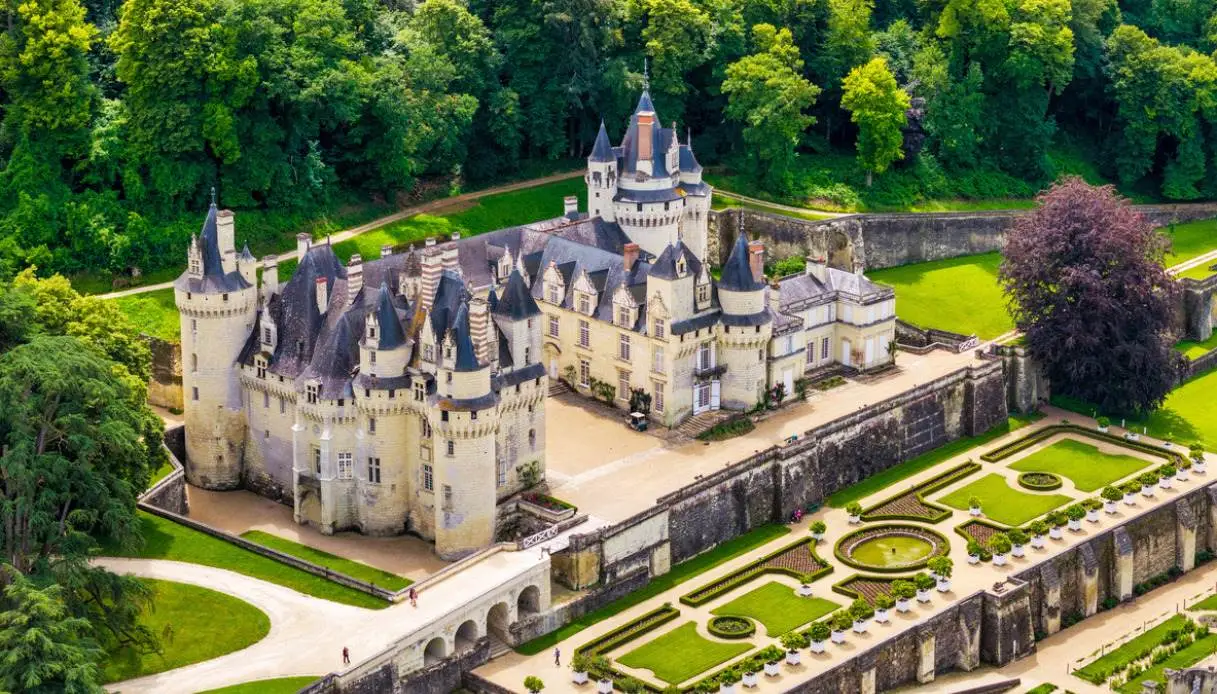
The Château d’Ussé is one of those places that, once you visit, invites you to ask: am I dreaming, or is this all true? Indeed, this jewel of France reveals itself with tower tips that seem to chase one another, slate-gray roofs slanting toward the sky, and ivory-hued façades that stand out against the lush green of the trees. A captivating ensemble of spires, windows, and terraces, behind which hides a history made of battles, aristocratic families, and architectural transformations.
We are in Touraine, along a section of the Loire Valley that was recognized as a UNESCO World Heritage Site in 2000, and the fortress overlooks the Indre, a tributary of the Loire, with the expansive Chinon forest behind it. Yet while defensive towers share space with refined decorations, Château d’Ussé also carries a literary identity: it is nicknamed “Castle of the Sleeping Beauty in the Woods,” because it is believed to have inspired Charles Perrault to craft one of the world’s best-known fairy tales.
A Brief History and Legends of Ussé Castle
The current building began to take shape in the fifteenth century thanks to Jean V de Bueil, a French captain who had fought beside Joan of Arc during the Hundred Years’ War. He started from a fortification of wood and stone perched on the hillside. At the end of the 1400s, the estate passed to the Espinay family, of Breton origin.
It was especially in the sixteenth century, under Charles d’Espinay and Lucrèce de Pons, that the residence acquired a more elegant character, in part due to the completion of the central body, a portion of the right-hand wing, and the Renaissance chapel, along with decorative elements inspired by Italian artistic culture.
A new era began in the seventeenth century with the Bernin de Valentinay, tied to the court of Louis XIV. The residence gained spaces for formal entertaining and a pavilion built for the marriage of the marquis de Valentinay to the daughter of the famed military engineer Vauban.
Vauban himself contributed to the arrangement of the terraces, while André Le Nôtre, the designer of the Versailles gardens, plotted the green spaces following the principles of the French formal garden. But the changes did not stop there: during the 1800s additional modifications arrived, including a neo-Gothic gallery. Since the 19th century, Ussé has belonged to the Blacas family, the same one that continues to inhabit it.
Among the figures tied to the castle one cannot fail to mention Charles Perrault, the French author who lived from 1628 to 1703, renowned for giving literary form to popular tales that would become enduring classics. According to tradition, the writer frequented this jewel of France, struck by its slender silhouette emerging from the Chinon forest. From that image (again, according to tradition) arose the inspiration for Sleeping Beauty in the Woods, published in 1697.
Visiting Ussé Castle
Surveying the sequence of towers, monumental chimneys, and sharp roofs, one immediately feels like strolling through the pages of a magical book. Once you pass the entrance, however, the fairy-tale dimension gradually gives way to that of a true aristocratic residence, with furniture, tapestries, silverware, and objects from different eras.
Among the most fascinating rooms is without a doubt the Marble Hall, corresponding to the old 15th-century access protected by the drawbridge. Looking upward, one discovers a seventeenth-century ceiling decorated with trompe-l’œil, which covers arms and Eastern artifacts.
The Vauban Room stands out for its refinement, carved from an old chapel and designed to host the marshal during visits to the daughter. Brussels tapestries from the 16th century accompany a refined seventeenth-century Florentine cabinet, notable for its hidden drawers and decorations fashioned from precious materials.
In the Central Gallery, large Flemish fabrics from the 1600s depict scenes of rural life inspired by David Teniers’ compositions, while the Dining Room houses furniture in the Louis XV style and silverware bearing noble emblems. Still used by the owners, it offers a sense of continuity between the historic heritage and family life.
A grand staircase attributed to Mansart leads to the upper floor, passing through the eighteenth-century antechamber, and into the King’s Room, where sumptuous furnishings and precious objects are safeguarded. The most curious part of the tour, however, waits along the old patrol route: a staircase leads to the octagonal tower (also known as the Knights’ Tower) with medieval defensive structures and notable wooden carpentry.
In the rooms carved along the passage, wax figures recreate the key moments of the fairy tale Sleeping Beauty: first comes the christening of Princess Aurora, then the meeting with the spinning wheel, the pricking of the finger, and the sleep destined to last 100 years. Finally, the prince reaches the maiden and breaks the spell.
As you exit, you are welcomed by geometric parterres, neatly shaped hedges, and ornamental flowerbeds. All elements that compose the French-style gardens designed by André Le Nôtre. The symmetry guides the eye toward the terraces overlooking the Indre, while basins and fountains contribute to the balance of the composition. The orangery, built in 1664, recalls the aristocratic passion for citrus cultivation and, even today, it houses orange trees and lemons, together with two majestic cedars donated by Chateaubriand.
Also worth a stop is the Renaissance chapel of Sainte-Anne, adorned with a portal decorated with medallions portraying the apostles. Inside are splendid carved wooden stalls, attributed to Jean Goujon. In the stables, beneath a large timber-framed roof, a collection of carriages used by former owners is displayed, while the wine cellars hewn in the tufa bear witness to agricultural work through reconstructions related to harvest and wine production.
Where It Is Located and How to Get There
The Château d’Ussé stands in the small commune of Rigny-Ussé, in the Indre-et-Loire department, in central-western France. This means it is about 15 km from Chinon, Langeais, and Azay-le-Rideau, while Tours is reachable in roughly 45 minutes by car. From Saumur it takes around 40 minutes, and from Paris roughly 2 hours and 30 minutes via the A10 motorway.
For those traveling by train, Tours constitutes one of the main rail gateways to the region, though a transfer to Rigny-Ussé must then be arranged. Its proximity to the cycling route La Loire à Vélo also makes the residence appealing for a bike itinerary.
