
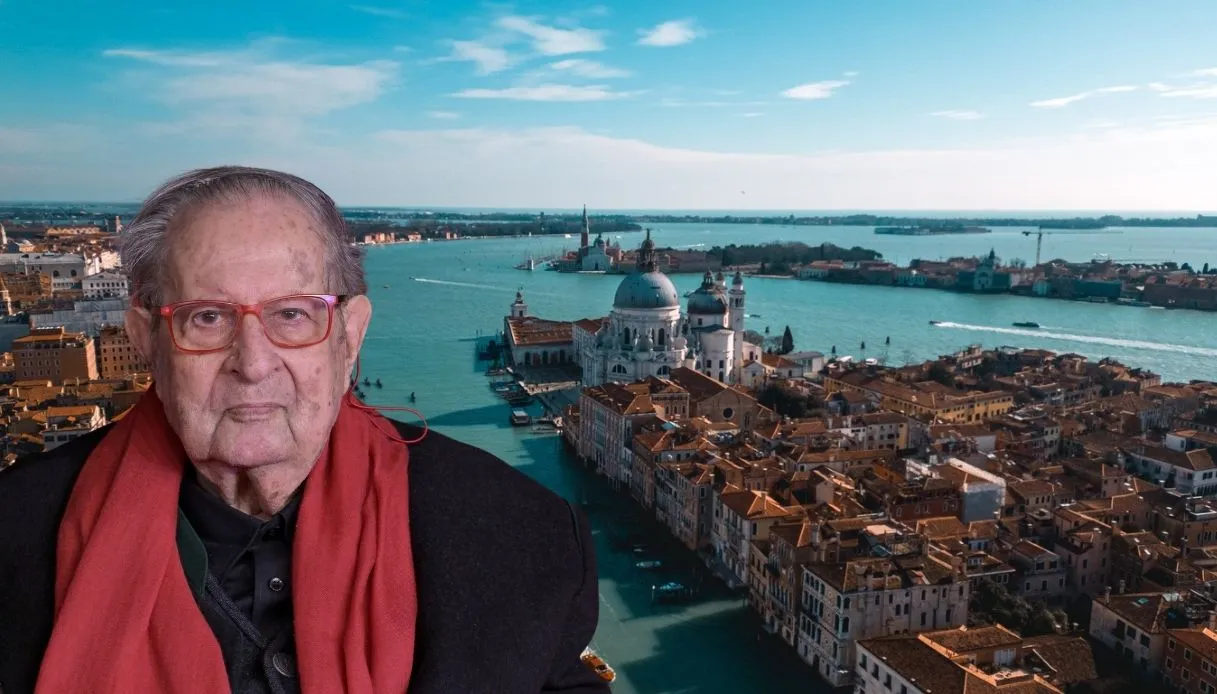
There is a private geography behind Tinto Brass’s cinema, which threads through the alleys of Venice, the countryside of the Po Valley, the film studios in Rome, and ends in a medieval village immersed in greenery. The director, died in Rome on November 4, 2026 at the age of 93, had transformed many of these places into settings for provocative tales.
Here are the places dear to Tinto Brass and the “secret” village where he lived.
The locations of Tinto Brass’s films
There are three main localities that have served as the backdrop to Tinto Brass’s films.
At the top of them all Venice which provided the backdrop for The Key in 1983 with Stefania Sandrelli. Among the locations touched by the shoots are the Caffè Florian and the Accademia. The Italian director returns to the city for the shooting of Senso ’45, set during World War II, traversing Venetian fields and palaces, from Ca’ Zenobio to Campo San Francesco della Vigna, but they also reach villas and theatres outside the city.
Rome and Lazio, instead, represent the great production workshop. For Caligula ancient environments were reconstructed in the Dear Studios of the capital, with set designs by Danilo Donati. The city and Lazio also appear in Così fan tutte and Snack Bar Budapest: for the latter, among the recognizable locations is the former Vittorio Emanuele III naval colony on the Ostia seafront. And already with The Scream, shot in 1968, Brass had sought unusual places: Sermoneta and the former prison on the island of Santo Stefano, in the Pontine Archipelago.
Equally important is the Po plain with its embankments and small towns that can be seen in Miranda with Serena Grandi, shot between Canaro, in the Rovigo area, Pomponesco, in Mantua, and Villa Contarini in Piazzola sul Brenta. Monella, however, chose as its backdrop Pomponesco, Dosolo and Marcaria.
The places where Tinto Brass lived
While the sets changed constantly, in his private life Brass kept some precise references. Venice was the city of formation; Rome the one of work. Then came a different choice: a house in Isola Farnese, where he stayed for over half a century.
Venice and the director’s bond
Although he was born in Milan, Venice is the city of the heart of Tinto Brass. The lagoon city, closely tied to his family, framed his childhood and accompanied him as he grew. As a young man he studied law before moving definitively toward cinema. In his films, La Serenissima loses the postcard dimension and becomes an intertwining of rooms, bridges and secluded corners, capable of telling secrets and desires.
Paris
He also spent time in Paris and at the Cinémathèque française, coming into contact with the Nouvelle Vague. Venice, however, remained a place to return to with memory and the camera.
Isola Farnese, the village of fairy tales
To the north of Rome, near the Cassia and a short distance from La Storta, lies the place Brass chose as a refuge: Isola Farnese. Perched on a tuff cliff in the Veio Park, the village seems separated from the rest of the capital. Houses gathered around the castle, narrow lanes and quiet: a corner of Rome left behind in time.
Brass arrived there in the seventies, after living at Piazza del Popolo. He bought an agricultural farmhouse, renovated it, and jokingly named it the “Republic of Cascinone”. That house became his home, studio and meeting point. In a February 2026 interview he spoke of choosing the Lazio village for its tranquility and of writing all his films there, often starting work before dawn. Though elderly and ill, in 2026 the director used his voice to remind the villagers of their right not to be isolated after two landslides that made access to the village more difficult. Many people consider it the last gesture of his attachment to the community.
