
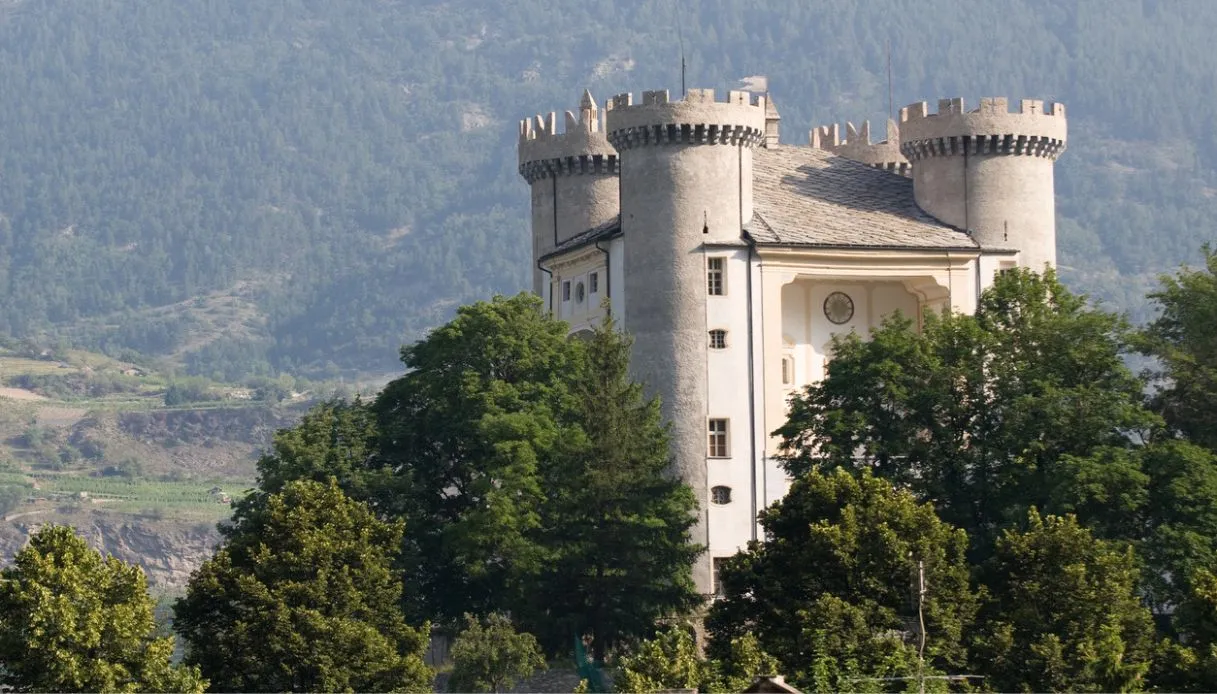
Almost unexpectedly, four cylindrical towers and white façades adorned with stucco rise from a position that seems deliberately chosen to admire the mountains. That is the Castello di Aymavilles, in the Aosta Valley, a kind of anomaly because its architecture is difficult to confuse with that of the other fortresses in the region.
At first glance, indeed, it seems like an aristocratic residence with its elegant lines and loggias facing the landscape, but this refined appearance is a kind of shield: in fact it is a real medieval fortress built to defend a strategic territory (to then be transformed over the centuries according to the ambitions of its owners).
Just a few kilometers from Aosta, it dominates a hill crowned by vineyards, while in the background the mountains of the Graian Alps are recognizable. After a long restoration, completed with its opening to the public in 2022, the Castello di Aymavilles has finally returned to telling more than 800 years of Valdostan history. And yes, it is absolutely worth treating yourself to this intriguing journey through time.
A Brief History of Castello di Aymavilles
The origins of this jewel date back to the 12th-13th centuries, when on the hill stood a fortified structure with a quadrangular layout. The current building, however, owes much of its identity to the Challant family, one of the most influential lineages of medieval Valle d’Aosta.
In particular, between 1713 and 1728, Joseph-Félix de Challant promoted a radical renewal, transforming the fortress into a noble residence. Among the towers, erected in the early 1400s at the initiative of Amedeo di Challant, elegant loggias decorated with stucco appeared, while the old external fortifications gave way to a terraced park.
Then came the 1800s, a century in which Vittorio Cacherano della Rocca (son of Countess Teresa di Challant) had the interiors renewed to suit the tastes of the era and transformed part of the dwelling into a private museum, rich with paintings, coins, medals and antique objects.
In the 20th century, however, the manor became a holiday residence, frequented also by the Genoese Bombrini family. Purchased by the Autonomous Region of Valle d’Aosta in 1970, it was finally subjected to an articulated program of studies and restorations, which as already mentioned concluded in 2022.
Visiting Castello di Aymavilles and What to See
Everything begins already along the access avenue, which accompanies visitors with trees and green spaces that refresh even the most skeptical. Then the white façades above the park terraces come into view, while the towers, especially when viewed up close, reveal their imposing grandeur. Soon after, the refinement of the eighteenth-century portal captures attention, also because it is enriched with stuccoes attributed to the Lugano-born craftsman Stefano De Giorgis.
Beyond the threshold, the contrast between the exterior appearance and the interior spaces becomes even more interesting: there is a museum-route distributed over four levels that allows you to traverse the castle’s different eras, thanks to restored rooms, artworks, reconstructions and multimedia installations.
On the ground floor unfolds the story of the owning families, from the Challants to the Bombrinis. Documents and exhibited materials reconstruct the succession of the protagonists, highlighting the link between their lives and the architectural changes of the building.
Climbing to the first floor, one passes through the thresholds of the rooms that preserve 19th-century decorative paintings evidencing the eclectic taste of the nobility of the period. Neo-Gothic motifs, chinoiserie, references to ancient Egypt, naturalistic elements and mythical figures appear on the walls, doors and overmantels.
The grand hall, for its part, introduces 19th-century collecting: Vittorio Cacherano had gathered numerous works of art and historical curiosities, later dispersed. To evoke that interest, the new display hosts part of the collections of the Académie Saint-Anselme, a cultural society founded in 1855 to promote the study and preservation of Valdostan heritage.
Among the works on display, particular attention is drawn to the alabaster gypsum relief depicting Saint Catherine of Alexandria, attributed to the workshop of Stefano Mossettaz, one of the leading sculptors active in the Valle d’Aosta in the 1400s. There are also archaeological finds, liturgical objects and materials related to the territory’s history.
On the upper level one encounters rooms associated with Madama Giovane, a figure of the castle’s 19th-century life, while furnishings and decorations offer a more intimate glimpse of daily life in the residence. The most surprising moment, however, is in the attic: above the genteel rooms lies an extraordinary 15th-century wooden structure, made up of more than 360 elements.
Also worthy of time is the park, dotted with terraces that descend toward the village, where you can also find a Baroque fountain, ornamental trees and views over the vineyards. Notably curious in this space are the grandze, ancient farm buildings, and the stables, today used as the ticket office.
The Castello di Aymavilles can be explored independently, with the option to use an audio guide, or through guided tours at scheduled times. An admission fee allows visitors to allocate as much time as they wish to the spaces, following the museum route.
Where It Is Located and How to Get There
The Castello di Aymavilles is located in the eponymous commune of the Valle d’Aosta, at Castello 1, about 8 km from the regional capital. It stands along the road that leads to the Valle di Cogne, in a position particularly favorable for exploring the towns and monuments of the western part of the region.
By car, starting from Aosta, take the SS26 toward Courmayeur and Mont Blanc. After passing the Sarre area, take the fork for Cogne and continue following the tourist signs to Aymavilles and the castle.
Those using the A5 motorway can reach the area via the Aosta Ovest exit, then continuing towards the regional road of the Valle di Cogne.
Whoever chooses public transport can consider that from Aosta there is a direct bus to Cogne, with a stop at Aymavilles – Bettex Castle. An alternative is line 5 Aosta-Aymavilles, active on weekdays as per the service schedule, with a stop at the Bettex terminus.
