
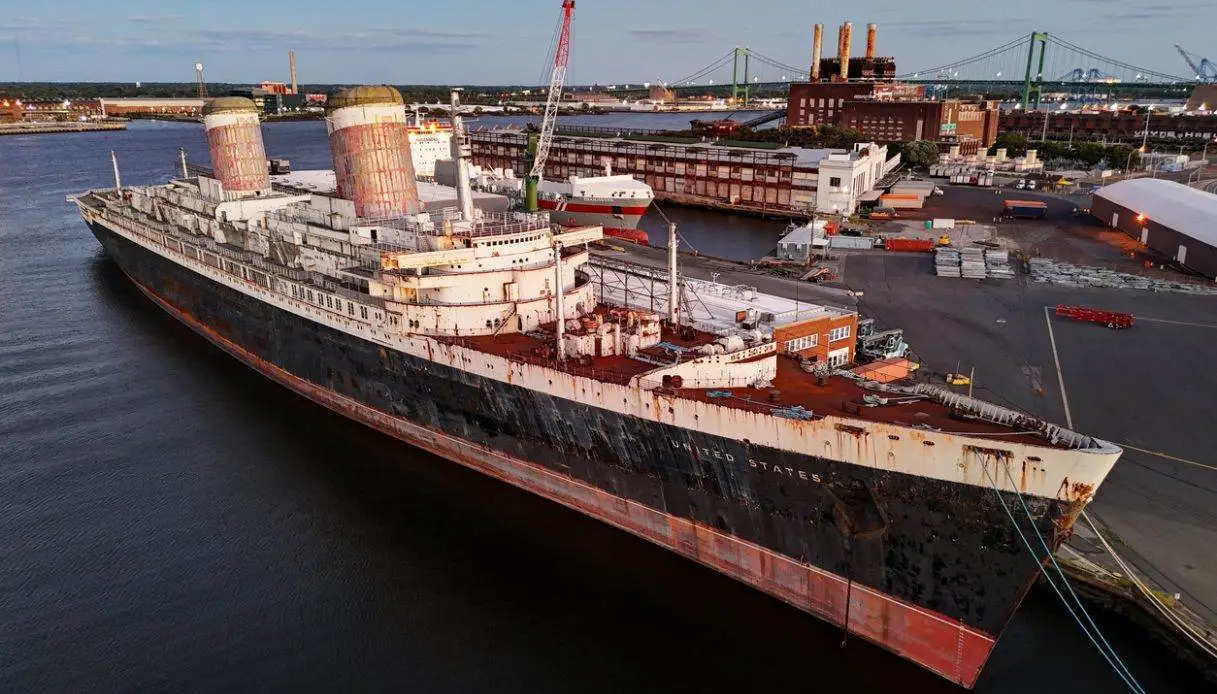
After having been the fastest passenger ship to cross the Atlantic, hosting presidents and stars aboard, and after thirty years moored at a Philadelphia pier, the SS United States is preparing for its final voyage, this time with no one aboard.
The legendary American transatlantic liner will be deliberately sunk in the Gulf of Mexico to become the world’s largest artificial coral reef. The operation, announced by Okaloosa County, is slated for the second week of November, about 40 kilometers southwest of Destin.
The History of the SS United States
The farewell of the SS United States has sparked a heated debate and divided public opinion. To understand why the decision is so controversial, we must go back to 1952.
Nearly 305 meters in length, more than thirty meters longer than the Titanic, the SS United States completed its maiden voyage crossing the Atlantic in 3 days, 10 hours and 40 minutes: a speed record for a passenger ship that no one has managed to beat since. It quickly became the symbol of postwar American engineering, and, in 17 years of service, completed over 400 transatlantic crossings with heads of state, diplomats and celebrities aboard.
Its decline, definitively in 1969, was marked by the spread of commercial flights, which allowed people to reach their destinations more quickly.
Since 1996 it remained moored in Philadelphia, while ideas for converting it into a hotel, a floating museum or a tourist attraction circulated. None came to fruition, hindered by the extremely high maintenance costs, until a legal dispute with the pier operator forced its departure. In 2024 it was purchased by Okaloosa County with the aim of turning it into an artificial coral reef.
In February 2025 the SS United States thus left Philadelphia, towed by a tugboat, and after 12 days of sailing arrived in Mobile, Alabama. Here the preparation for the sinking began: to avoid contaminating the seabed, workers removed glass, plastic, cables and all hazardous substances present on board.
A Paradise for Divers and a Museum
Once resting on the seabed, the ship will lie at about 55 meters of depth, while the upper decks will be around 18 meters from the surface. This very configuration, according to the promoters, will make the site suitable for divers of different levels. The wreck will join more than 500 artificial reefs already present in the county, including several sunken ships, with a double objective: to provide a habitat for marine life and to attract diving enthusiasts and sport fishing fans.
Not everyone, however, is happy with this choice. A group dedicated to the preservation of historic heritage fought in court to stop the sinking, convinced that an irreplaceable piece of American maritime history is being sacrificed. To keep its memory alive, a terrestrial museum will also be created along with the SS United States Conservancy: here will be housed the famous funnels, the radar mast and other original elements, to tell future generations about the ship that made maritime history.
