
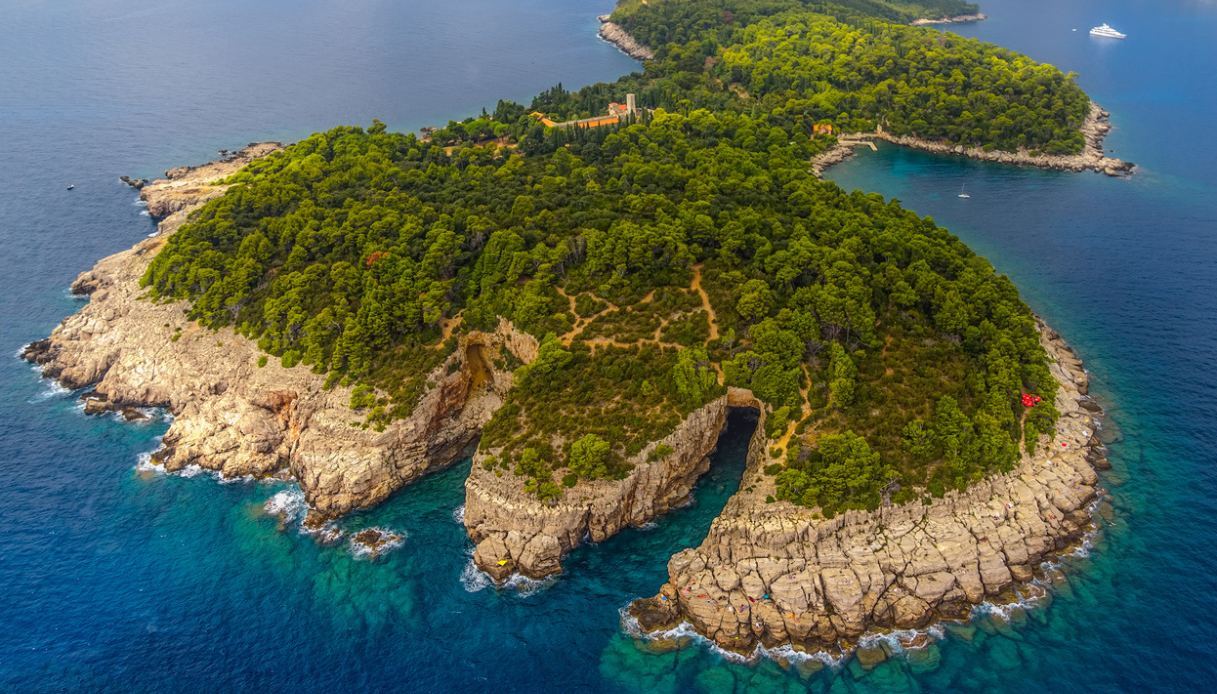
Right there, facing the imposing (and splendid) walls of Dubrovnik, a dark patch of vegetation seems to rise from the Adriatic waters. That is Lokrum, a small island teeming with pines (so many, there are truly countless), ancient monasteries, and peacocks that wander the paths with absolute ease.
Also known as Lacroma and romantically nicknamed the Isola dell’Amore, over the centuries it has welcomed Benedictine monks, rulers, French soldiers, and Austro-Hungarian aristocrats. So much so that, among its ruins, there are still tales of real shipwrecks, curses, and mysterious deaths.
A mere 72 hectares of surface enclose a surprising natural heritage, with forests covering about 90% of the territory. Protected since 1948 as a special reserve of forest vegetation, it represents one of the oldest protected natural areas in Croatia, to the point that its territory is even included in the UNESCO area recognized together with Dubrovnik’s historic center.
A Brief History of Lokrum Island and Its Mysterious Legends
Numerous archaeological testimonies that dot this mysterious Croatian island indicate human presence dating back to prehistoric times. Its documented history, however, takes shape mainly with the arrival of the Benedictines; specifically in 1023, the year in which the first written mention of the monastery appears.
For the monks, the island represented a place of prayer and labor. Alongside the religious buildings they cultivated gardens, vineyards, olive groves, and medicinal plants. In 1192, however, according to tradition something truly legendary happened: Richard the Lionheart, King of England, would have been caught in a violent storm while returning from the Third Crusade.
According to the tale, his ship found shelter in the Skalica Bay, a wonderful corner of the same island. The sovereign would have promised to build a church as a sign of gratitude for the escaped danger. The citizens of Ragusa would then have convinced him to devote his contribution to the city cathedral.
Even more unsettling, however, is the Benedictine curse: it is said that during their last night, the monks walked the paths with their hoods drawn over their faces and candles lit pointing downward. They would then pronounce terrible words against future owners, dooming them to misfortune. Fate, with its classic irony, subsequently unleashed a series of tragedies that struck the Austro-Hungarian imperial family.
Examples of this omen include the execution of Archduke Maximilian of Austria in Mexico in 1867, the death of Prince Rudolf at Mayerling in 1889, and the assassination of Empress Elisabeth, famously known as Sissi, in 1898.
A Visit to Lokrum Island and the Wonders to See
Although small, exploring Lokrum takes a few hours (especially in summer, when you can also bathe in its clear sea). From the main landing at Portoč, a network of marked paths winds through forests, clearings, and ancient cultivated spaces.
One of the main points of interest is certainly the Benedictine Monastery, of which today only the Romanesque-Gothic basilica structures and some convent spaces remain. Adjacent to these are the portions of the later Gothic-Renaissance monastery, built between the 15th and 16th centuries and severely damaged by the 1667 earthquake.
Among columns, arches, cloisters, and arcades you can notice that above one of the doors there is a Latin inscription reminding how concord lets small things flourish, while discord leads to ruin even the greatest ones. Maximilian’s intervention added a residence with Neo-Romanesque, Neo-Gothic, and Neo-Renaissance elements.
To the imperial past also belongs Charlotte’s Well, an oval stone basin intended to collect water for irrigating exotic plants. The monastery also maintains a link with the TV series Game of Thrones: some scenes were shot right here. Not far away lies the Botanical Garden, spanning 3.3 hectares and including an exhibition area divided into 13 sectors, with about 500 plant species.
A little further on rises the Annunciation Chapel, a Gothic-Renaissance building from the 15th and 16th centuries, inside which kneelers belonging to Maximilian and his wife Charlotte are preserved. Climbing toward Fort Royal, the French-built fortress atop the Glavica Hill, you get a totally different but highly captivating perspective of this Croatian island, including the profile of Dubrovnik’s walls.
The ascent also follows the evocative Path of Paradise, the Paradise Path, part of a system of promenades designed during the Austro-Hungarian era and originally lined with Mediterranean cypresses. And then we reach the island’s most unusual spot for its size: the Mrtvo more, literally the Dead Sea, a small natural saltwater lake connected to the Adriatic through underground caverns and passages. Its waters, generally calmer than the open sea, are particularly appreciated for a refreshing break.
Along the coast, instead, rocks and calcareous platforms prevail. The Stijene area is among the spots frequented for sunbathing, while in the northwest part there is a traditionally nudist area. Ah, all that we’ve described can be enjoyed in the company of a group of Indian peacocks, incredibly elegant birds that roam the meadows and near the historic buildings (sometimes with their plumage fully displayed).
Where Lokrum Is Located and How to Get There
Lokrum floats about 600 meters from Dubrovnik’s coast, opposite its famous historic center facing the Adriatic. The island is uninhabited and without hotels, with controlled access to protect its delicate natural heritage. The simplest connection departs from the city’s Old Port, located at the foot of the walls, and reaches the destination in about 10 minutes of sailing.
For 2026 the price of the standard ticket is 30 euros and includes entry to the reserve and the round-trip transfer with the official boat. Even those arriving at Lokrum by private boat or taxi boat must purchase the reserve access ticket, maintaining the same ordinary fare.
Departures and schedules vary according to the time of year and weather conditions. During the winter closure the island remains closed to visitors, while in the opening months it is mandatory to return before the departure of the last authorized boat.
There are a few refreshment points on the island, but it’s worth bringing water, sturdy footwear suitable for unpaved paths, and everything needed for a day outdoors.
